


Evaluating interest in an influenza A(H5N1) vaccine among laboratory workers who work with highly-pathogenic avian influenza viruses in the United States
Supporting Files

-
Dec 02 2017
-
File Language:
English
Details
-
Alternative Title:Vaccine
-
Personal Author:
-
Description:Background
Highly pathogenic avian influenza A (HPAI) viruses found in poultry and wild birds occasionally infect humans and can cause serious disease. In 2014, the Advisory Committee on Immunization Practices (ACIP) reviewed data from one licensed ASO3-adjuvanted influenza A(H5N1) vaccine for consideration of use during inter-pandemic periods among persons with occupational exposure. To guide vaccine policy decisions, we conducted a survey of laboratory workers to assess demand for HPAI vaccination.
Methods
We designed an anonymous web survey (EpiInfo 7.0) to collect information on demographics, type of work and time spent with HPAI viruses, and interest in HPAI vaccination. Eligible participants were identified from 42 entities registered with United States Department of Agriculture’s Agricultural Select Agent program in 2016 and emailed electronic surveys. Personnel with Biosafety Level 3 enhanced (BSL-3E) laboratory access were surveyed. Descriptive analysis was performed.
Results
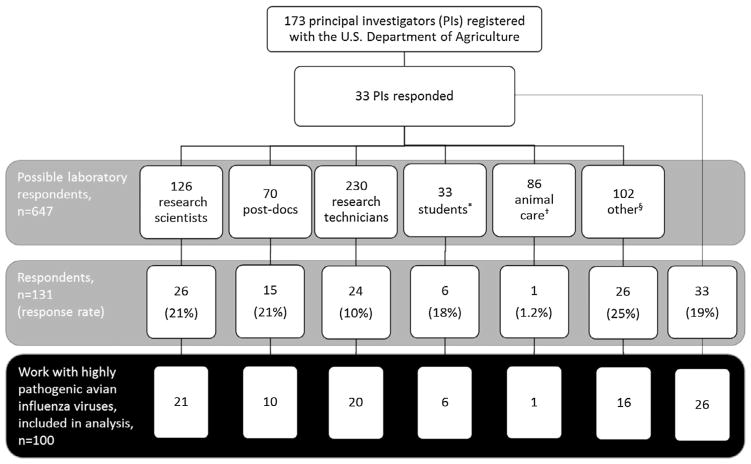
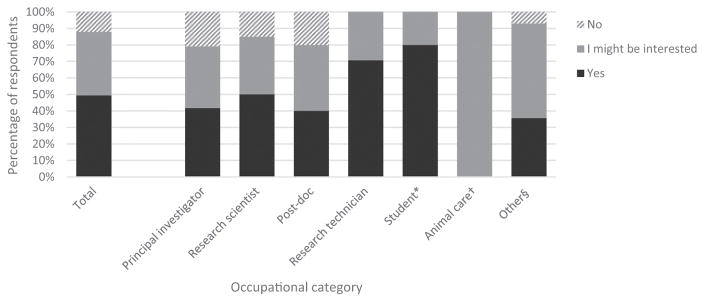
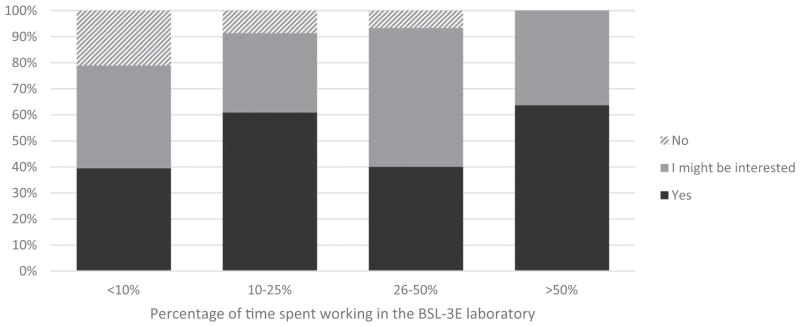
Overall, 131 responses were received from 33 principal investigators, 26 research scientists, 24 technicians, 15 postdoctoral fellows, 6 students, and 27 others. The estimated response rate was 15% among the laboratory personnel of responding principal investigators. One hundred respondents reported working in a BSL-3E area where HPAI experiments occurred with a mean time of 5.1–11.7 h per week. Overall, 49% were interested in receiving an A(H5N1) vaccine. By role, interest was highest among students (80%) and among those who spent >50% of their time in a BSL-3E area (64%). Most (61%) of those who said they might be or were not interested in vaccine believed it would not provide additional protection to current safety practices.
Conclusions
Half of responding laboratory workers was interested in receiving an influenza A(H5N1) vaccine. HPAI vaccination of laboratory workers at risk of occupational exposure could be used along with existing safety practices to protect this population.
-
Subjects:
-
Source:Vaccine. 36(2):306-312
-
Pubmed ID:29199043
-
Pubmed Central ID:PMC5759037
-
Document Type:
-
Funding:
-
Place as Subject:
-
Volume:36
-
Issue:2
-
Collection(s):
-
Main Document Checksum:urn:sha256:d6206753c19b43086eaf1380a46d711d3ba66554f99249b92f9ca70cd1cb13cf
-
Download URL:
-
File Type:
 [PDF
- 376.01 KB
]
[PDF
- 376.01 KB
]
Supporting Files


File Language:
English
ON THIS PAGE


CDC STACKS serves as an archival repository of CDC-published products including
scientific findings,
journal articles, guidelines, recommendations, or other public health information authored or
co-authored by CDC or funded partners.
As a repository, CDC STACKS retains documents in their original published format to ensure public access to scientific information.
As a repository, CDC STACKS retains documents in their original published format to ensure public access to scientific information.
You May Also Like
COLLECTION
CDC Public Access