


Short Communication: Heightened HIV Antibody Responses in Postpartum Women as Exemplified by Recent Infection Assays: Implications for Incidence Estimates
Supporting Files

-
May 24 2017
-
File Language:
English
Details
-
Alternative Title:AIDS Res Hum Retroviruses
-
Personal Author:
-
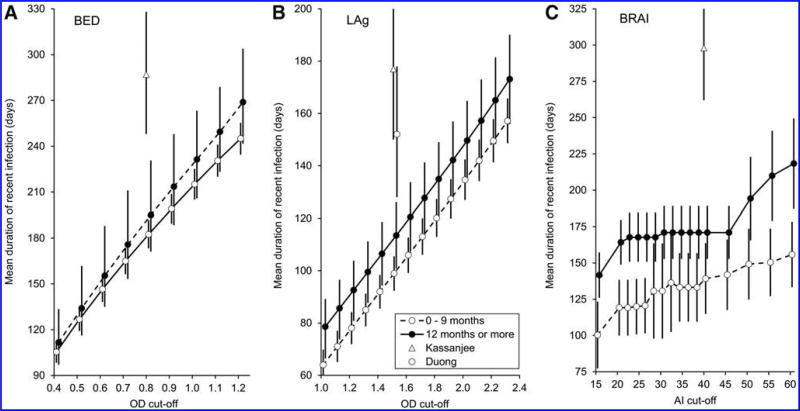
Description:Laboratory assays that identify recent HIV infections are important for assessing impacts of interventions aimed at reducing HIV incidence. Kinetics of HIV humoral responses can vary with inherent assay properties, and between HIV subtypes, populations, and physiological states. They are important in determining mean duration of recent infection (MDRI) for antibody-based assays for detecting recent HIV infections. We determined MDRIs for multi-subtype peptide representing subtypes B, E and D (BED)-capture enzyme immunoassay, limiting antigen (LAg), and Bio-Rad Avidity Incidence (BRAI) assays for 101 seroconverting postpartum women, recruited in Harare from 1997 to 2000 during the Zimbabwe Vitamin A for Mothers and Babies trial, comparing them against published MDRIs estimated from seroconverting cases in the general population. We also compared MDRIs for women who seroconverted either during the first 9 months, or at later stages, postpartum. At cutoffs (C) of 0.8 for BED, 1.5 for LAg, and 40% for BRAI, estimated MDRIs for postpartum mothers were 192, 104, and 144 days, 33%, 32%, and 52% lower than published estimates of 287, 152 and 298 days, respectively, for clade C samples from general populations. Point estimates of MDRI values were 7%-19% shorter for women who seroconverted in the first 9 months postpartum than for those seroconverting later. MDRI values for three HIV incidence biomarkers are longer in the general population than among postpartum women, particularly those who recently gave birth, consistent with heightened immunological activation soon after birth. Our results provide a caution that MDRI may vary significantly between subjects in different physiological states.
-
Subjects:
-
Source:AIDS Res Hum Retroviruses. 33(9):902-904.
-
Pubmed ID:28443672
-
Pubmed Central ID:PMC5745575
-
Document Type:
-
Funding:
-
Place as Subject:
-
Volume:33
-
Issue:9
-
Collection(s):
-
Main Document Checksum:urn:sha256:18c520b24592a6997a615d4bdde2c2fca3094e1ab0ec4ede64b0cf58d8e76045
-
Download URL:
-
File Type:
 [PDF
- 254.44 KB
]
[PDF
- 254.44 KB
]
Supporting Files


File Language:
English
ON THIS PAGE


CDC STACKS serves as an archival repository of CDC-published products including
scientific findings,
journal articles, guidelines, recommendations, or other public health information authored or
co-authored by CDC or funded partners.
As a repository, CDC STACKS retains documents in their original published format to ensure public access to scientific information.
As a repository, CDC STACKS retains documents in their original published format to ensure public access to scientific information.
You May Also Like
COLLECTION
CDC Public Access