


Recalibration of the Limiting Antigen Avidity EIA to Determine Mean Duration of Recent Infection in Divergent HIV-1 Subtypes
Supporting Files

-
Feb 24 2015
-
File Language:
English
Details
-
Alternative Title:PLoS One
-
Personal Author:Duong, Yen T. ; Kassanjee, Reshma ; Welte, Alex ; Morgan, Meade ; De, Anindya ; Dobbs, Trudy ; Rottinghaus, Erin ; Nkengasong, John ; Curlin, Marcel E. ; Kittinunvorakoon, Chonticha ; Raengsakulrach, Boonyos ; Martin, Michael ; Choopanya, Kachit ; Vanichseni, Suphak ; Jiang, Yan ; Qiu, Maofeng ; Yu, Haiying ; Hao, Yan ; Shah, Neha ; Le, Linh-Vi ; Kim, Andrea A. ; Nguyen, Tuan Anh ; Ampofo, William ; Parekh, Bharat S.
-
Description:Background
Mean duration of recent infection (MDRI) and misclassification of long-term HIV-1 infections, as proportion false recent (PFR), are critical parameters for laboratory-based assays for estimating HIV-1 incidence. Recent review of the data by us and others indicated that MDRI of LAg-Avidity EIA estimated previously required recalibration. We present here results of recalibration efforts using >250 seroconversion panels and multiple statistical methods to ensure accuracy and consensus.
Methods
A total of 2737 longitudinal specimens collected from 259 seroconverting individuals infected with diverse HIV-1 subtypes were tested with the LAg-Avidity EIA as previously described. Data were analyzed for determination of MDRI at ODn cutoffs of 1.0 to 2.0 using 7 statistical approaches and sub-analyzed by HIV-1 subtypes. In addition, 3740 specimens from individuals with infection >1 year, including 488 from patients with AIDS, were tested for PFR at varying cutoffs.
Results
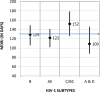
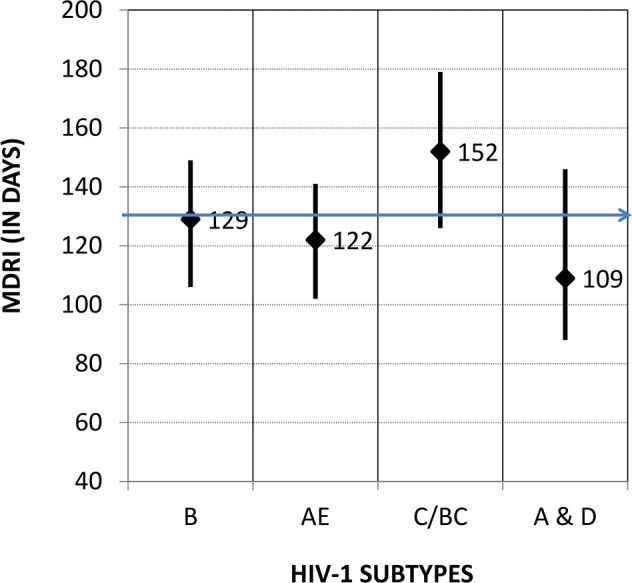
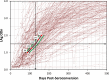
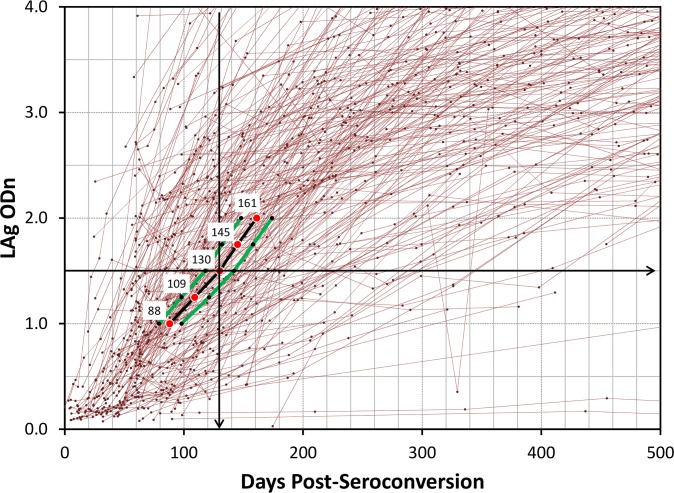
Using different statistical methods, MDRI values ranged from 88–94 days at cutoff ODn = 1.0 to 177–183 days at ODn = 2.0. The MDRI values were similar by different methods suggesting coherence of different approaches. Testing for misclassification among long-term infections indicated that overall PFRs were 0.6% to 2.5% at increasing cutoffs of 1.0 to 2.0, respectively. Balancing the need for a longer MDRI and smaller PFR (<2.0%) suggests that a cutoff ODn = 1.5, corresponding to an MDRI of 130 days should be used for cross-sectional application. The MDRI varied among subtypes from 109 days (subtype A&D) to 152 days (subtype C).
Conclusions
Based on the new data and revised analysis, we recommend an ODn cutoff = 1.5 to classify recent and long-term infections, corresponding to an MDRI of 130 days (118–142). Determination of revised parameters for estimation of HIV-1 incidence should facilitate application of the LAg-Avidity EIA for worldwide use.
-
Subjects:
-
Source:PLoS One. 10(2).
-
Pubmed ID:25710171
-
Pubmed Central ID:PMC4339840
-
Document Type:
-
Funding:
-
Name as Subject:
-
Volume:10
-
Issue:2
-
Collection(s):
-
Main Document Checksum:urn:sha-512:f6e526b90750f9c7abcbe6a2deb08d2876927137bd93773781ccf0a3c89e1010791a8c52a7076267707c04c58bb87b0dd2bde0fc359f7feb121d56244d444655
-
Download URL:
-
File Type:
 [PDF
- 3.53 MB
]
[PDF
- 3.53 MB
]
Supporting Files


File Language:
English
ON THIS PAGE





CDC STACKS serves as an archival repository of CDC-published products including
scientific findings,
journal articles, guidelines, recommendations, or other public health information authored or
co-authored by CDC or funded partners.
As a repository, CDC STACKS retains documents in their original published format to ensure public access to scientific information.
As a repository, CDC STACKS retains documents in their original published format to ensure public access to scientific information.
You May Also Like
COLLECTION
CDC Public Access