


Immigration Factors and Prostate Cancer Survival Among Hispanic Men in California
Supporting Files

-
Jan 29 2014
File Language:
English
Details
-
Alternative Title:Cancer
-
Personal Author:
-
Description:BACKGROUND
Hispanics are more likely than other racial/ethnic groups in the United States to be diagnosed with later stage of prostate cancer, yet they have lower prostate cancer mortality rates. The authors evaluated the impact of nativity and neighborhood-level Hispanic ethnic enclave on prostate cancer survival among Hispanics.
METHODS
A total of 35,427 Hispanic men diagnosed with invasive prostate cancer from 1995 through 2008 in the California Cancer Registry were studied; vital status data were available through 2010. Block group-level neighborhood measures were developed from US Census data. Stage-stratified Cox proportional hazards models were used to assess the effect of nativity and ethnic enclave on prostate cancer survival.
RESULTS
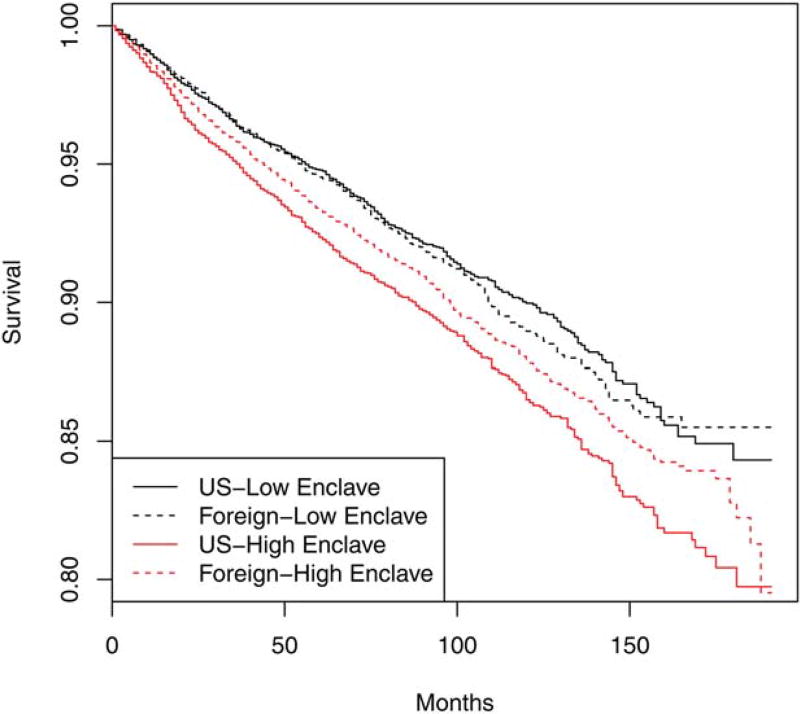
In models adjusted for neighborhood socioeconomic status and other individual factors, foreign-born Hispanics were found to have a significantly lower risk of prostate cancer survival (hazards ratio [HR], 0.81; 95% confidence interval [95% CI], 0.75–0.87). Living in an ethnic enclave appeared to modify this effect, with the survival advantage slightly more pronounced in the high ethnic enclave neighborhoods (HR, 0.78; 95% CI, 0.71–0.86) compared with low ethnic enclave neighborhoods (HR, 0.86; 95% CI, 0.76–0.98).
CONCLUSIONS
Despite lower socioeconomic status, Hispanic immigrants have better survival after prostate cancer than US-born Hispanics and this pattern was more striking among those living in ethnic enclaves. Identifying the modifiable individual and neighborhood-level factors that facilitate this survival advantage in Hispanic immigrants may help to inform specific interventions to improve survival among all patients.
-
Subjects:
-
Source:Cancer. 120(9):1401-1408.
-
Pubmed ID:24477988
-
Pubmed Central ID:PMC5739913
-
Document Type:
-
Funding:HHSN261201000034C/PHS HHS/United States ; U58DP003862-01/DP/NCCDPHP CDC HHS/United States ; HHSN261201000035C/PC,CA/None/None ; HHSN261201000140C/CA/NCI NIH HHS/United States ; HHSN261201000035C/PHS HHS/United States ; HHSN261201000035I/CA/NCI NIH HHS/United States ; HHSN261201000034C/CA/NCI NIH HHS/United States ; U58 DP003862/DP/NCCDPHP CDC HHS/United States ; HHSN261201000140C/PHS HHS/United States ; P30 CA124435/CA/NCI NIH HHS/United States ; N01 PC035137/PC/NCI NIH HHS/United States
-
Place as Subject:
-
Volume:120
-
Issue:9
-
Collection(s):
-
Main Document Checksum:urn:sha256:90233b2f32fb4034dcee6efc796300f5fe6227412bfde0a0e5922eab2e34b5be
-
Download URL:
-
File Type:
 [PDF
- 323.81 KB
]
[PDF
- 323.81 KB
]
Supporting Files


File Language:
English
ON THIS PAGE

CDC STACKS serves as an archival repository of CDC-published products including
scientific findings,
journal articles, guidelines, recommendations, or other public health information authored or
co-authored by CDC or funded partners.
As a repository, CDC STACKS retains documents in their original published format to ensure public access to scientific information.
As a repository, CDC STACKS retains documents in their original published format to ensure public access to scientific information.
You May Also Like
COLLECTION
CDC Public Access