



Simultaneous Identification and Susceptibility Determination to Multiple Antibiotics of Staphylococcus aureus by Bacteriophage Amplification Detection Combined with Mass Spectrometry
Supporting Files

-
7 07 2015 ; 7-07-
-
Available in CDC Stacks on December 04, 2017, 12:00 AM
File Language:
English
Details
-
Alternative Title:Anal Chem
-
Personal Author:
-
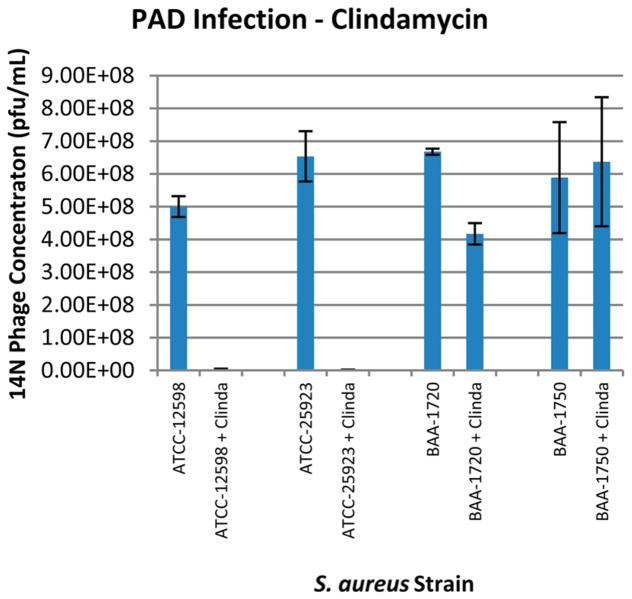
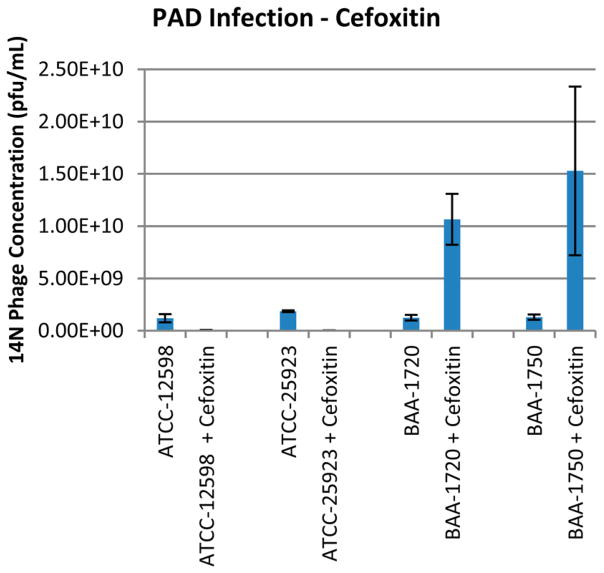
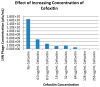
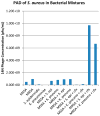
Description:The continued advance of antibiotic resistance in clinically relevant bacterial strains necessitates the development and refinement of assays that can rapidly and cost-effectively identify bacteria and determine their susceptibility to a panel of antibiotics. A methodology is described herein that exploits the specificity and physiology of the Staphylococci bacteriophage K to identify Staphylococcus aureus (S. aureus) and determine its susceptibility to clindamycin and cefoxitin. The method uses liquid chromatography-mass spectrometry to monitor the replication of bacteriophage after it is used to infect samples thought to contain S. aureus. Amplification of bacteriophage K indicates the sample contains S. aureus, for it is only in the presence of a suitable host that bacteriophage K can amplify. If bacteriophage amplification is detected in samples containing the antibiotics clindamycin or cefoxitin, the sample is deemed to be resistant to these antibiotics, respectively, for bacteriophage can only amplify in a viable host. Thus, with a single work flow, S. aureus can be detected in an unknown sample and susceptibility to clindamycin and cefoxitin can be ascertained. This Article discusses implications for the use of bacteriophage amplification in the clinical laboratory.
-
Keywords:
-
Source:Anal Chem. 87(13):6769-6777
-
Pubmed ID:26016659
-
Pubmed Central ID:PMC5713475
-
Document Type:
-
Funding:
-
Volume:87
-
Issue:13
-
Download URL:
-
File Type:
 [PDF - 1.13 MB]
 -
Collection(s):
-
Main Document Checksum:urn:sha256:536f85cebcfeffe9b6cdc2293393e70d39c1eff69fafdc1065f6cb653fa8a988
Supporting Files


File Language:
English
 Was this page helpful?
 Found an issue?






CDC STACKS serves as an archival repository of CDC-published products including
scientific findings, journal articles, guidelines, recommendations, or other public health information authored or
co-authored by CDC or funded partners.
As a repository, CDC STACKS retains documents in their original published format to ensure public access to scientific information.
As a repository, CDC STACKS retains documents in their original published format to ensure public access to scientific information.
You May Also Like
COLLECTION
CDC Public Access