



Laboratory Measurement Implications of Decreasing Childhood Blood Lead Levels
Supporting Files

-
Jul 17 2017
-
Available in CDC Stacks on 2017-12-01T00:00:00Z
File Language:
English
Details
-
Alternative Title:Pediatrics
-
Personal Author:
-
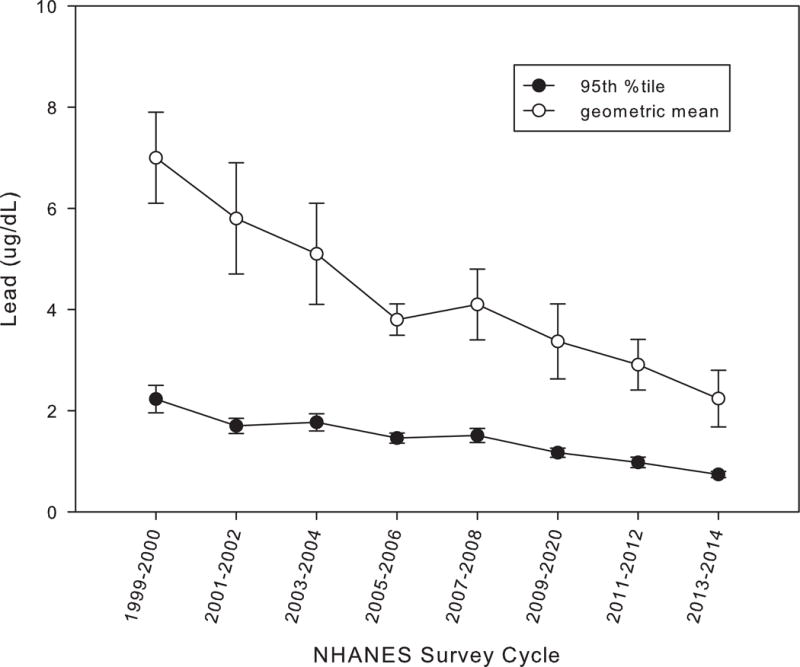
Description:In 2012, the Centers for Disease Control and Prevention (CDC) adopted its Advisory Committee on Childhood Lead Poisoning Prevention recommendation to use a population-based reference value to identify children and environments associated with lead hazards. The current reference value of 5 μg/dL is calculated as the 97.5th percentile of the distribution of blood lead levels (BLLs) in children 1 to 5 years old from 2007 to 2010 NHANES data. We calculated and updated selected percentiles, including the 97.5th percentile, by using NHANES 2011 to 2014 blood lead data and examined demographic characteristics of children whose blood lead was ≥90th percentile value. The 97.5th percentile BLL of 3.48 µg/dL highlighted analytical laboratory and clinical interpretation challenges of blood lead measurements ≤5 μg/dL. Review of 5 years of results for target blood lead values <11 µg/dL for US clinical laboratories participating in the CDC's voluntary Lead and Multi-Element Proficiency quality assurance program showed 40% unable to quantify and reported a nondetectable result at a target blood lead value of 1.48 µg/dL, compared with 5.5% at a target BLL of 4.60 µg/dL. We describe actions taken at the CDC's Environmental Health Laboratory in the National Center for Environmental Health, which measures blood lead for NHANES, to improve analytical accuracy and precision and to reduce external lead contamination during blood collection and analysis.
-
Subjects:
-
Source:Pediatrics. 140(2).
-
Pubmed ID:28771411
-
Pubmed Central ID:PMC5709716
-
Document Type:
-
Funding:
-
Place as Subject:
-
Volume:140
-
Issue:2
-
Download URL:
-
File Type:
 [PDF - 427.23 KB]
 -
Collection(s):
-
Main Document Checksum:urn:sha256:7c342d4a984b74cf84b53ae5f467b6bc79e9bd80fa0316dae18659c663c21dc1
Supporting Files


File Language:
English
 Was this page helpful?
 Found an issue?

CDC STACKS serves as an archival repository of CDC-published products including
scientific findings, journal articles, guidelines, recommendations, or other public health information authored or
co-authored by CDC or funded partners.
As a repository, CDC STACKS retains documents in their original published format to ensure public access to scientific information.
As a repository, CDC STACKS retains documents in their original published format to ensure public access to scientific information.
You May Also Like
COLLECTION
CDC Public Access