



Akap350 Recruits Eb1 to The Spindle Poles, Ensuring Proper Spindle Orientation and Lumen Formation in 3d Epithelial Cell Cultures
Supporting Files

-
Nov 02 2017
-
File Language:
English
Details
-
Alternative Title:Sci Rep
-
Personal Author:
-
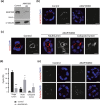
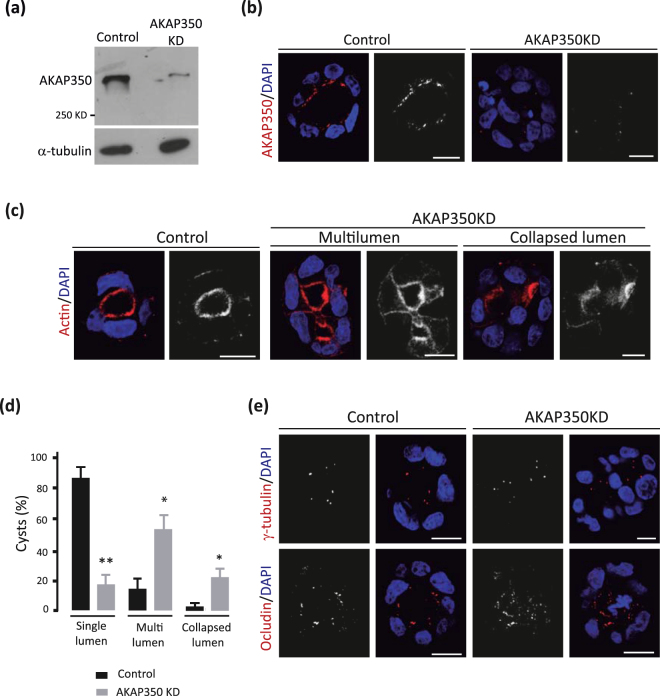
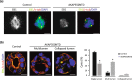
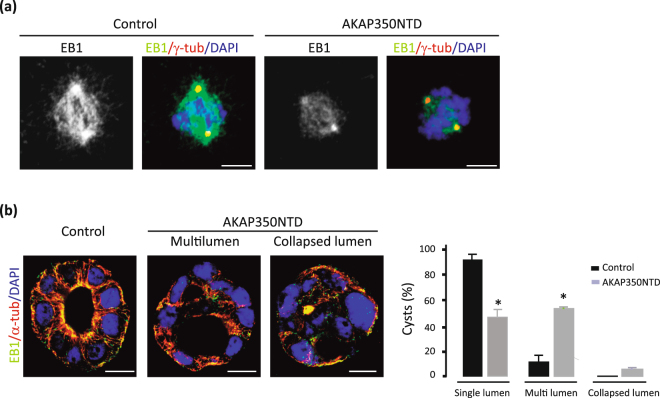
Description:The organization of epithelial cells to form hollow organs with a single lumen requires the accurate three-dimensional arrangement of cell divisions. Mitotic spindle orientation is defined by signaling pathways that provide molecular links between specific spots at the cell cortex and astral microtubules, which have not been fully elucidated. AKAP350 is a centrosomal/Golgi scaffold protein, implicated in the regulation of microtubule dynamics. Using 3D epithelial cell cultures, we found that cells with decreased AKAP350 expression (AKAP350KD) formed polarized cysts with abnormal lumen morphology. Analysis of mitotic cells in AKAP350KD cysts indicated defective spindle alignment. We established that AKAP350 interacts with EB1, a microtubule associated protein that regulates spindle orientation, at the spindle poles. Decrease of AKAP350 expression lead to a significant reduction of EB1 levels at spindle poles and astral microtubules. Conversely, overexpression of EB1 rescued the defective spindle orientation induced by deficient AKAP350 expression. The specific delocalization of the AKAP350/EB1complex from the centrosome decreased EB1 levels at astral microtubules and lead to the formation of 3D-organotypic structures which resembled AKAP350KD cysts. We conclude that AKAP350 recruits EB1 to the spindle poles, ensuring EB1 presence at astral microtubules and proper spindle orientation during epithelial morphogenesis.
-
Subjects:
-
Source:Sci Rep. 7.
-
Pubmed ID:29097729
-
Pubmed Central ID:PMC5668257
-
Document Type:
-
Funding:
-
Volume:7
-
Collection(s):
-
Main Document Checksum:urn:sha256:29ae2c2e951d1dc9869006a51afb696c0b87ff7316ed82af0dec43bbff62f87a
-
Download URL:
-
File Type:
 [PDF
- 2.36 MB
]
[PDF
- 2.36 MB
]
Supporting Files


File Language:
English
 Was this page helpful?
 Found an issue?






CDC STACKS serves as an archival repository of CDC-published products including
scientific findings,
journal articles, guidelines, recommendations, or other public health information authored or
co-authored by CDC or funded partners.
As a repository, CDC STACKS retains documents in their original published format to ensure public access to scientific information.
As a repository, CDC STACKS retains documents in their original published format to ensure public access to scientific information.
You May Also Like
COLLECTION
CDC Public Access