


Infection prevention and control measures and tools for the prevention of entry of carbapenem-resistant Enterobacteriaceae into healthcare settings: guidance from the European Centre for Disease Prevention and Control
Supporting Files
Public Domain

-
Nov 15 2017
-
Details
-
Alternative Title:Antimicrob Resist Infect Control
-
Personal Author:
-
Description:Background
Infections with carbapenem-resistant Enterobacteriaceae (CRE) are increasingly being reported from patients in healthcare settings. They are associated with high patient morbidity, attributable mortality and hospital costs. Patients who are “at-risk” may be carriers of these multidrug-resistant Enterobacteriaceae (MDR-E).
Methods
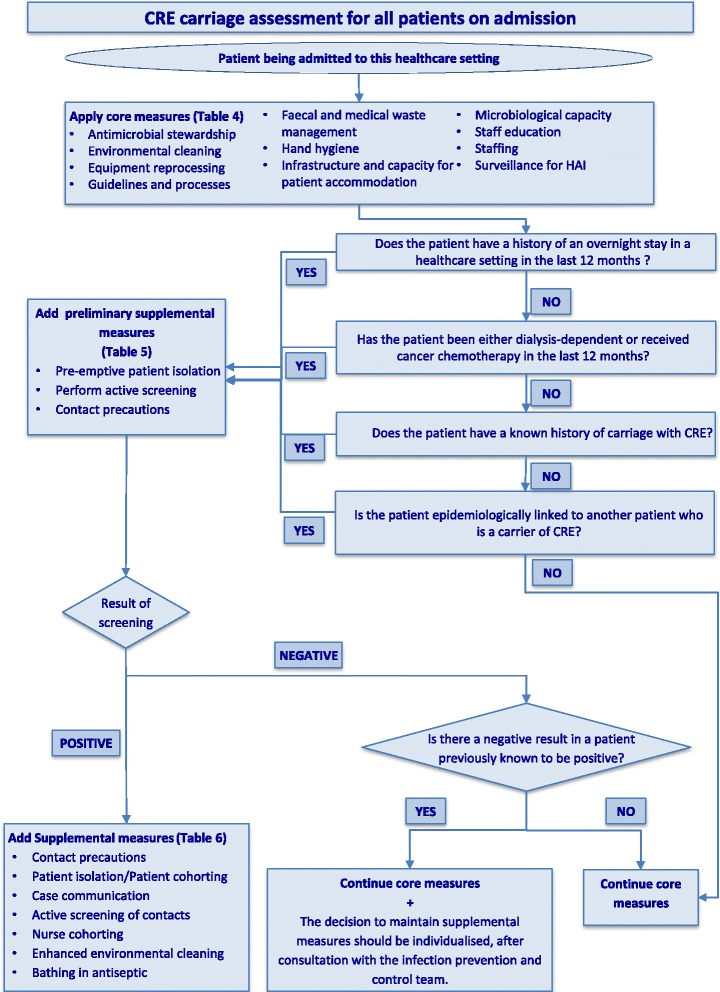
The guidance was created by a group of experts who were functioning independently of their organisations, during two meetings hosted by the European Centre for Disease Prevention and Control. A list of epidemiological risk factors placing patients “at-risk” for carriage with CRE was created by the experts. The conclusions of a systematic review on the prevention of spread of CRE, with the addition of expert opinion, were used to construct lists of core and supplemental infection prevention and control measures to be implemented for “at-risk” patients upon admission to healthcare settings.
Results
Individuals with the following profile are “at-risk” for carriage of CRE: a) a history of an overnight stay in a healthcare setting in the last 12 months, b) dialysis-dependent or cancer chemotherapy in the last 12 months, c) known previous carriage of CRE in the last 12 months and d) epidemiological linkage to a known carrier of a CRE.
Conclusions
Strengthening the microbiological capacity, surveillance and reporting of new cases of CRE in healthcare settings and countries is necessary to monitor the epidemiological situation so that, if necessary, the implemented CRE prevention strategies can be refined in a timely manner. Creating a large communication network to exchange this information would be helpful to understand the extent of the CRE reservoir and to prevent infections in healthcare settings, by applying the principles outlined here.
Electronic supplementary material
The online version of this article (10.1186/s13756-017-0259-z) contains supplementary material, which is available to authorized users.
-
Subjects:
-
Source:Antimicrob Resist Infect Control. 6.
-
Pubmed ID:29163939
-
Pubmed Central ID:PMC5686856
-
Document Type:
-
Volume:6
-
Collection(s):
-
Main Document Checksum:urn:sha256:05eb05d9c9a1ca34ee81fd1a91d282bc74bc5bf41924e5a8abedfd528d731d46
-
Download URL:
-
File Type:
 [PDF
- 1.31 MB
]
[PDF
- 1.31 MB
]
Supporting Files


ON THIS PAGE


CDC STACKS serves as an archival repository of CDC-published products including
scientific findings,
journal articles, guidelines, recommendations, or other public health information authored or
co-authored by CDC or funded partners.
As a repository, CDC STACKS retains documents in their original published format to ensure public access to scientific information.
As a repository, CDC STACKS retains documents in their original published format to ensure public access to scientific information.
You May Also Like
COLLECTION
CDC Public Access