



Bacillus anthracis gamma phage lysis among soil bacteria: an update on test specificity
Supporting Files
Public Domain

-
Nov 16 2017
-
Available in CDC Stacks on 2017-11-16T00:00:00Z
Details
-
Alternative Title:BMC Res Notes
-
Personal Author:
-
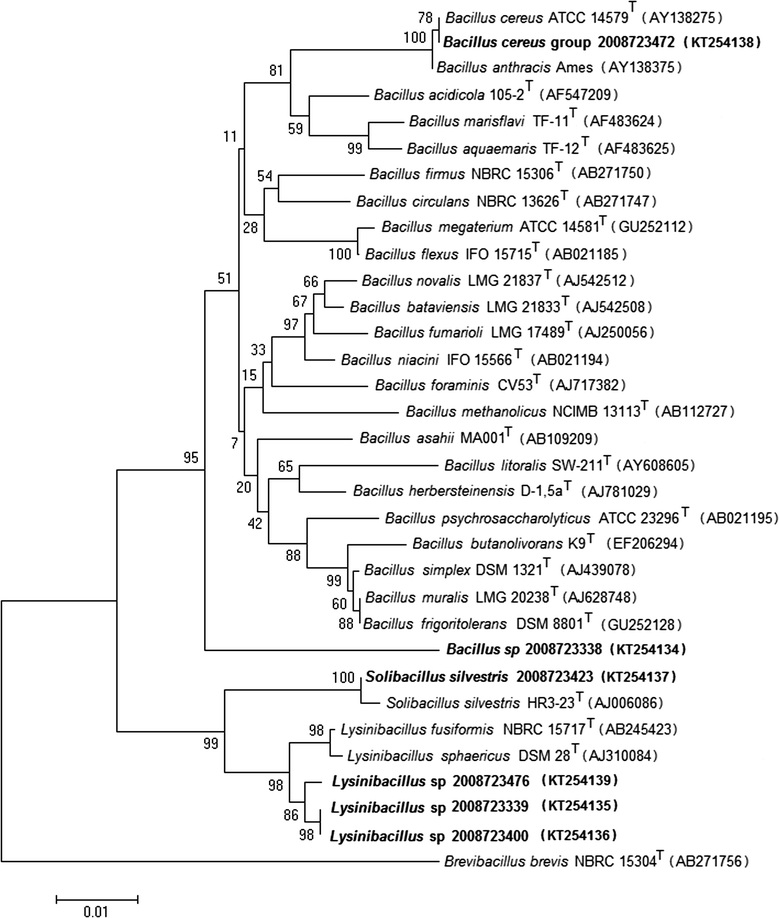
Description:Background ; Bacillus anthracis, which causes anthrax in humans and animals, is enzootic in parts of the U.S. state of Texas where cases are typically reported in animals annually. The gamma phage lysis assay is a common diagnostic method for identification of B. anthracis and is based on the bacterium’s susceptibility to lysis. This test has been shown to be 97% specific for B. anthracis, as a small number of strains of other Bacillus spp. are known to be susceptible. In this study, we evaluated the performance of a combination of B. anthracis diagnostic assays on 700 aerobic, spore-forming isolates recovered from soil collected in Texas. These assays include phenotypic descriptions, gamma phage susceptibility, and real-time polymerase chain reaction specific for B. anthracis. Gamma phage-susceptible isolates were also tested using cell wall and capsule direct fluorescent-antibody assays specific for B. anthracis. Gamma phage-susceptible isolates that were ruled out as B. anthracis were identified by 16S rRNA gene sequencing. ; Findings ; We identified 29 gamma phage-susceptible isolates. One was confirmed as B. anthracis, while the other 28 isolates were ruled out for B. anthracis by the other diagnostic tests. Using 16S rRNA gene sequencing results, we identified these isolates as members of the B. cereus group, Bacillus sp. (not within B. cereus group), Lysinibacillus spp., and Solibacillus silvestris. Based on these results, we report a specificity of 96% for gamma phage lysis as a diagnostic test for B. anthracis, and identified susceptible isolates outside the Bacillus genus. ; Conclusions ; In this study we found gamma phage susceptibility to be consistent with previously reported results. However, we identified non-B. anthracis environmental isolates (including isolates from genera other than Bacillus) that are susceptible to gamma phage lysis. To date, susceptibility to gamma phage lysis has not been reported in genera other than Bacillus. Though these isolates are not of clinical origin, description of unexpected positives is important, especially as new diagnostic assays for B. anthracis are being developed based on gamma phage lysis or gamma phage proteins. ; Electronic supplementary material ; The online version of this article (10.1186/s13104-017-2919-8) contains supplementary material, which is available to authorized users.
-
Subjects:
-
Source:BMC Res Notes. 10.
-
Pubmed ID:29145870
-
Pubmed Central ID:PMC5691394
-
Document Type:
-
Volume:10
-
Download URL:
-
File Type:
 [PDF - 1.43 MB]
 -
Collection(s):
-
Main Document Checksum:urn:sha256:ea661f6c9dd676ba9bf3e6dfecda86e0869fd1cba18173056b8f1d4acda80afc
Supporting Files


 Was this page helpful?
 Found an issue?


CDC STACKS serves as an archival repository of CDC-published products including
scientific findings, journal articles, guidelines, recommendations, or other public health information authored or
co-authored by CDC or funded partners.
As a repository, CDC STACKS retains documents in their original published format to ensure public access to scientific information.
As a repository, CDC STACKS retains documents in their original published format to ensure public access to scientific information.
You May Also Like
COLLECTION
CDC Public Access