


Fatal Outbreak in Tonkean Macaques Caused by Possibly Novel Orthopoxvirus, Europe, January 20151
Supporting Files
Public Domain

-
Dec 17 2017
-
Details
-
Alternative Title:Emerg Infect Dis
-
Personal Author:Cardeti, Giusy ; Gruber, Cesare Ernesto Maria ; Eleni, Claudia ; Carletti, Fabrizio ; Castilletti, Concetta ; Manna, Giuseppe ; Rosone, Francesca ; Giombini, Emanuela ; Selleri, Marina ; Lapa, Daniele ; Puro, Vincenzo ; Di Caro, Antonino ; Lorenzetti, Raniero ; Scicluna, Maria Teresa ; Grifoni, Goffredo ; Rizzoli, Annapaola ; Tagliapietra, Valentina ; De Marco, Lorenzo ; Capobianchi, Maria Rosaria ; Autorino, Gian Luca
-
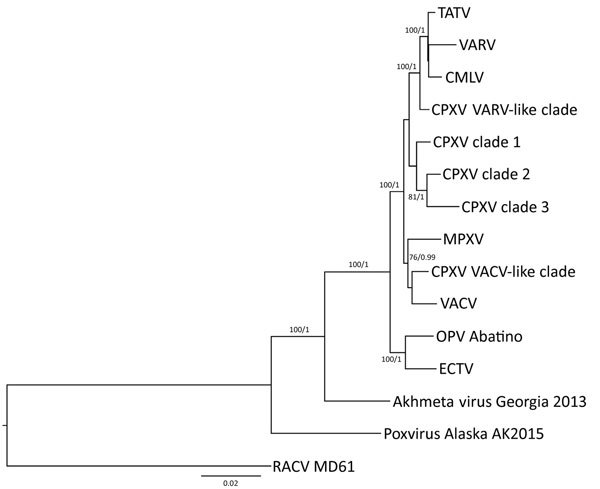
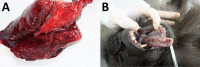
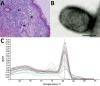
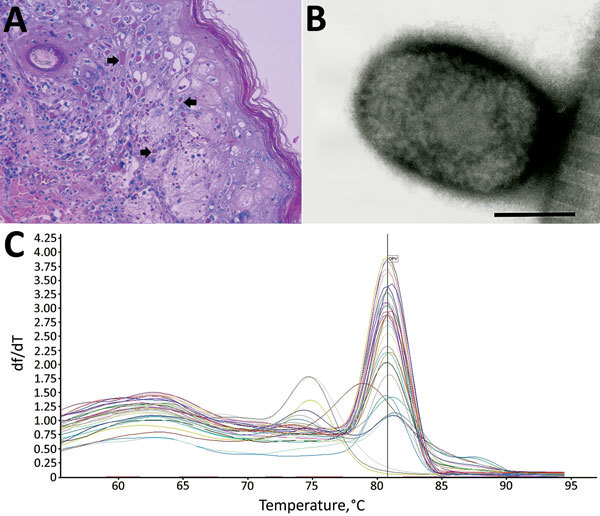
Description:In January 2015, during a 3-week period, 12 captive Tonkean macacques at a sanctuary in Europe died. An orthopoxvirus infection was suspected because of negative-staining electron microscopy results. The diagnosis was confirmed by histology, virus isolation, and molecular analysis performed on different organs from all animals. An epidemiologic investigation was unable to define the infection source in the surrounding area. Trapped rodents were negative by virologic testing, but specific IgG was detected in 27.27% of small rodents and 14.28% of rats. An attenuated live vaccine was administered to the susceptible monkey population, and no adverse reactions were observed; a detectable humoral immune response was induced in most of the vaccinated animals. We performed molecular characterization of the orthopoxvirus isolate by next-generation sequencing. According to the phylogenetic analysis of the 9 conserved genes, the virus could be part of a novel clade, lying between cowpox and ectromelia viruses.
-
Subjects:
-
Source:Emerg Infect Dis. 23(12):1941-1949.
-
Pubmed ID:28975882
-
Pubmed Central ID:PMC5708245
-
Document Type:
-
Volume:23
-
Issue:12
-
Collection(s):
-
Main Document Checksum:urn:sha256:42883e9c216b0d82d4da20feadeb10e08198a10458f581f7ea7d1ce9377111c5
-
Download URL:
-
File Type:
 [PDF
- 4.94 MB
]
[PDF
- 4.94 MB
]
Supporting Files


ON THIS PAGE






CDC STACKS serves as an archival repository of CDC-published products including
scientific findings,
journal articles, guidelines, recommendations, or other public health information authored or
co-authored by CDC or funded partners.
As a repository, CDC STACKS retains documents in their original published format to ensure public access to scientific information.
As a repository, CDC STACKS retains documents in their original published format to ensure public access to scientific information.
You May Also Like
COLLECTION
Emerging Infectious Diseases