



Differences by Sex in Association of Mental Health With Video Gaming or Other Nonacademic Computer Use Among US Adolescents
Supporting Files

-
2017/11/22
File Language:
English
Details
-
Journal Article:Preventing Chronic Disease (PCD)
-
Personal Author:
-
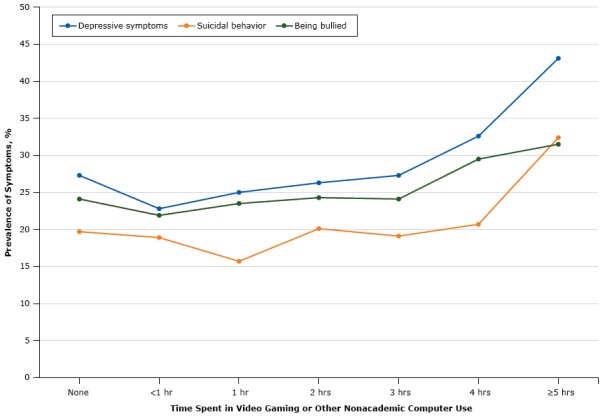
Description:Introduction ; Although numerous studies have examined the association between playing video games and cognitive skills, aggression, and depression, few studies have examined how these associations differ by sex. The objective of our study was to determine differences by sex in association between video gaming or other nonacademic computer use and depressive symptoms, suicidal behavior, and being bullied among adolescents in the United States. ; Methods ; We used data from the 2015 Youth Risk Behavior Survey on 15,624 US high school students. Rao–Scott χ2 tests, which were adjusted for the complex sampling design, were conducted to assess differences by sex in the association of mental health with video gaming or other nonacademic computer use. ; Results ; Approximately one-fifth (19.4%) of adolescents spent 5 or more hours daily on video gaming or other nonacademic computer use, and 17.9% did not spend any time in those activities. A greater percentage of female adolescents than male adolescents reported spending no time (22.1% and 14.0%, respectively) or 5 hours or more (21.3% and 17.5%, respectively) in gaming and other nonacademic computer use (P < .001). The association between mental problems and video gaming or other nonacademic computer use differed by sex. Among female adolescents, prevalence of mental problems increased steadily in association with increased time spent, whereas the pattern for male adolescents followed a J-shaped curve, decreasing initially, increasing slowly, and then increasing rapidly beginning at 4 hours or more. ; Conclusion ; Female adolescents were more likely to have all 3 mental health problems than male adolescents were. Spending no time or 5 hours or more daily on video gaming or other nonacademic computer use was associated with increased mental problems among both sexes. As suggested by the J-shaped relationship, 1 hour or less spent on video gaming or other nonacademic computer use may reduce depressive symptoms, suicidal behavior, and being bullied compared with no use or excessive use.
-
Subjects:
-
Source:Prev Chronic Dis. 14.
-
DOI:
-
ISSN:1545-1151
-
Pubmed ID:29166250
-
Pubmed Central ID:PMC5703649
-
Document Type:
-
Funding:
-
Genre:
-
Volume:14
-
Download URL:
-
File Type:
 [PDF - 290.21 KB]
 -
Collection(s):
-
Main Document Checksum:urn:sha-512:4bed10edd817d77c94fbe8b3b21ef46a0753c584c66af9edd499b6901a5473bde4d06691aaeeb02370e7263e7c501600223cc7837328fc87a66b6ae16591ee8c
Supporting Files


File Language:
English
 Was this page helpful?
 Found an issue?

CDC STACKS serves as an archival repository of CDC-published products including
scientific findings, journal articles, guidelines, recommendations, or other public health information authored or
co-authored by CDC or funded partners.
As a repository, CDC STACKS retains documents in their original published format to ensure public access to scientific information.
As a repository, CDC STACKS retains documents in their original published format to ensure public access to scientific information.
You May Also Like
COLLECTION
Preventing Chronic Disease