



Cross-Sectional Associations Between Violent Video and Computer Game Playing and Weapon Carrying in a National Cohort of Children
Supporting Files

-
2014/07/01
Details
-
Alternative Title:Aggress Behav
-
Personal Author:
-
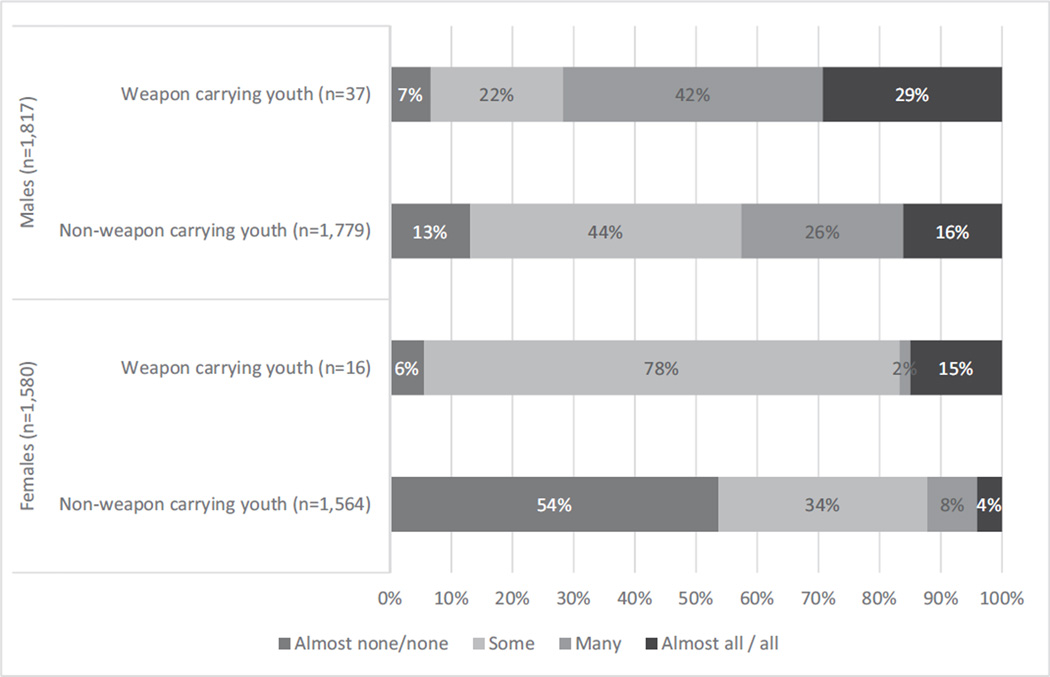
Description:Data were collected from 9 to 18 year olds surveyed nationally in a three-wave longitudinal survey. The population-average (generalized estimating equation, GEE) odds of carrying a weapon to school in the last month were estimated as a function of past-year exposure to violent content in video, computer, and Internet games, as well as peer aggression and biological sex. The sample included youth who were at risk for both the exposure (i.e., game play) and the outcome (i.e., who attended public or private school). 3,397 observations from 1,489 youth were included in analyses. 1.4% of youth reported carrying a weapon to school in the last month and 69% reported that at least some of the games they played depicted violence. After adjusting for other potentially influential characteristics (e.g., aggressive behavior), playing at least some violent games in the past year was associated with a fourfold increase in odds of also reporting carrying a weapon to school in the last month. Although youth who reported frequent and intense peer victimization in the past year were more likely to report carrying a weapon to school in the last month, this relation was explained by other influential characteristics. Consistent with the predictions of social-cognitive, observational learning theory, this study supports the hypothesis that carrying weapons to school is associated with violent game play. As one of the first studies of its kind, findings should be interpreted cautiously and need to be replicated.
-
Subjects:
-
Source:Aggress Behav. 2014; 40(4):345-358.
-
Pubmed ID:24464267
-
Pubmed Central ID:PMC4513935
-
Document Type:
-
Funding:
-
Genre:
-
Volume:40
-
Issue:4
-
Collection(s):
-
Main Document Checksum:urn:sha-512:eef3c166102a7c5fdcf69211db21cf90d8088b5a37d88fe5459700f2225e54e6ba0232e6439372dd342d95ef4cf94a0f2a48b6e420ab534abc34e3cef3b87dc4
-
Download URL:
-
File Type:
 [PDF
- 510.93 KB
]
[PDF
- 510.93 KB
]
Supporting Files


 Was this page helpful?
 Found an issue?
CDC STACKS serves as an archival repository of CDC-published products including
scientific findings,
journal articles, guidelines, recommendations, or other public health information authored or
co-authored by CDC or funded partners.
As a repository, CDC STACKS retains documents in their original published format to ensure public access to scientific information.
As a repository, CDC STACKS retains documents in their original published format to ensure public access to scientific information.
You May Also Like
COLLECTION
CDC Public Access