



Accuracy-based proficiency testing for testosterone measurements with immunoassays and liquid chromatography-mass spectrometry
Supporting Files

-
-
By Show All

-
-
Available in CDC Stacks on
File Language:
English
Details
-
Journal Article:Clin Chim Acta
-
Description:Background
Accurate testosterone measurements are needed to correctly diagnose and treat patients. Proficiency Testing (PT) programs using modified specimens for testing can be limited because of matrix effects and usage of non-reference measurement procedure (RMP)-defined targets for evaluation. Accuracy-based PT can overcome such limitations; however, there is a lack of information on accuracy-based PT and feasibility of its implementation in evaluation for testosterone measurements.
Methods
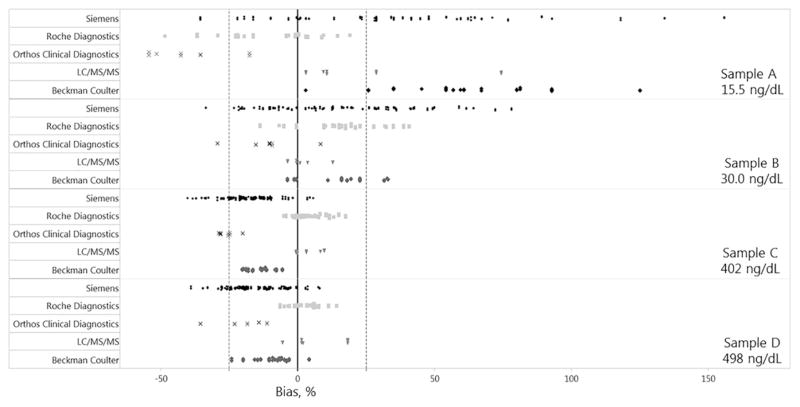
Unaltered, single-donor human serum from 2 male and 2 female adult donors were analyzed for testosterone by 142 NYSDH-certified clinical laboratories using 16 immunoassays and LC-MS/MS methods. Testosterone target values were determined using an RMP.
Results
The testosterone target concentrations for the 4 specimens were 15.5, 30.0, 402 and 498 ng/dl. The biases ranged from −17.8% to 73.1%, 3.1% to 21.3%, −24.8% to 8.6%, and −22.1% to 6.8% for the 4 specimens, respectively. Using a total error target of ±25.1%, which was calculated using the minimum allowable bias and imprecision, 73% of participating laboratories had ≥3 of the 4 results within these limits.
Conclusions
The variability in total testosterone measurements can affect clinical decisions. Accuracy-based PT can significantly contribute to improving testosterone testing by providing reliable data on accuracy in patient care to laboratories, assay manufacturers, and standardization programs. -
Subjects:
-
Pubmed ID:28288785
-
Pubmed Central ID:PMC5695555
-
Document Type:
-
Funding:
-
Volume:469
-
Download URL:
-
File Type:
 [PDF - 535.43 KB]
-
Collection(s):
-
Main Document Checksum:urn:sha-512:ce9bc006cab4e5dd0bbef016c0a33be2b1f771d099d3cad614abc0ee0911bbd01c59f08544b36e64d355f9a1be2aae8890c189a8f4f06e2ac556c55b92b35d27
Supporting Files


File Language:
English
 Was this page helpful?
 Found an issue?



CDC STACKS serves as an archival repository of CDC-published products including
scientific findings, journal articles, guidelines, recommendations, or other public health information authored or
co-authored by CDC or funded partners.
As a repository, CDC STACKS retains documents in their original published format to ensure public access to scientific information.
As a repository, CDC STACKS retains documents in their original published format to ensure public access to scientific information.
You May Also Like
COLLECTION
CDC Public Access