


A Comparison of South African National HIV Incidence Estimates: A Critical Appraisal of Different Methods
Supporting Files

-
Jul 31 2015
-
File Language:
English
Details
-
Alternative Title:PLoS One
-
Personal Author:
-
Description:Background
The interpretation of HIV prevalence trends is increasingly difficult as antiretroviral treatment programs expand. Reliable HIV incidence estimates are critical to monitoring transmission trends and guiding an effective national response to the epidemic.
Methods and Findings
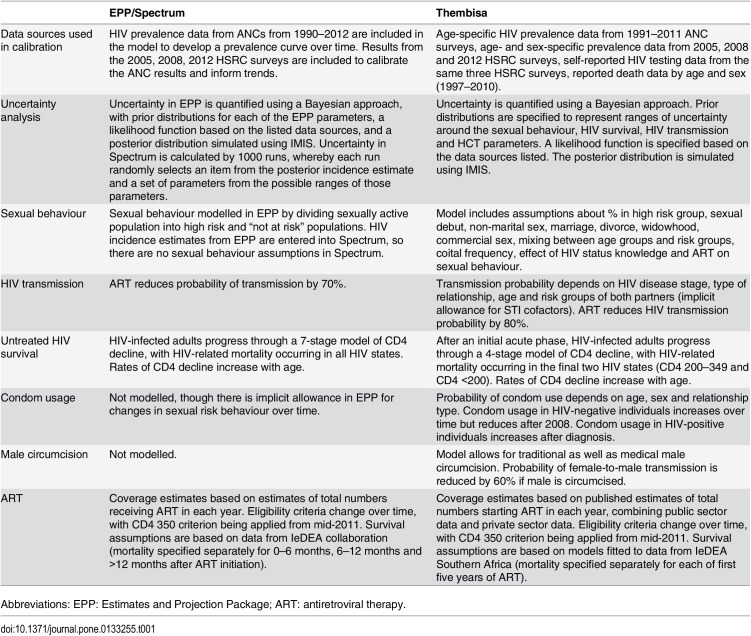
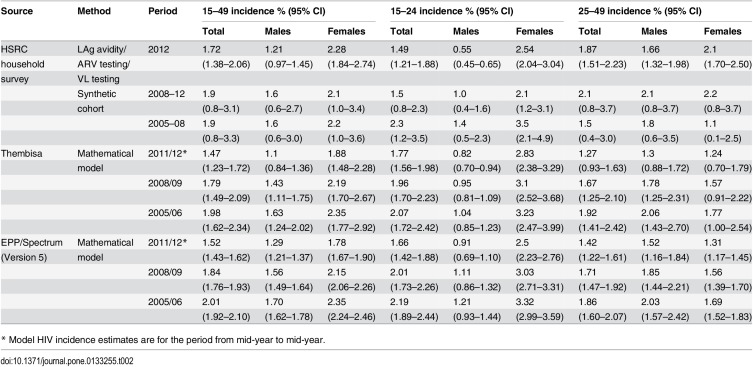
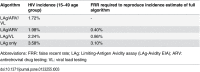
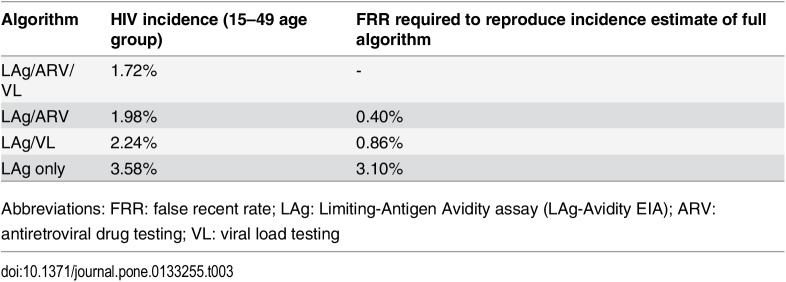
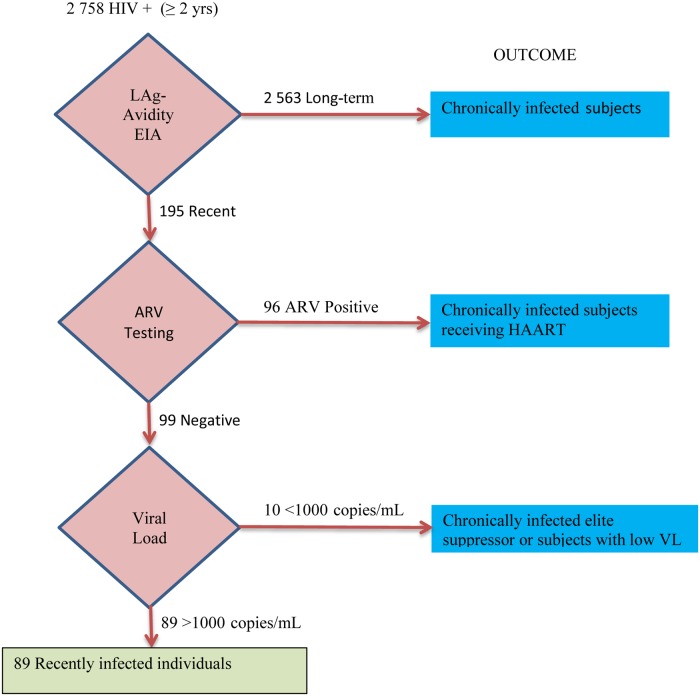
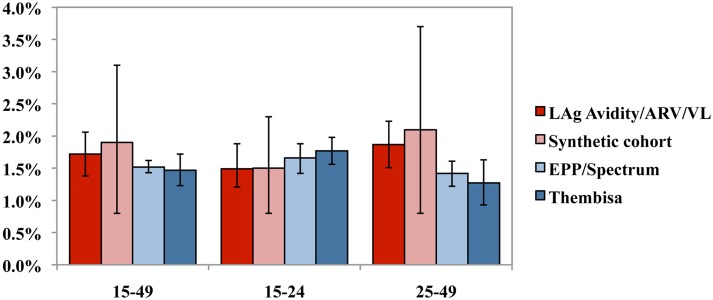
We used a range of methods to estimate HIV incidence in South Africa: (i) an incidence testing algorithm applying the Limiting-Antigen Avidity Assay (LAg-Avidity EIA) in combination with antiretroviral drug and HIV viral load testing; (ii) a modelling technique based on the synthetic cohort principle; and (iii) two dynamic mathematical models, the EPP/Spectrum model package and the Thembisa model. Overall, the different incidence estimation methods were in broad agreement on HIV incidence estimates among persons aged 15-49 years in 2012. The assay-based method produced slightly higher estimates of incidence, 1.72% (95% CI 1.38 – 2.06), compared with the mathematical models, 1.47% (95% CI 1.23 – 1.72) in Thembisa and 1.52% (95% CI 1.43 – 1.62) in EPP/Spectrum, and slightly lower estimates of incidence compared to the synthetic cohort, 1.9% (95% CI 0.8 – 3.1) over the period from 2008 to 2012. Among youth aged 15-24 years, a declining trend in HIV incidence was estimated by all three mathematical estimation methods.
Conclusions
The multi-method comparison showed similar levels and trends in HIV incidence and validated the estimates provided by the assay-based incidence testing algorithm. Our results confirm that South Africa is the country with the largest number of new HIV infections in the world, with about 1 000 new infections occurring each day among adults aged 15-49 years in 2012.
-
Subjects:
-
Source:PLoS One. 10(7).
-
Pubmed ID:26230949
-
Pubmed Central ID:PMC4521952
-
Document Type:
-
Funding:
-
Name as Subject:
-
Place as Subject:
-
Volume:10
-
Issue:7
-
Collection(s):
-
Main Document Checksum:urn:sha-512:83e17157e0673336476a109255849f7448ab63826aeed763bc93848a02fd7bc99507df37ac175bdaccc013e98b2f091f78e3a6b7529b4341af6ab5ca0cbfd1f1
-
Download URL:
-
File Type:
 [PDF
- 735.58 KB
]
[PDF
- 735.58 KB
]
Supporting Files


File Language:
English
ON THIS PAGE

CDC STACKS serves as an archival repository of CDC-published products including
scientific findings,
journal articles, guidelines, recommendations, or other public health information authored or
co-authored by CDC or funded partners.
As a repository, CDC STACKS retains documents in their original published format to ensure public access to scientific information.
As a repository, CDC STACKS retains documents in their original published format to ensure public access to scientific information.
You May Also Like
COLLECTION
CDC Public Access