


Prenatal Alcohol Exposure in Relation to Autism Spectrum Disorder: Findings from the Study to Explore Early Development (SEED)
Supporting Files

-
11 2017
-
File Language:
English
Details
-
Alternative Title:Paediatr Perinat Epidemiol
-
Personal Author:
-
Description:Background
Prenatal alcohol exposure can affect neurodevelopment, but few studies have examined associations with autism spectrum disorder (ASD).
Methods
We assessed the association between maternal alcohol use and ASD in the Study to Explore Early Development, a multi-site case-control study of children born September 2003 – August 2006 in the U.S. Regression analyses included 684 children with research clinician-confirmed ASD, 869 children with non-ASD developmental delays or disorders (DDs) and 962 controls ascertained from the general population (POP). Maternal alcohol exposure during each month from three months prior to conception until delivery was assessed by self-report.
Results
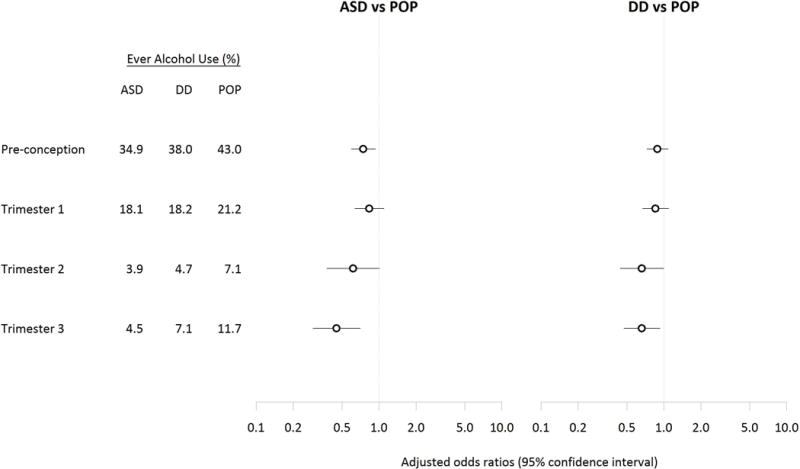
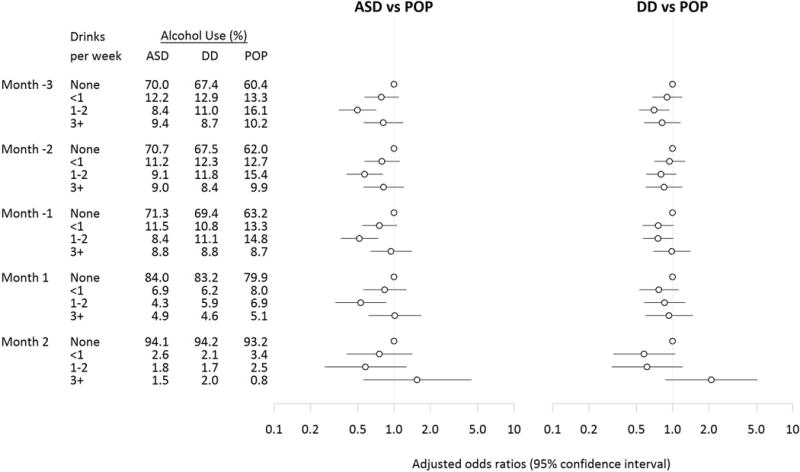
Mothers of POP children were more likely to report any prenatal alcohol use than mothers of children with ASD or DD. In trimester one, 21.2% of mothers of POP children reported alcohol use compared to 18.1% and 18.2% of mothers of children with ASD or DD, respectively (adjusted OR for ASD versus POP 0.8, 95% confidence interval 0.6, 1.1). During preconception and the first month of pregnancy, 1–2 drinks on average per week was inversely associated with ASD risk.
Conclusions
These results do not support an adverse association between low-level alcohol exposure and ASD, though these findings were based retrospective self-reported alcohol use. Unmeasured confounding or exposure misclassification may explain inverse associations with 1–2 drinks per week. Pregnant or potentially pregnant women should continue to follow recommendations to avoid alcohol use because of other known effects on infant health and neurodevelopment.
-
Subjects:
-
Keywords:
-
Source:Paediatr Perinat Epidemiol. 31(6):573-582
-
Pubmed ID:28881390
-
Pubmed Central ID:PMC5690833
-
Document Type:
-
Funding:U10 DD000180/DD/NCBDD CDC HHSUnited States/ ; T32 ES007018/ES/NIEHS NIH HHSUnited States/ ; U10 DD000181/DD/NCBDD CDC HHSUnited States/ ; U10 DD000184/DD/NCBDD CDC HHSUnited States/ ; U01 DD001205/DD/NCBDD CDC HHSUnited States/ ; U01 DD000750/DD/NCBDD CDC HHSUnited States/ ; U01DD000750/ACL/ACL HHSUnited States/ ; P2C HD050924/HD/NICHD NIH HHSUnited States/ ; U10 DD000183/DD/NCBDD CDC HHSUnited States/ ; U01 DD001210/DD/NCBDD CDC HHSUnited States/ ; U01 DD000498/DD/NCBDD CDC HHSUnited States/ ; U01 DD001214/DD/NCBDD CDC HHSUnited States/ ; U10 DD000182/DD/NCBDD CDC HHSUnited States/
-
Volume:31
-
Issue:6
-
Collection(s):
-
Main Document Checksum:urn:sha256:2f8edfbe47f96383561c9466f3ec7c104107d75912a373db805b31ce1cef5b8d
-
Download URL:
-
File Type:
 [PDF
- 191.17 KB
]
[PDF
- 191.17 KB
]
Supporting Files


File Language:
English
ON THIS PAGE


CDC STACKS serves as an archival repository of CDC-published products including
scientific findings,
journal articles, guidelines, recommendations, or other public health information authored or
co-authored by CDC or funded partners.
As a repository, CDC STACKS retains documents in their original published format to ensure public access to scientific information.
As a repository, CDC STACKS retains documents in their original published format to ensure public access to scientific information.
You May Also Like
COLLECTION
CDC Public Access