


Physiologically based pharmacokinetic modeling of human exposure to perfluorooctanoic acid suggests historical non drinking-water exposures are important for predicting current serum concentrations
Supporting Files

-
9 01 2017
File Language:
English
Details
-
Alternative Title:Toxicol Appl Pharmacol
-
Personal Author:
-
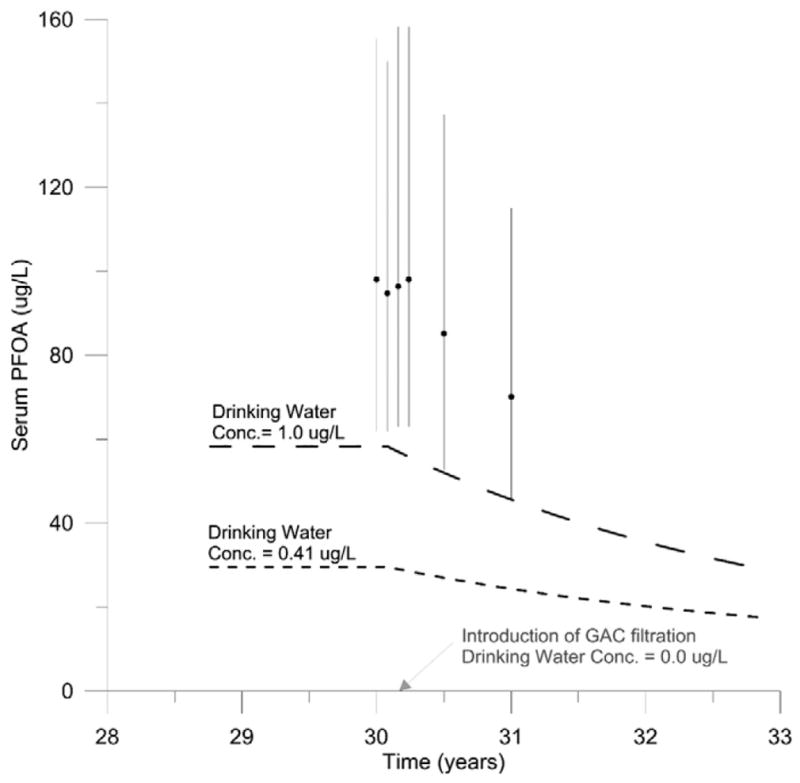
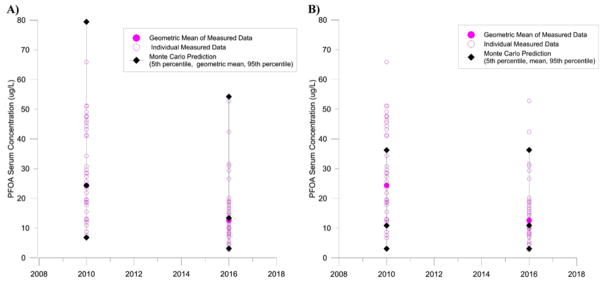
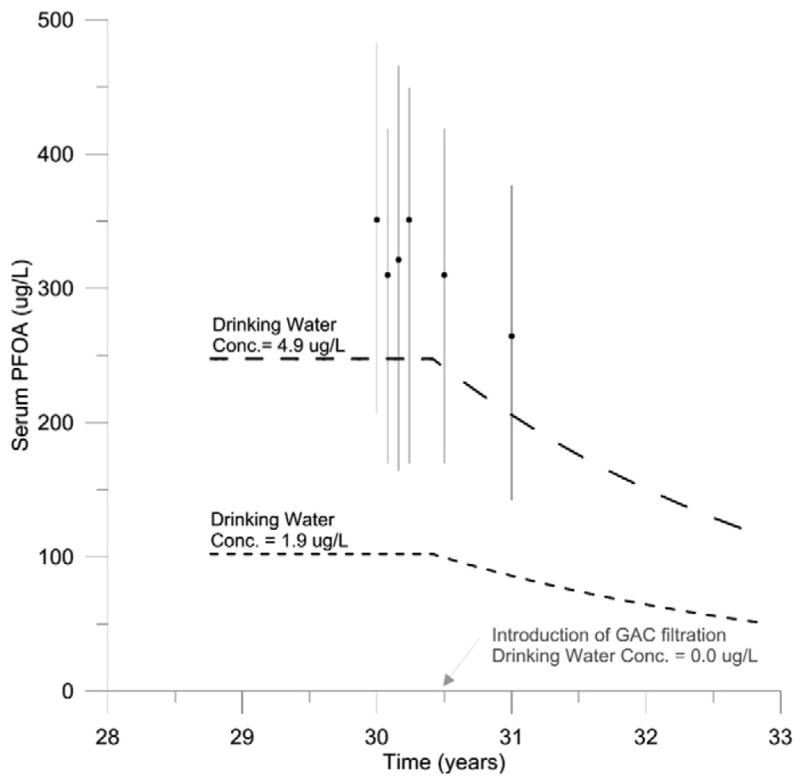
Description:Manufacturing of perfluorooctanoic acid (PFOA), a synthetic chemical with a long half-life in humans, peaked between 1970 and 2002, and has since diminished. In the United States, PFOA is detected in the blood of >99% of people tested, but serum concentrations have decreased since 1999. Much is known about exposure to PFOA in drinking water; however, the impact of non-drinking water PFOA exposure on serum PFOA concentrations is not well characterized. The objective of this research is to apply physiologically based pharmacokinetic (PBPK) modeling and Monte Carlo analysis to evaluate the impact of historic non-drinking water PFOA exposure on serum PFOA concentrations. In vitro to in vivo extrapolation was utilized to inform descriptions of PFOA transport in the kidney. Monte Carlo simulations were incorporated to evaluate factors that account for the large inter-individual variability of serum PFOA concentrations measured in individuals from North Alabama in 2010 and 2016, and the Mid-Ohio River Valley between 2005 and 2008. Predicted serum PFOA concentrations were within two-fold of experimental data. With incorporation of Monte Carlo simulations, the model successfully tracked the large variability of serum PFOA concentrations measured in populations from the Mid-Ohio River Valley. Simulation of exposure in a population of 45 adults from North Alabama successfully predicted 98% of individual serum PFOA concentrations measured in 2010 and 2016, respectively, when non-drinking water ingestion of PFOA exposure was included. Variation in serum PFOA concentrations may be due to inter-individual variability in the disposition of PFOA and potentially elevated historical non-drinking water exposures.
-
Subjects:
-
Keywords:
-
Source:Toxicol Appl Pharmacol. 330:9-21
-
Pubmed ID:28684146
-
Pubmed Central ID:PMC5664934
-
Document Type:
-
Funding:
-
Volume:330
-
Collection(s):
-
Main Document Checksum:urn:sha256:afe05cf5a23713baf98e5b4ef4a48c79258a27339213bd5536ab5cc2a9f7ba8b
-
Download URL:
-
File Type:
 [PDF
- 832.53 KB
]
[PDF
- 832.53 KB
]
Supporting Files


File Language:
English
ON THIS PAGE








CDC STACKS serves as an archival repository of CDC-published products including
scientific findings,
journal articles, guidelines, recommendations, or other public health information authored or
co-authored by CDC or funded partners.
As a repository, CDC STACKS retains documents in their original published format to ensure public access to scientific information.
As a repository, CDC STACKS retains documents in their original published format to ensure public access to scientific information.
You May Also Like
COLLECTION
CDC Public Access