



Measurement of Urinary Benzo[a]pyrene Tetrols and Their Relationship to Other Polycyclic Aromatic Hydrocarbon Metabolites and Cotinine in Humans
Supporting Files

-
Sep 18 2017
-
Available in CDC Stacks on December 01, 2018, 12:00 AM
File Language:
English
Details
-
Alternative Title:Chemosphere
-
Personal Author:
-
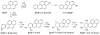
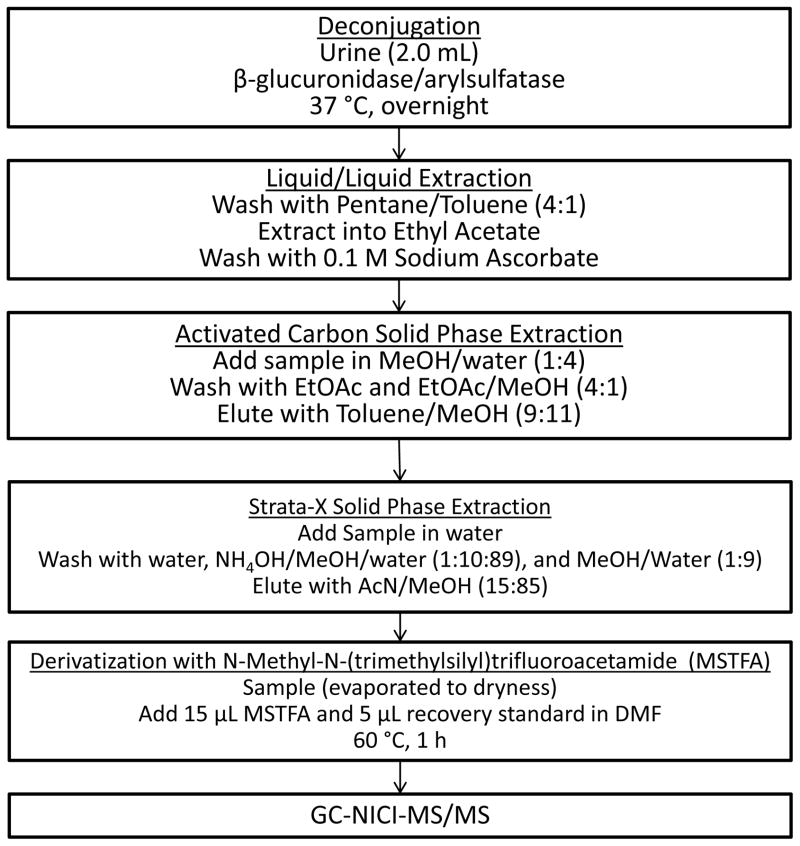
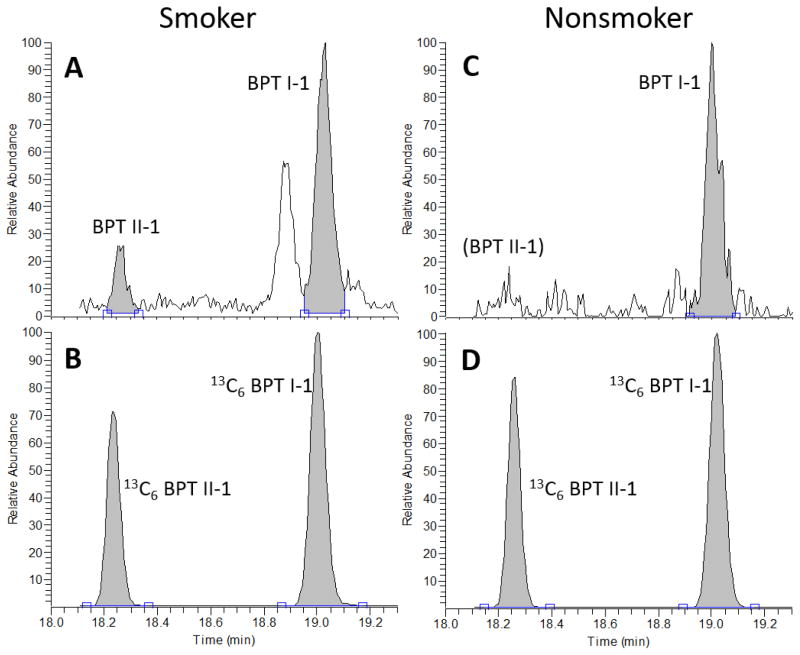
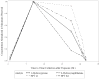
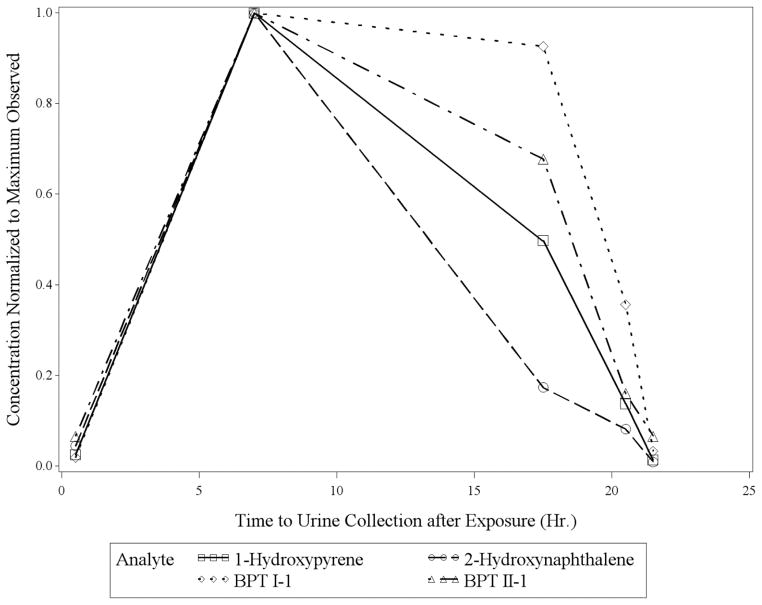
Description:Biomonitoring of exposure to polycyclic aromatic hydrocarbons (PAHs) typically uses measurement of metabolites of PAHs with four or less aromatic rings, such as 1-hydroxypyrene, even though interest may be in exposure to larger and carcinogenic PAHs, such as benzoapyrene (BaP). An improved procedure for measuring two tetrol metabolites of BaP has been developed. Using 2 mL urine, the method includes enzymatic deconjugation of the tetrol conjugates, liquid-liquid extraction, activated carbon solid phase extraction (SPE) and Strata-X SPE, and gas chromatography-electron capture negative ionization-tandem mass spectrometric determination. Limits of detection were 0.026 pg/mL (benzoapyrene-r-7,t-8,t-9,c-10-tetrahydrotetrol, BPT I-1) and 0.090 pg/mL (benzoapyrene-r-7,t-8,c-9,c-10-tetrahydrotetrol, BPT II-1). We quantified BPT I-1 and BPT II-1 in urine from a volunteer who consumed one meal containing high levels of PAHs (barbequed chicken). We also measured urinary concentrations of BPT I-1 and BPT II-1 in smokers and nonsmokers, and compared these concentrations with those of monohydroxy PAHs (OH-PAHs) and cotinine. Urinary elimination of BPT I-1 and BPT II-1 as a function of time after dietary exposure was similar to that observed previously for OH-PAHs. While the median BPT I-1 concentration in smokers' urine (0.069 pg/mL) significantly differs from nonsmokers (0.043 pg/mL), BPT I-1 is only weakly correlated with cotinine. The urinary concentration of BPT I-1 shows a weaker relationship to tobacco smoke than metabolites of smaller PAHs, suggesting that other routes of exposure such as for example dietary routes may be of larger quantitative importance.
-
Subjects:
-
Source:Chemosphere. 189:365-372.
-
Pubmed ID:28946070
-
Pubmed Central ID:PMC5647254
-
Document Type:
-
Funding:
-
Volume:189
-
Download URL:
-
File Type:
 [PDF - 1.11 MB]
 -
Collection(s):
-
Main Document Checksum:urn:sha256:4cf240dfb2fe03e8a062bbb5219f5145e549f3495698d021cf0284677ac39a86
Supporting Files


File Language:
English
 Was this page helpful?
 Found an issue?




CDC STACKS serves as an archival repository of CDC-published products including
scientific findings, journal articles, guidelines, recommendations, or other public health information authored or
co-authored by CDC or funded partners.
As a repository, CDC STACKS retains documents in their original published format to ensure public access to scientific information.
As a repository, CDC STACKS retains documents in their original published format to ensure public access to scientific information.
You May Also Like
COLLECTION
CDC Public Access