


Modifiable risk factors for typhoid intestinal perforations during a large outbreak of typhoid fever, Kampala Uganda, 2015
Supporting Files
Public Domain

-
Sep 25 2017
-
File Language:
English
Details
-
Alternative Title:BMC Infect Dis
-
Personal Author:
-
Description:Background
Between January and June, 2015, a large typhoid fever outbreak occurred in Kampala, Uganda, with 10,230 suspected cases. During the outbreak, area surgeons reported a surge in cases of typhoid intestinal perforation (TIP), a complication of typhoid fever. We conducted an investigation to characterize TIP cases and identify modifiable risk factors for TIP.
Methods
We defined a TIP case as a physician-diagnosed typhoid patient with non-traumatic terminal ileum perforation. We identified cases by reviewing medical records at all five major hospitals in Kampala from 2013 to 2015. In a matched case-control study, we compared potential risk factors among TIP cases and controls; controls were typhoid patients diagnosed by TUBEX TF, culture, or physician but without TIP, identified from the outbreak line-list and matched to cases by age, sex and residence. Cases and controls were interviewed using a standard questionnaire from 1st -23rd December 2015. We used conditional logistic regression to assess risk factors for TIP and control for confounding.
Results
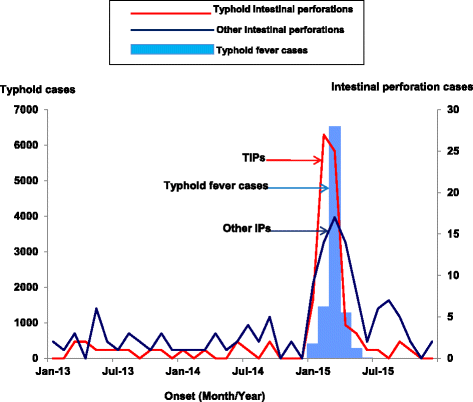
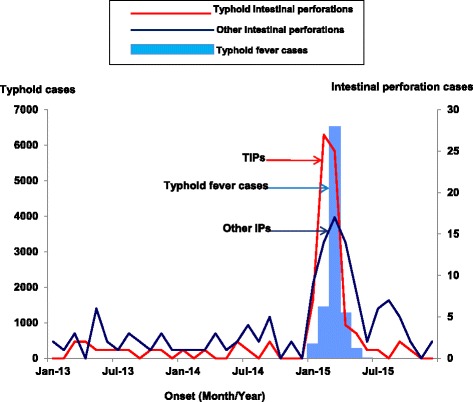
Of the 88 TIP cases identified during 2013–2015, 77% (68/88) occurred between January and June, 2015; TIPs sharply increased in January and peaked in March, coincident with the typhoid outbreak. The estimated risk of TIP was 6.6 per 1000 suspected typhoid infections (68/10,230). The case-fatality rate was 10% (7/68). Cases sought care later than controls; Compared with 29% (13/45) of TIP cases and 63% (86/137) of controls who sought treatment within 3 days of onset, 42% (19/45) of cases and 32% (44/137) of controls sought treatment 4–9 days after illness onset (ORadj = 2.2, 95%CI = 0.83–5.8), while 29% (13/45) of cases and 5.1% (7/137) of controls sought treatment ≥10 days after onset (ORadj = 11, 95%CI = 1.9–61). 68% (96/141) of cases and 23% (23/100) of controls had got treatment before being treated at the treatment centre (ORadj = 9.0, 95%CI = 1.1–78).
Conclusion
Delay in seeking treatment increased the risk of TIPs. For future outbreaks, we recommended aggressive community case-finding, and informational campaigns in affected communities and among local healthcare providers to increase awareness of the need for early and appropriate treatment.
-
Subjects:
-
Source:BMC Infect Dis. 17.
-
Pubmed ID:28946853
-
Pubmed Central ID:PMC5613338
-
Document Type:
-
Place as Subject:
-
Volume:17
-
Collection(s):
-
Main Document Checksum:urn:sha256:67783a4ea0a618505f9c219bf69dcf3053a3cc305f2675289e3d1f2c276ac766
-
Download URL:
-
File Type:
 [PDF
- 506.40 KB
]
[PDF
- 506.40 KB
]
Supporting Files


File Language:
English
ON THIS PAGE

CDC STACKS serves as an archival repository of CDC-published products including
scientific findings,
journal articles, guidelines, recommendations, or other public health information authored or
co-authored by CDC or funded partners.
As a repository, CDC STACKS retains documents in their original published format to ensure public access to scientific information.
As a repository, CDC STACKS retains documents in their original published format to ensure public access to scientific information.
You May Also Like
COLLECTION
CDC Public Access