


Cervical Cancer Screening and Prevention in 78 Sexually Transmitted Disease Clinics—United States, 2014–2015
Supporting Files

-
Oct 2017
-
File Language:
English
Details
-
Alternative Title:Sex Transm Dis
-
Personal Author:
-
Description:Background
Human papillomavirus (HPV) infections cause approximately 30,700 cancers annually among US men and women, cervical cancer being the most common. Human papillomavirus vaccination is recommended routinely for US girls and boys at age 11 to 12 years, and for those not previously vaccinated, through age 26 and 21 years for women and men, respectively. Our objective was to assess current cervical cancer screening and HPV vaccination practices among sexually transmitted disease (STD) clinics in the United States.
Methods
We surveyed a geographically diverse convenience sample of US STD clinics identified by members of the National Coalition of STD Directors within 65 state, territorial, and local jurisdictions. An online multiple-choice survey about clinical services was administered to clinic directors or designees during October 2014 to February 2015.
Results
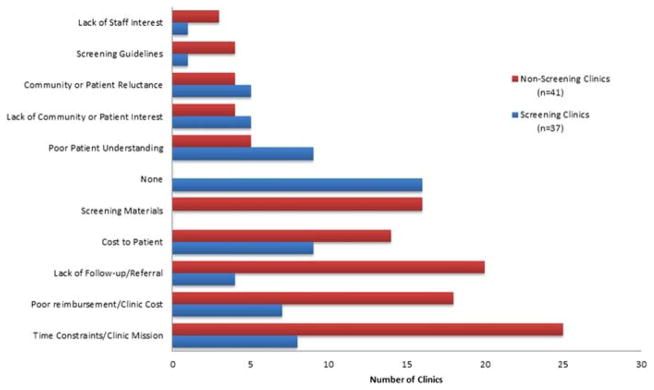
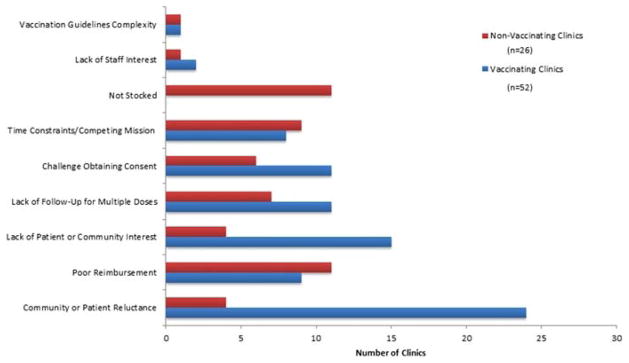
Survey respondents included 78 clinics from 46 states and territories. Of these clinics, 31 (39.7%) offered both cervical cancer screening and HPV vaccination, 6 (7.7%) offered cervical cancer screening only, 21 (26.9%) offered HPV vaccination only, and 20 (25.6%) offered neither cervical cancer prevention service. Among those not offering the service, the most commonly reported barrier to cervical cancer screening was time constraints (25/41, 61.0%); for HPV vaccination it was reimbursement (11/26, 42.3%).
Conclusions
By early 2015, in a geographically diverse group of 78 STD clinics, 39.7% provided nationally recommended HPV vaccination and cervical cancer screening, whereas 25.6% provided neither. Further research could identify strategies for STD clinics to reduce HPV-associated cancers by increasing provision of HPV vaccination and cervical cancer screening services, particularly among medically underserved populations.
-
Subjects:
-
Source:Sex Transm Dis. 44(10):637-641.
-
Pubmed ID:28876317
-
Pubmed Central ID:PMC5615813
-
Document Type:
-
Funding:
-
Volume:44
-
Issue:10
-
Collection(s):
-
Main Document Checksum:urn:sha256:5e6569b73ef3257a8bd62b56817e2bab2dcd9ecb0e19da38d8477b3fabd13168
-
Download URL:
-
File Type:
 [PDF
- 478.60 KB
]
[PDF
- 478.60 KB
]
Supporting Files


File Language:
English
ON THIS PAGE


CDC STACKS serves as an archival repository of CDC-published products including
scientific findings,
journal articles, guidelines, recommendations, or other public health information authored or
co-authored by CDC or funded partners.
As a repository, CDC STACKS retains documents in their original published format to ensure public access to scientific information.
As a repository, CDC STACKS retains documents in their original published format to ensure public access to scientific information.
You May Also Like
COLLECTION
CDC Public Access