



Cervical Cancer Screening Among Young Adult Women in the United States
Supporting Files

-
4 2013 ; 4-2013
-
Available in CDC Stacks on 2015-06-25T00:00:00Z
File Language:
English
Details
-
Alternative Title:Cancer Epidemiol Biomarkers Prev
-
Personal Author:
-
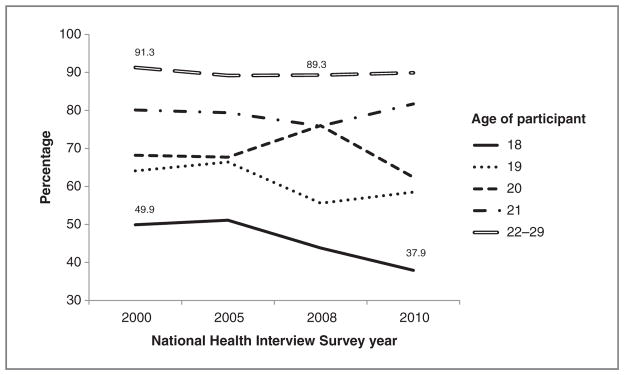
Description:Background ; Cervical cancer screening guidelines have evolved significantly in the last decade for young adult women, with current recommendations promoting later initiation and longer intervals. ; Methods ; Using self-reported cross-sectional National Health Interview Survey (NHIS) 2000–2010 data, trends in Papanicolaou (Pap) testing among women ages 18–29 years were examined. NHIS 2010 data were used to investigate age at first Pap test (N =2,198), time since most recent Pap test (n =1,622), and predictors of Pap testing within the last 12 months (n = 1,622). ; Results ; The percentage of 18-year-olds who reported ever having a Pap test significantly decreased from 49.9% in 2000 to 37.9% in 2010. Mean age at first Pap test in 2010 was significantly younger for non-Hispanic black women (16.9 years), women < high school education (16.9 years), women who received the HPV vaccine (17.1 years), and women who have ever given birth (17.3 years). The majority reported their last Pap test within the previous 12 months (73.1%). Usual source of healthcare (OR, 2.31) and current birth control use (OR, 1.64) significantly increased chances of having a Pap test within the previous 12 months. ; Conclusions ; From 2000 to 2010, there was a gradual decline in Pap test initiation among 18-year-olds; however, in 2010, many women reported ≤12 months since last screening. Evidence-based guidelines should be promoted, as screening young adult women for cervical cancer more frequently than recommended can cause considerable harms. ; Impact ; A baseline of cervical cancer screening among young adult women in the United States to assess adherence to evidence-based screening guidelines.
-
Keywords:
- Adolescent
- Adult
- Cross-Sectional Studies
- Early Detection of Cancer
- Ethnicity
- Female
- Health Knowledge, Attitudes, Practice
- Humans
- Neoplasm Staging
- Papanicolaou Test
- Papillomaviridae
- Papillomavirus Infections
- Papillomavirus Vaccines
- Prognosis
- Socioeconomic Factors
- Surveys and Questionnaires
- Uterine Cervical Neoplasms
- Vaginal Smears
- Young Adult
-
Source:Cancer Epidemiol Biomarkers Prev. 2013; 22(4):580-588
-
Pubmed ID:23355601
-
Pubmed Central ID:PMC4480768
-
Document Type:
-
Funding:
-
Volume:22
-
Issue:4
-
Download URL:
-
File Type:
 [PDF - 459.83 KB]
 -
Collection(s):
-
Main Document Checksum:urn:sha256:6bf6c4f5bcad9cfb6feff0a75c04f9abda6e2fb93a5e5e670616e2219f888062
Supporting Files


File Language:
English
 Was this page helpful?
 Found an issue?


CDC STACKS serves as an archival repository of CDC-published products including
scientific findings, journal articles, guidelines, recommendations, or other public health information authored or
co-authored by CDC or funded partners.
As a repository, CDC STACKS retains documents in their original published format to ensure public access to scientific information.
As a repository, CDC STACKS retains documents in their original published format to ensure public access to scientific information.
You May Also Like
COLLECTION
CDC Public Access