


GLYCOGENIC HEPATOPATHY: A COMPLICATION OF UNCONTROLLED DIABETES
Supporting Files

-
2017
-
File Language:
English
Details
-
Alternative Title:AACE Clin Case Rep
-
Personal Author:
-
Description:Objective
To describe a case of hepatomegaly and elevated transaminases in a patient with glycogenic hepatopathy (GH) as a complication of uncontrolled diabetes.
Methods
Clinical, laboratory, and pathological information are described.
Results
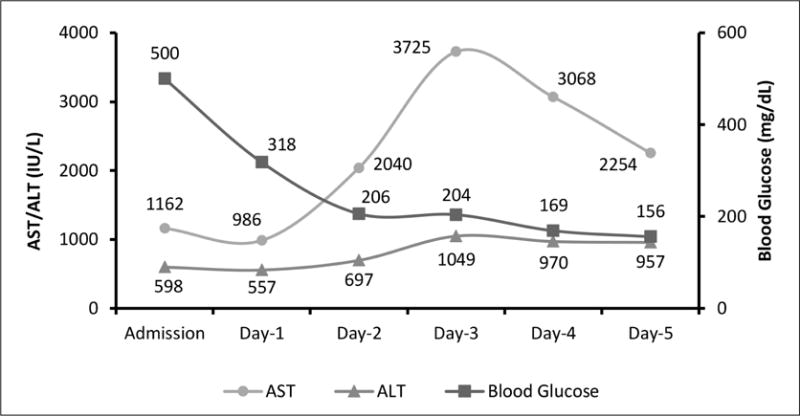
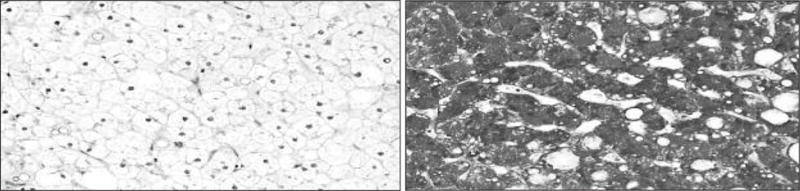
An 18-year-old male with uncontrolled type 1 diabetes and recurrent diabetic ketoacidosis (DKA) presented with abdominal distention and severe hyperglycemia. Physical examination revealed massive hepatomegaly. Laboratory evaluation showed anion-gap metabolic acidosis, ketonuria, and markedly elevated aspartate and alanine amino transaminases (AST = 1,162 IU/L and ALT = 598 IU/L, respectively). Despite resolution of DKA with insulin infusion, transaminases continued to increase (peak AST = 3,725 U/L, ALT = 1,049 U/L) with no signs of liver failure (normal coagulation profile and albumin level). Abdominal ultrasonography revealed an enlarged liver with moderate echogenicity, consistent with steatosis. Extensive evaluation for causes of hepatitis including toxic, autoimmune, genetic, and infectious diseases was unrevealing. Liver biopsy showed no signs of nonalcoholic fatty liver disease (NAFLD), such as fibrosis, steatosis, or portal inflammation. However, swollen hepatocytes with glycogen accumulation consistent with GH were seen.
Conclusion
GH can present as hepatomegaly and elevated liver transaminases in patients with uncontrolled diabetes. Clinicians should consider GH in patients with uncontrolled diabetes after ruling out other common causes. Liver ultrasound cannot differentiate this condition from the more commonly seen NAFLD. Although liver biopsy remains a gold standard, evaluation with magnetic resonance imaging may be considered as a less invasive alternative in the appropriate clinical setting.
-
Subjects:
-
Source:AACE Clin Case Rep. 3(3):e255-e259.
-
Pubmed ID:28868358
-
Pubmed Central ID:PMC5580824
-
Document Type:
-
Funding:
-
Volume:3
-
Issue:3
-
Collection(s):
-
Main Document Checksum:urn:sha256:fc0e0c0adf67f49533d43376112793a3b93016593f3b730c463355f635135fe2
-
Download URL:
-
File Type:
 [PDF
- 211.98 KB
]
[PDF
- 211.98 KB
]
Supporting Files


File Language:
English
ON THIS PAGE




CDC STACKS serves as an archival repository of CDC-published products including
scientific findings,
journal articles, guidelines, recommendations, or other public health information authored or
co-authored by CDC or funded partners.
As a repository, CDC STACKS retains documents in their original published format to ensure public access to scientific information.
As a repository, CDC STACKS retains documents in their original published format to ensure public access to scientific information.
You May Also Like
COLLECTION
CDC Public Access