


Total and methyl mercury in whole blood measured for the first time in the U.S. population: NHANES 2011–2012
Supporting Files

-
Aug 29 2014
-
File Language:
English
Details
-
Alternative Title:Environ Res
-
Personal Author:
-
Description:Background
Despite the public health and toxicologic interest in methyl mercury (MeHg) and ethyl mercury (EHg), these mercury species have been technically difficult to measure in large population studies.
Methods
Using NHANES 2011–2012 data, we calculated reference ranges and examined demographic factors associated with specific mercury species concentrations and the ratio of MeHg to THg. We conducted several multiple regression analyses to examine factors associated with MeHg concentrations and also with the ratio of MeHg to THg.
Results
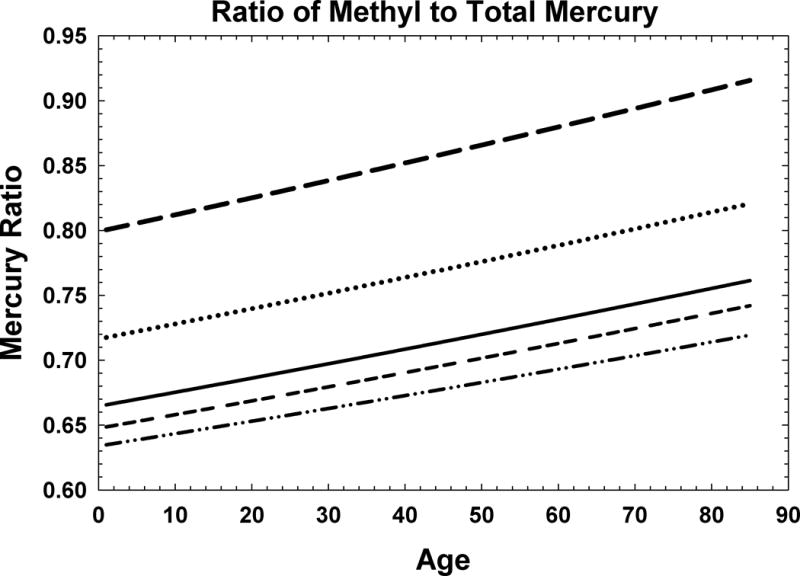
Asians had the highest geometric mean concentrations for MeHg, 1.58 μg/L (95% CI 1.29, 1.93) and THg, 1.86 μg/L (1.58, 2.19), followed by non-Hispanic blacks with MeHg, 0.52 μg/L (0.39, 0.68) and THg, 0.68 μg/L (0.54, 0.85). Greater education attainment in adults and male sex were associated with higher MeHg and THg concentrations. Race/ethnicity, age, and sex were significant predictors of MeHg concentrations, which increased with age and were highest in Asians in all age categories, followed by non-Hispanic blacks. Mexican Americans had the lowest adjusted MeHg concentrations. The ratio of MeHg to THg was highest in Asians, varied by racial/ethnic group, and increased with age in a non-linear fashion. The amount of increase in the MeHg to THg ratio with age depended on the initial ratio, with a greater increase as age increased.
Conclusions
Asians, males, older individuals, and adults with greater educational attainment had higher MeHg concentrations. The ratio of MeHg to THg varied with racial/ethnic group, increased with age, and was nonlinear. U.S. population reference values for MeHg and the ratio of MeHg to THg can assist in more precise assessment of public health risk from MeHg consumed in seafood.
-
Subjects:
-
Source:Environ Res. 134:257-264.
-
Pubmed ID:25173092
-
Pubmed Central ID:PMC5584810
-
Document Type:
-
Funding:
-
Place as Subject:
-
Volume:134
-
Collection(s):
-
Main Document Checksum:urn:sha256:93f81a09fba655d472e699172dd9024f782a0a700b38a84d149508d3567c01b7
-
Download URL:
-
File Type:
 [PDF
- 217.95 KB
]
[PDF
- 217.95 KB
]
Supporting Files


File Language:
English
ON THIS PAGE


CDC STACKS serves as an archival repository of CDC-published products including
scientific findings,
journal articles, guidelines, recommendations, or other public health information authored or
co-authored by CDC or funded partners.
As a repository, CDC STACKS retains documents in their original published format to ensure public access to scientific information.
As a repository, CDC STACKS retains documents in their original published format to ensure public access to scientific information.
You May Also Like
COLLECTION
CDC Public Access