



Association of prenatal urinary phthalate metabolite concentrations and childhood BMI and obesity
Supporting Files

-
May 31 2017
-
File Language:
English
Details
-
Alternative Title:Pediatr Res
-
Personal Author:
-
Description:BACKGROUND
Although experiments in animals suggest that phthalates may have obesogenic effects, studies on prenatal exposure in children show inconsistent results.
METHODS
We measured urinary concentrations of 11 phthalate metabolites collected twice during pregnancy from mothers participating in the Center for the Health Assessment of Mothers and Children of Salinas (CHAMACOS) cohort study (N = 345). Height, weight, waist circumference, and percent body fat were assessed in their children between 5 and 12 years of age. We used generalized estimating equations to examine associations at each age and tested for interaction by sex.
RESULTS
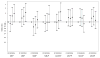
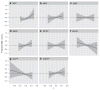
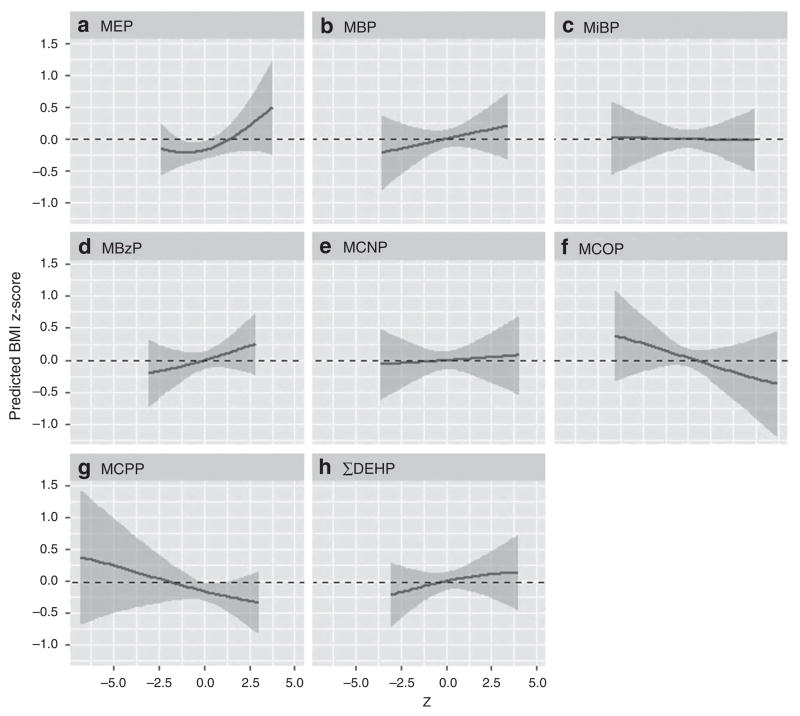
Metabolites of diethyl phthalate (DEP), di-n-butyl phthalate (DBP), butyl benzyl phthalate, and di(2-ethylhexyl) phthalate (DEHP) were positively associated with BMI z-score, waist circumference z-score, and percent body fat at multiple ages. At age 12, we observed increased odds of being overweight/obese with each doubling of prenatal concentrations of DEP (odds ratio = 1.3; 95% confidence intervals: 1.1, 1.4), DBP (1.2; 1.0, 1.4), and DEHP (1.3; 1.0, 1.6) metabolites. Results were similar in boys and girls except for DBP metabolites and the non-specific metabolite mono-(3-carbox-ypropyl) phthalate, which showed positive associations only in boys.
CONCLUSION
In utero exposure to certain phthalates is associated with increased BMI and risk for overweight/obesity in childhood.
-
Subjects:
-
Source:Pediatr Res. 82(3):405-415.
-
Pubmed ID:28426647
-
Pubmed Central ID:PMC5581502
-
Document Type:
-
Funding:
-
Volume:82
-
Issue:3
-
Collection(s):
-
Main Document Checksum:urn:sha256:9d38c268f9a26262c51e36a10d799b975c55e30dea0e4091418733cb9cb957cd
-
Download URL:
-
File Type:
 [PDF
- 746.39 KB
]
[PDF
- 746.39 KB
]
Supporting Files


File Language:
English
 Was this page helpful?
 Found an issue?

CDC STACKS serves as an archival repository of CDC-published products including
scientific findings,
journal articles, guidelines, recommendations, or other public health information authored or
co-authored by CDC or funded partners.
As a repository, CDC STACKS retains documents in their original published format to ensure public access to scientific information.
As a repository, CDC STACKS retains documents in their original published format to ensure public access to scientific information.
You May Also Like
COLLECTION
CDC Public Access