


National assessment of HPV and Pap tests: Changes in cervical cancer screening, National Health Interview Survey
Supporting Files

-
May 11 2017
-
File Language:
English
Details
-
Alternative Title:Prev Med
-
Personal Author:
-
Description:Background
Major organizations recommend cytology screening (Pap test) every 3 years for women aged 21–65; women aged 30 to 65 have the option of adding the HPV test (co-test) every 5 years. We examined national percentages of cervical cancer screening, and we examined use of co-testing as an option for screening.
Methods
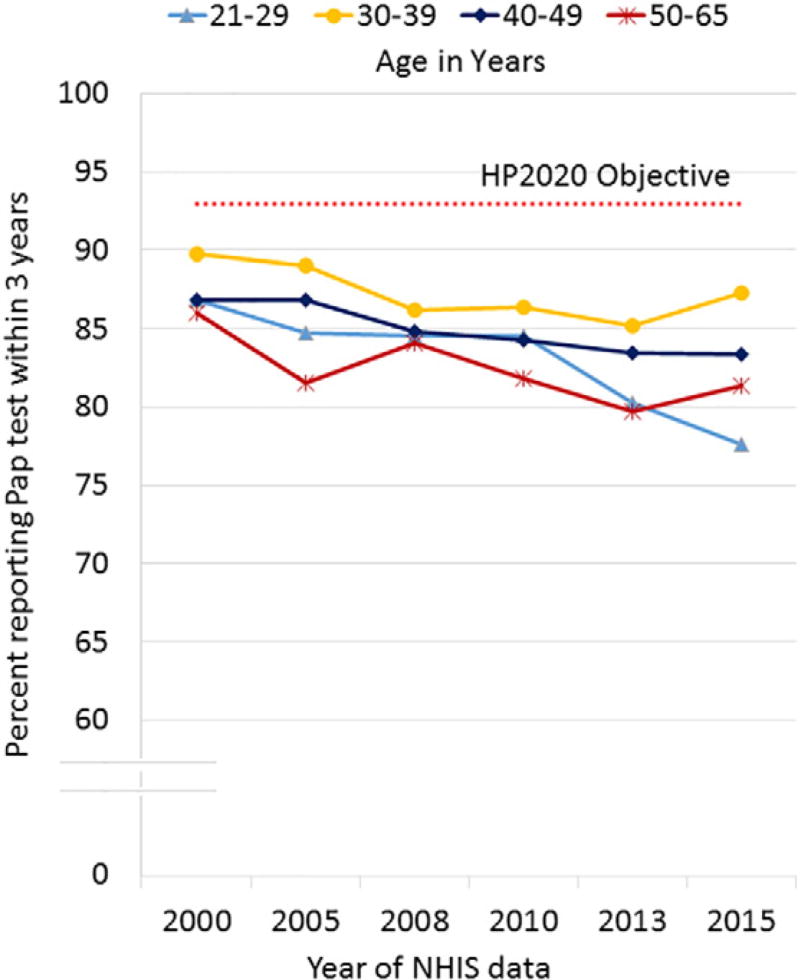
We used 2015 U.S. National Health Interview Survey (NHIS) data to examine recent cervical cancer screening (Pap test within 3 years among women aged 21–65without a hysterectomy; N = 10,596) and co-testing (N = 9,125). We also conducted a multivariable analysis to determine odds of having had a Pap test or co-test by demographic variables. To evaluate changes in screening over time, we examined Pap testing during the years 2000, 2005, 2008, 2010, 2013 and 2015. Analysis completed in Atlanta, GA during 2016.
Results
Overall, 81.1% of eligible women reported having a Pap test within 3 years; percentages declined over time among all age groups. An estimated 14 million women aged 21–65 had not been screened within the past 3 years. Recent immigrants to the United States, women without insurance, and women without a usual source of healthcare had lower odds of being up to date with screening. About 1/3 of women up to date on Pap testing reported having a co-test with their most recent Pap test.
Conclusions
Declines in screening among women aged 21–65 are cause for concern. More research is needed on co-testing practices. Provider and patient education efforts may be needed to clarify recommended use of HPV tests.
-
Subjects:
-
Source:Prev Med. 100:243-247.
-
Pubmed ID:28502575
-
Pubmed Central ID:PMC5573169
-
Document Type:
-
Funding:
-
Volume:100
-
Collection(s):
-
Main Document Checksum:urn:sha256:943f5cc1d0562b07b0c14d3167ecb406883876dcd3d23ac41d197ac57c1764fa
-
Download URL:
-
File Type:
 [PDF
- 294.51 KB
]
[PDF
- 294.51 KB
]
Supporting Files


File Language:
English
ON THIS PAGE

CDC STACKS serves as an archival repository of CDC-published products including
scientific findings,
journal articles, guidelines, recommendations, or other public health information authored or
co-authored by CDC or funded partners.
As a repository, CDC STACKS retains documents in their original published format to ensure public access to scientific information.
As a repository, CDC STACKS retains documents in their original published format to ensure public access to scientific information.
You May Also Like
COLLECTION
CDC Public Access