



Early Life Bisphenol A Exposure and Neurobehavior at 8 Years of Age: Identifying Windows of Heightened Vulnerability
Supporting Files

-
Jul 29 2017
-
Available in CDC Stacks on October 01, 2018, 12:00 AM
File Language:
English
Details
-
Alternative Title:Environ Int
-
Personal Author:
-
Description:Background
Early life BPA exposure could affect neurobehavior, but few studies have investigated whether there are developmental periods when the fetus or child is more vulnerable to these potential effects.
Objectives
We explored windows of vulnerability to BPA exposure in a multiethnic cohort of 228 mothers and their children from Cincinnati, Ohio.
Methods
We measured urinary BPA concentrations at up to two prenatal and six postnatal time points from the 2nd trimester of pregnancy until the child was age 8 years. At age 8 years, we administered the Behavioral Assessment System for Children-2 (BASC-2), Behavior Rating Inventory of Executive Function, and Wechsler Intelligence Scale for Children-IV. We estimated covariate-adjusted differences in composite scores from each instrument using a multiple informant model designed to identify heightened windows of vulnerability.
Results
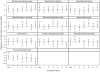
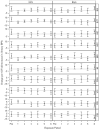
Among all children, there was not strong evidence that the associations between BPA and neurobehavior varied by the timing of exposure (Visit × BPA p-values=0.16). However, child sex modified the associations of repeated BPA measures with BASC-2 scores (Visit × Sex × BPA p-values=0.02–0.23). For example, each 10-fold increase in prenatal BPA was associated with more externalizing behaviors in girls (β=6.2, 95% CI: 0.8, 11.6), but not boys (β=−0.8, 95% CI: −5.0, 3.4). In contrast, a 10-fold increase in 8-year BPA was associated with more externalizing behaviors in boys (β=3.9, 95% CI: 0.6, 7.2), but not girls (β=0.3, 95% CI: −3.5, 4.1).
Conclusions
We found that sex-dependent associations between BPA and child neurobehavior may depend on the timing of BPA exposure. -
Subjects:
- Article
- Bisphenol A
- children
- neurodevelopment
- epidemiology
- Benzhydryl Compounds
- Child
- Child Behavior
- Child, Preschool
- Cohort Studies
- Endocrine Disruptors
- Environmental Monitoring
- Environmental Pollutants
- Female
- Humans
- Infant
- Male
- Mothers
- Phenols
- Pregnancy
- Prenatal Exposure Delayed Effects
- Time Factors
-
Source:Environ Int. 107:258-265.
-
Pubmed ID:28764921
-
Pubmed Central ID:PMC5567845
-
Document Type:
-
Funding:
-
Volume:107
-
Download URL:
-
File Type:
 [PDF - 558.06 KB]
 -
Collection(s):
-
Main Document Checksum:urn:sha256:2f8f972d5212d563374077738aaac2e3232f650662cf5ddca72b516d423a43b4
Supporting Files


File Language:
English
 Was this page helpful?
 Found an issue?



CDC STACKS serves as an archival repository of CDC-published products including
scientific findings, journal articles, guidelines, recommendations, or other public health information authored or
co-authored by CDC or funded partners.
As a repository, CDC STACKS retains documents in their original published format to ensure public access to scientific information.
As a repository, CDC STACKS retains documents in their original published format to ensure public access to scientific information.
You May Also Like
COLLECTION
CDC Public Access