


Genome-wide association study of glioma subtypes identifies specific differences in genetic susceptibility to glioblastoma and non-glioblastoma tumors
Supporting Files

-
March 27 2017
-
File Language:
English
Details
-
Alternative Title:Nat Genet
-
Personal Author:Melin, Beatrice S ; Barnholtz-Sloan, Jill S ; Wrensch, Margaret R ; Johansen, Christoffer ; Il’yasova, Dora ; Kinnersley, Ben ; Ostrom, Quinn T ; Labreche, Karim ; Chen, Yanwen ; Armstrong, Georgina ; Liu, Yanhong ; Eckel-Passow, Jeanette E ; Decker, Paul A ; Labussière, Marianne ; Idbaih, Ahmed ; Hoang-Xuan, Khe ; Di Stefano, Anna-Luisa ; Mokhtari, Karima ; Delattre, Jean-Yves ; Broderick, Peter ; Galan, Pilar ; Gousias, Konstantinos ; Schramm, Johannes ; Schoemaker, Minouk J ; Fleming, Sarah J ; Herms, Stefan ; Heilmann, Stefanie ; Nöthen, Markus M ; Wichmann, Heinz-Erich ; Schreiber, Stefan ; Swerdlow, Anthony ; Lathrop, Mark ; Simon, Matthias ; Sanson, Marc ; Andersson, Ulrika ; Rajaraman, Preetha ; Chanock, Stephen ; Linet, Martha ; Wang, Zhaoming ; Yeager, Meredith ; Wiencke, John K ; Hansen, Helen ; McCoy, Lucie ; Rice, Terri ; Kosel, Matthew L ; Sicotte, Hugues ; Amos, Christopher I ; Bernstein, Jonine L ; Davis, Faith ; Lachance, Dan ; Lau, Ching ; Merrell, Ryan T ; Shildkraut, Joellen ; Ali-Osman, Francis ; Sadetzki, Siegal ; Scheurer, Michael ; Shete, Sanjay ; Lai, Rose K ; Claus, Elizabeth B ; Olson, Sara H ; Jenkins, Robert B ; Houlston, Richard S ; Bondy, Melissa L
-
Corporate Authors:
-
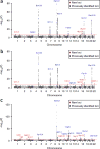
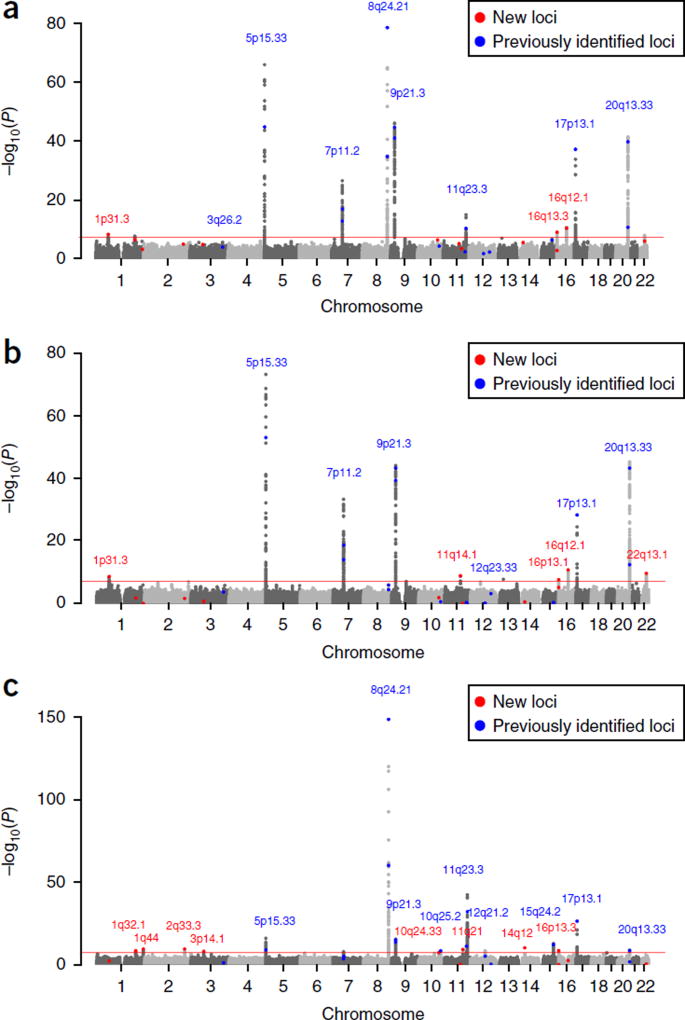
Description:Genome-wide association studies (GWAS) have transformed our understanding of glioma susceptibility, but individual studies have had limited power to identify risk loci. We performed a meta-analysis of existing GWAS and two new GWAS, which totaled 12,496 cases and 18,190 controls. We identified five new loci for glioblastoma (GBM) at 1p31.3 (rs12752552; P = 2.04 × 10|, odds ratio (OR) = 1.22), 11q14.1 (rs11233250; P = 9.95 × 10|, OR = 1.24), 16p13.3 (rs2562152; P = 1.93 × 10|, OR = 1.21), 16q12.1 (rs10852606; P = 1.29 × 10|, OR = 1.18) and 22q13.1 (rs2235573; P = 1.76 × 10|, OR = 1.15), as well as eight loci for non-GBM tumors at 1q32.1 (rs4252707; P = 3.34 × 10|, OR = 1.19), 1q44 (rs12076373; P = 2.63 × 10|, OR = 1.23), 2q33.3 (rs7572263; P = 2.18 × 10|, OR = 1.20), 3p14.1 (rs11706832; P = 7.66 × 10|, OR = 1.15), 10q24.33 (rs11598018; P = 3.39 × 10|, OR = 1.14), 11q21 (rs7107785; P = 3.87 × 10|, OR = 1.16), 14q12 (rs10131032; P = 5.07 × 10|, OR = 1.33) and 16p13.3 (rs3751667; P = 2.61 × 10|, OR = 1.18). These data substantiate that genetic susceptibility to GBM and non-GBM tumors are highly distinct, which likely reflects different etiology.
-
Subjects:
-
Source:Nat Genet. 49(5):789-794
-
Pubmed ID:28346443
-
Pubmed Central ID:PMC5558246
-
Document Type:
-
Funding:R01 CA139020/CA/NCI NIH HHS/United States ; P30 CA016672/CA/NCI NIH HHS/United States ; HHSN261201000140C/CA/NCI NIH HHS/United States ; P50 CA108961/CA/NCI NIH HHS/United States ; RC1 NS068222/NS/NINDS NIH HHS/United States ; K07 CA181480/CA/NCI NIH HHS/United States ; R01 CA126831/CA/NCI NIH HHS/United States ; UL1 RR024131/RR/NCRR NIH HHS/United States ; P30 CA023108/CA/NCI NIH HHS/United States ; P30 CA008748/CA/NCI NIH HHS/United States ; P30 CA125123/CA/NCI NIH HHS/United States ; P50 CA097257/CA/NCI NIH HHS/United States ; R01 CA052689/CA/NCI NIH HHS/United States ; P30 CA015083/CA/NCI NIH HHS/United States ; HHSN261201000035I/CA/NCI NIH HHS/United States ; HHSN261201000035C/PC/NCI NIH HHS/United States ; HHSN261201000034C/CA/NCI NIH HHS/United States ; U58 DP003862/DP/NCCDPHP CDC HHS/United States ; WT_/Wellcome Trust/United Kingdom
-
Volume:49
-
Issue:5
-
Collection(s):
-
Main Document Checksum:urn:sha256:b333ca18a48a2a21ae38888aecac6d81ac550fac3ccfb1d41c1f2b7a6c5117c3
-
Download URL:
-
File Type:
 [PDF
- 1.02 MB
]
[PDF
- 1.02 MB
]
Supporting Files


File Language:
English
ON THIS PAGE


CDC STACKS serves as an archival repository of CDC-published products including
scientific findings,
journal articles, guidelines, recommendations, or other public health information authored or
co-authored by CDC or funded partners.
As a repository, CDC STACKS retains documents in their original published format to ensure public access to scientific information.
As a repository, CDC STACKS retains documents in their original published format to ensure public access to scientific information.
You May Also Like
COLLECTION
CDC Public Access