



Polyfluoroalkyl substance exposure in the Mid-Ohio River Valley, 1991–2012
Supporting Files

-
9 2017 ; 9-2017
-
Available in CDC Stacks on 2018-09-01T00:00:00Z
File Language:
English
Details
-
Alternative Title:Environ Pollut
-
Personal Author:
-
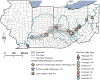
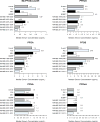
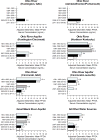
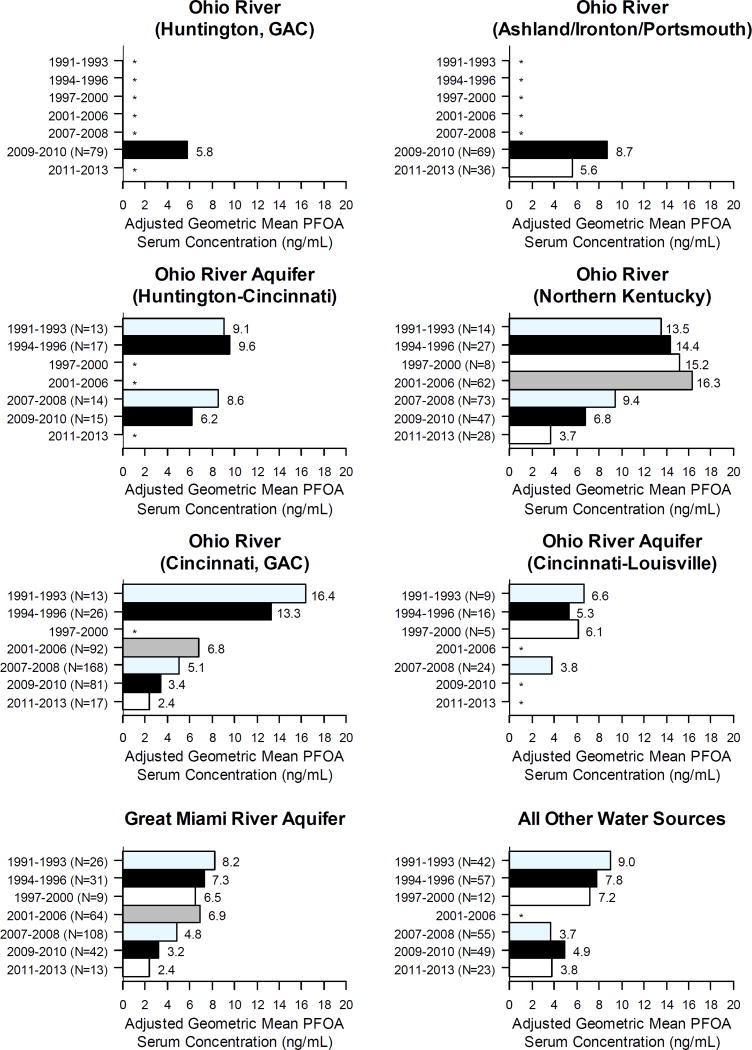
Description:Background ; Industrial discharges of perfluorooctanoic acid (PFOA) to the Ohio River, contaminating water systems near Parkersburg, WV, were previously associated with nearby residents’ serum PFOA concentrations above US general population medians. Ohio River PFOA concentrations downstream are elevated, suggesting Mid-Ohio River Valley residents are exposed through drinking water. ; Objectives ; Quantify PFOA and 10 other per- and polyfluoroalkyl substances (PFAS) in Mid-Ohio River Valley resident sera collected between 1991 and 2013 and determine whether the Ohio River and Ohio River Aquifer are exposure sources. ; Methods ; We measured eleven PFAS in 1608 sera from 931 participants. Serum PFOA concentration and water source associations were assessed using linear mixed-effects models. We estimated between-sample serum PFOA using one-compartment pharmacokinetics for participants with multiple samples. ; Results ; In serum samples collected as early as 1991, PFOA (median=7.6ng/mL) was detected in 99.9% of sera; 47% had concentrations greater than US population 95th percentiles. Five other PFAS were detected in greater than 82% of samples; median other PFAS concentrations were similar to the US general population. Serum PFOA was significantly associated with water source, sampling year, age at sampling, tap water consumption, pregnancy, gravidity and breastfeeding. Serum PFOA was 40–60% lower with granular activated carbon (GAC) use. Repeated measurements and pharmacokinetics suggest serum PFOA peaked 2000–2006 for participants using water without GAC treatment; where GAC was used, serum PFOA concentrations decreased from 1991 to 2012. ; Conclusions ; Mid-Ohio River Valley residents appear to have PFOA, but not other PFAS, serum concentrations above US population levels. Drinking water from the Ohio River and Ohio River Aquifer, primarily contaminated by industrial discharges 209–666 kilometers upstream, is likely the primary exposure source. GAC treatment of drinking water mitigates, but does not eliminate, PFOA exposure.
-
Subjects:
-
Keywords:
-
Source:Environ Pollut. 228:50-60
-
Pubmed ID:28505513
-
Pubmed Central ID:PMC5540235
-
Document Type:
-
Funding:U01 ES012770/ES/NIEHS NIH HHSUnited States/ ; R21 ES017176/ES/NIEHS NIH HHSUnited States/ ; P30 ES006096/ES/NIEHS NIH HHSUnited States/ ; CC999999/Intramural CDC HHSUnited States/ ; U01 ES019453/ES/NIEHS NIH HHSUnited States/ ; U01 ES019457/ES/NIEHS NIH HHSUnited States/ ; T32 ES010957/ES/NIEHS NIH HHSUnited States/ ; UL1 RR026314/RR/NCRR NIH HHSUnited States/
-
Volume:228
-
Download URL:
-
File Type:
 [PDF - 1.67 MB]
 -
Collection(s):
-
Main Document Checksum:urn:sha-512:94da816036830c3077dca54d3f11636395236240482efc01c6fbc57e6f47d0042892913e5146aeb92055734a914922ed61fb24915333ba7b86261af2f5470cba
Supporting Files


File Language:
English
 Was this page helpful?
 Found an issue?




CDC STACKS serves as an archival repository of CDC-published products including
scientific findings, journal articles, guidelines, recommendations, or other public health information authored or
co-authored by CDC or funded partners.
As a repository, CDC STACKS retains documents in their original published format to ensure public access to scientific information.
As a repository, CDC STACKS retains documents in their original published format to ensure public access to scientific information.
You May Also Like
COLLECTION
CDC Public Access