


Added Value of Next-Generation Sequencing for Multilocus Sequence Typing Analysis of a Pneumocystis jirovecii Pneumonia Outbreak1
Supporting Files
Public Domain

-
Aug 2017
-
File Language:
English
Details
-
Alternative Title:Emerg Infect Dis
-
Personal Author:Charpentier, Elena ; Garnaud, Cécile ; Wintenberger, Claire ; Bailly, Sébastien ; Murat, Jean-Benjamin ; Rendu, John ; Pavese, Patricia ; Drouet, Thibault ; Augier, Caroline ; Malvezzi, Paolo ; Thiébaut-Bertrand, Anne ; Mallaret, Marie-Reine ; Epaulard, Olivier ; Cornet, Muriel ; Larrat, Sylvie ; Maubon, Danièle
-
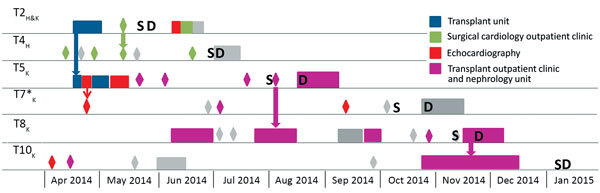
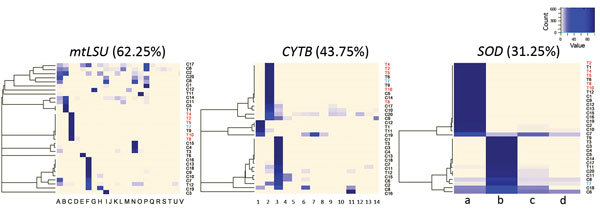
Description:Pneumocystis jirovecii is a major threat for immunocompromised patients, and clusters of pneumocystis pneumonia (PCP) have been increasingly described in transplant units during the past decade. Exploring an outbreak transmission network requires complementary spatiotemporal and strain-typing approaches. We analyzed a PCP outbreak and demonstrated the added value of next-generation sequencing (NGS) for the multilocus sequence typing (MLST) study of P. jirovecii strains. Thirty-two PCP patients were included. Among the 12 solid organ transplant patients, 5 shared a major and unique genotype that was also found as a minor strain in a sixth patient. A transmission map analysis strengthened the suspicion of nosocomial acquisition of this strain for the 6 patients. NGS-MLST enables accurate determination of subpopulation, which allowed excluding other patients from the transmission network. NGS-MLST genotyping approach was essential to deciphering this outbreak. This innovative approach brings new insights for future epidemiologic studies on this uncultivable opportunistic fungus.
-
Subjects:
-
Source:Emerg Infect Dis. 23(8):1237-1245.
-
Pubmed ID:28726611
-
Pubmed Central ID:PMC5547796
-
Document Type:
-
Volume:23
-
Issue:8
-
Collection(s):
-
Main Document Checksum:urn:sha256:36bcc1ba5dec657871e33442f0840cb7a3d0b39e9415f4d40f7c927f894cf4e8
-
Download URL:
-
File Type:
 [PDF
- 1.24 MB
]
[PDF
- 1.24 MB
]
Supporting Files


File Language:
English
ON THIS PAGE

CDC STACKS serves as an archival repository of CDC-published products including
scientific findings,
journal articles, guidelines, recommendations, or other public health information authored or
co-authored by CDC or funded partners.
As a repository, CDC STACKS retains documents in their original published format to ensure public access to scientific information.
As a repository, CDC STACKS retains documents in their original published format to ensure public access to scientific information.
You May Also Like
COLLECTION
Emerging Infectious Diseases