


Weight History, All-Cause and Cause-Specific Mortality in Three Prospective Cohort Studies
Supporting Files

-
5 02 2017
-
File Language:
English
Details
-
Alternative Title:Ann Intern Med
-
Personal Author:
-
Description:BACKGROUND
The relationship between body mass index (BMI) and mortality remains controversial.
OBJECTIVE
To investigate the relationship between maximum BMI over 16 years and subsequent mortality.
DESIGN
Three prospective cohort studies.
SETTING
Nurses’ Health Study I and II, Health Professionals Follow-up Study.
PARTICIPANTS
225,072 men and women accruing 32,571 deaths over a mean of 12.3 years of follow-up.
MEASUREMENTS
Maximum BMI over 16 years of weight history and all-cause and cause-specific mortality.
RESULTS
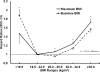
Maximum BMIs in the overweight (25.0 to 29.9 kg/m2) (multivariate hazard ratio (HR), 1.06; 95% confidence interval (CI), 1.03 – 1.08), obese I (30.0 to 34.9 kg/m2), (HR, 1.24; 95% CI, 1.20 – 1.29), and obese II (≥ 35.0 kg/m2) (HR, 1.73; 95% CI, 1.66 – 1.80) categories were associated with increases in risk of all-cause mortality. The pattern of excess risk with a maximum BMI above normal weight was maintained across strata defined by smoking status, sex, and age, but the excess was greatest among those <70 years old and never smokers. In contrast, a significant inverse association between overweight and mortality (HR, 0.96; 95% CI, 0.94 – 0.99) was observed when BMI was defined using a single baseline measurement. Maximum overweight was also associated with increased cause-specific mortality, including deaths from cardiovascular diseases and coronary heart disease.
LIMITATIONS
Residual confounding and misclassification.
CONCLUSIONS
The paradoxical association between overweight and mortality is reversed in analyses incorporating weight history. Maximum BMI may be a useful metric to minimize reverse causation bias associated with a single baseline BMI assessment.
-
Subjects:
-
Source:Ann Intern Med. 166(9):613-620
-
Pubmed ID:28384755
-
Pubmed Central ID:PMC5518318
-
Document Type:
-
Funding:R03 SH000037/SH/NCHS CDC HHSUnited States/ ; UM1 CA176726/CA/NCI NIH HHSUnited States/ ; R01 HL034594/HL/NHLBI NIH HHSUnited States/ ; UM1 CA186107/CA/NCI NIH HHSUnited States/ ; R01 AG040212/AG/NIA NIH HHSUnited States/ ; UM1 CA167552/CA/NCI NIH HHSUnited States/ ; R01 HL035464/HL/NHLBI NIH HHSUnited States/ ; R01 HL088521/HL/NHLBI NIH HHSUnited States/
-
Volume:166
-
Issue:9
-
Collection(s):
-
Main Document Checksum:urn:sha256:0fbf343a15e2feebfd8780553e2a2945c196e36ac900e582d0899f5a1a3ed425
-
Download URL:
-
File Type:
 [PDF
- 233.90 KB
]
[PDF
- 233.90 KB
]
Supporting Files


File Language:
English
ON THIS PAGE



CDC STACKS serves as an archival repository of CDC-published products including
scientific findings,
journal articles, guidelines, recommendations, or other public health information authored or
co-authored by CDC or funded partners.
As a repository, CDC STACKS retains documents in their original published format to ensure public access to scientific information.
As a repository, CDC STACKS retains documents in their original published format to ensure public access to scientific information.
You May Also Like
COLLECTION
CDC Public Access