



Cumulative Risk Exposure and Waist Circumference in Preschool-Aged Children: The Mediating Role of Television and Moderating Role of Sex
Supporting Files

-
8 2017 ; 8-2017
-
Available in CDC Stacks on 2018-08-01T00:00:00Z
File Language:
English
Details
-
Alternative Title:Ann Behav Med
-
Personal Author:
-
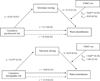
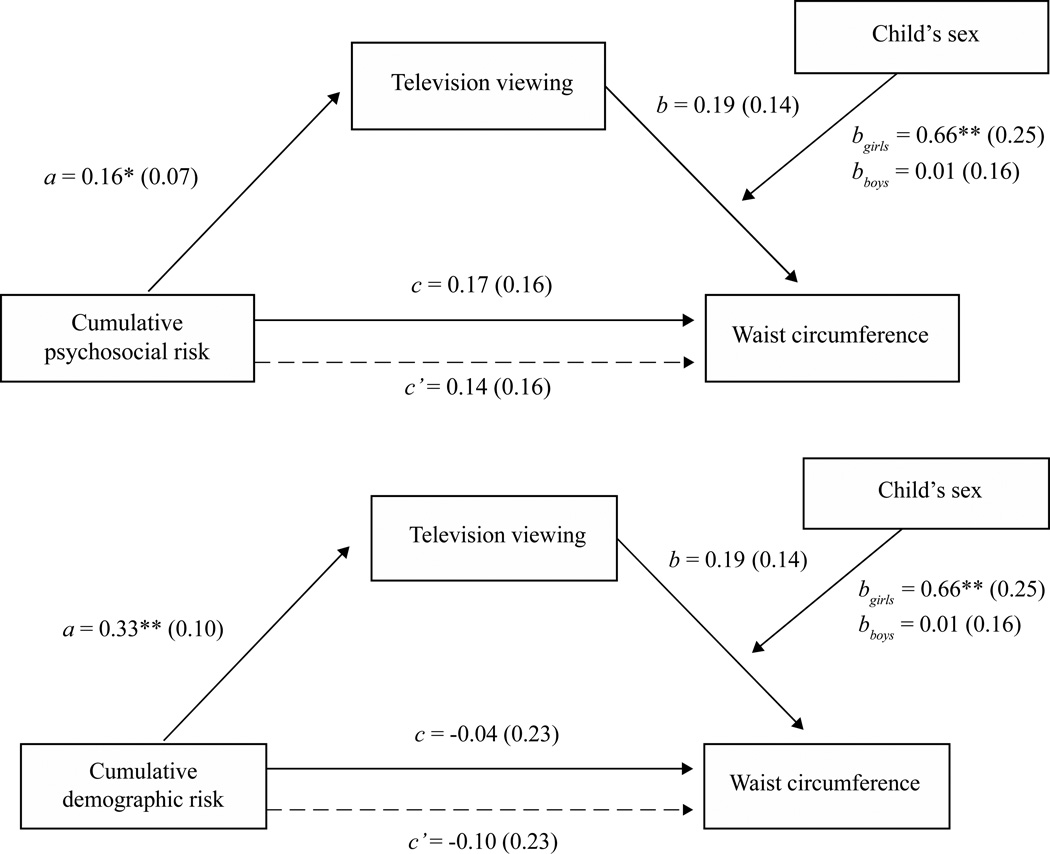
Description:Background ; Children exposed to multiple stressors are more likely to be overweight, but little is known about the mechanisms explaining this association. ; Purpose ; This cross-sectional study examined whether children exposed to multiple stressors had higher waist circumference, and whether this association was mediated through children’s television time. ; Methods ; Participants were 319 parent-child dyads. Children were 2–5 years old and had at least one overweight parent (BMI ≥ 25 kg/m2). Data were collected at baseline of a larger childhood obesity prevention study and included information on psychosocial stressors (e.g., parenting stress), demographic stressors (e.g., low income), children’s television time, and children’s waist circumference. Two cumulative risk scores were created by summing stressors in each domain (demographic and psychosocial). Mediation and moderated mediation analyses were conducted. ; Results ; Indirect effects of both cumulative risk scores on waist circumference through television time were not significant; however, moderated mediation analyses found significant moderation by gender. The indirect effects of both risk scores on waist circumference through television time were significant and positive for girls, but near-zero for boys. ; Conclusions ; Reducing television time should be explored as a strategy for buffering against the negative health effects of exposure to multiple stressors among girls. Longitudinal and intervention research is needed to confirm these results, and to identify mediating factors between cumulative risk and body weight among boys.
-
Subjects:
-
Keywords:
-
Source:Ann Behav Med. 51(4):489-499
-
Pubmed ID:28097514
-
Pubmed Central ID:PMC5513794
-
Document Type:
-
Funding:U48 DP005017/DP/NCCDPHP CDC HHSUnited States/ ; U48-DP005017/CC/CDC HHSUnited States/ ; T32 HD007168/HD/NICHD NIH HHSUnited States/ ; R01 1HL091093/HL/NHLBI NIH HHSUnited States/ ; R01 HL091093/HL/NHLBI NIH HHSUnited States/ ; P2C HD050924/HD/NICHD NIH HHSUnited States/ ; U48DP005017/ACL/ACL HHSUnited States/
-
Volume:51
-
Issue:4
-
Download URL:
-
File Type:
 [PDF - 849.99 KB]
 -
Collection(s):
-
Main Document Checksum:urn:sha256:4c2b1699f4f2ba9c60238cf44ea82b977284a76215cdb7323f4a83bb409437b3
Supporting Files


File Language:
English
 Was this page helpful?
 Found an issue?

CDC STACKS serves as an archival repository of CDC-published products including
scientific findings, journal articles, guidelines, recommendations, or other public health information authored or
co-authored by CDC or funded partners.
As a repository, CDC STACKS retains documents in their original published format to ensure public access to scientific information.
As a repository, CDC STACKS retains documents in their original published format to ensure public access to scientific information.
You May Also Like
COLLECTION
CDC Public Access