



Effects of Zika Virus Strain and Aedes Mosquito Species on Vector Competence
Supporting Files
Public Domain

-
Jul 15 2017
Details
-
Alternative Title:Emerg Infect Dis
-
Personal Author:
-
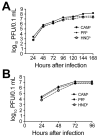
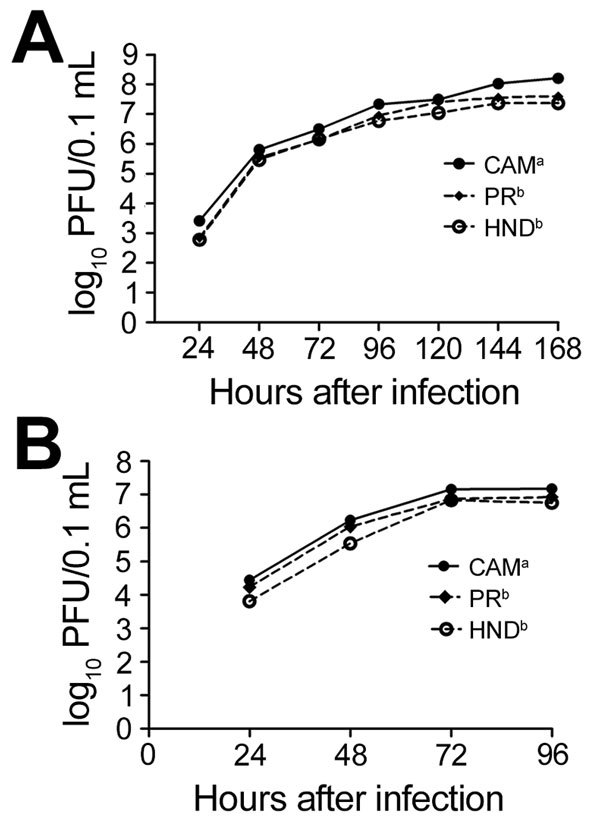
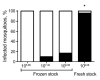
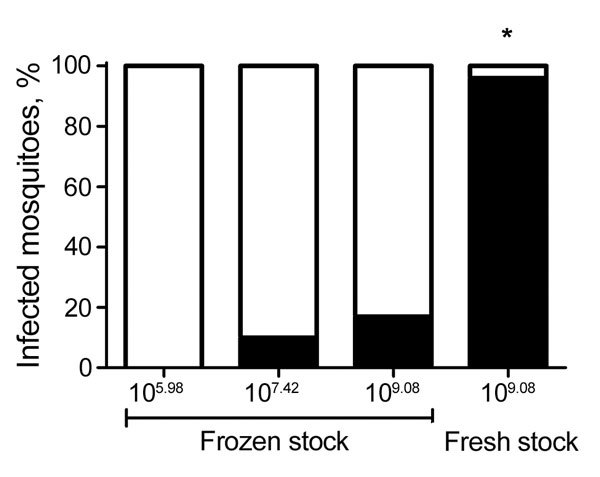
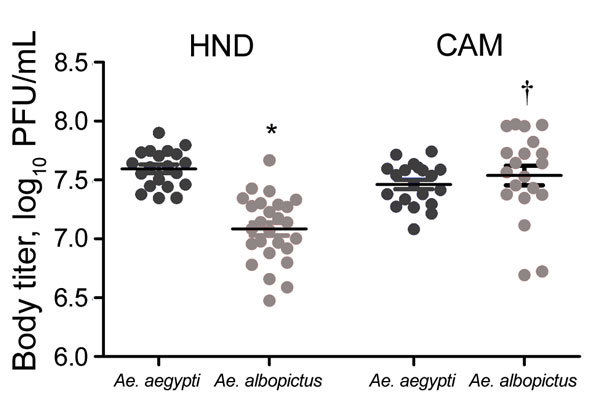
Description:In the Western Hemisphere, Zika virus is thought to be transmitted primarily by Aedes aegypti mosquitoes. To determine the extent to which Ae. albopictus mosquitoes from the United States are capable of transmitting Zika virus and the influence of virus dose, virus strain, and mosquito species on vector competence, we evaluated multiple doses of representative Zika virus strains in Ae. aegypti and Ae. albopictus mosquitoes. Virus preparation (fresh vs. frozen) significantly affected virus infectivity in mosquitoes. We calculated 50% infectious doses to be 6.1-7.5 log 10 PFU/mL; minimum infective dose was 4.2 log 10 PFU/mL. Ae. albopictus mosquitoes were more susceptible to infection than Ae. aegypti mosquitoes, but transmission efficiency was higher for Ae. aegypti mosquitoes, indicating a transmission barrier in Ae. albopictus mosquitoes. Results suggest that, although Zika virus transmission is relatively inefficient overall and dependent on virus strain and mosquito species, Ae. albopictus mosquitoes could become major vectors in the Americas.
-
Subjects:
-
Source:Emerg Infect Dis. 23(7):1110-1117.
-
Pubmed ID:28430564
-
Pubmed Central ID:PMC5512477
-
Document Type:
-
Volume:23
-
Issue:7
-
Download URL:
-
File Type:
 [PDF - 1.12 MB]
 -
Collection(s):
-
Main Document Checksum:urn:sha256:76e08956d93fcd08d308e85de988f0f83ee984a93bd9bba2fffdd5a5cacdff08
Supporting Files


 Was this page helpful?
 Found an issue?




CDC STACKS serves as an archival repository of CDC-published products including
scientific findings, journal articles, guidelines, recommendations, or other public health information authored or
co-authored by CDC or funded partners.
As a repository, CDC STACKS retains documents in their original published format to ensure public access to scientific information.
As a repository, CDC STACKS retains documents in their original published format to ensure public access to scientific information.
You May Also Like
COLLECTION
Emerging Infectious Diseases