


Neurocognitive function in HIV-infected persons with asymptomatic cryptococcal antigenemia: a comparison of three prospective cohorts
Supporting Files
Public Domain

-
Jun 12 2017
-
File Language:
English
Details
-
Alternative Title:BMC Neurol
-
Personal Author:Montgomery, Martha P. ; Nakasujja, Noeline ; Morawski, Bozena M. ; Rajasingham, Radha ; Rhein, Joshua ; Nalintya, Elizabeth ; Williams, Darlisha A. ; Huppler Hullsiek, Kathy ; Kiragga, Agnes ; Rolfes, Melissa A. ; Donahue Carlson, Renee ; Bahr, Nathan C. ; Birkenkamp, Kate E. ; Manabe, Yukari C. ; Bohjanen, Paul R. ; Kaplan, Jonathan E. ; Kambugu, Andrew ; Meya, David B. ; Boulware, David R.
-
Corporate Authors:
-
Description:Background
HIV-infected persons with detectable cryptococcal antigen (CrAg) in blood have increased morbidity and mortality compared with HIV-infected persons who are CrAg-negative. This study examined neurocognitive function among persons with asymptomatic cryptococcal antigenemia.
Methods
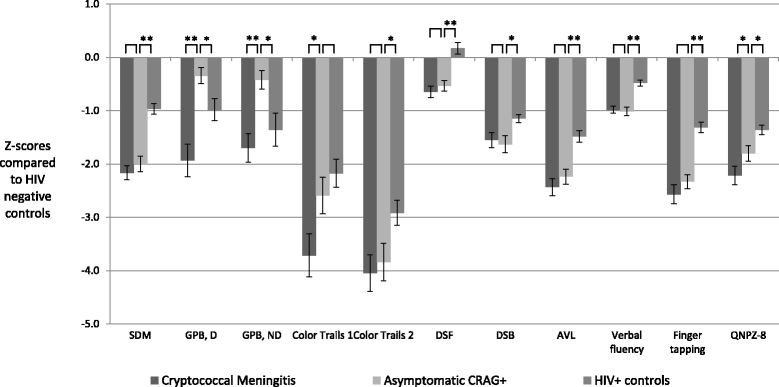
Participants from three prospective HIV cohorts underwent neurocognitive testing at the time of antiretroviral therapy (ART) initiation. Cohorts included persons with cryptococcal meningitis (N = 90), asymptomatic CrAg + (N = 87), and HIV-infected persons without central nervous system infection (N = 125). Z-scores for each neurocognitive test were calculated relative to an HIV-negative Ugandan population with a composite quantitative neurocognitive performance Z-score (QNPZ-8) created from eight tested domains. Neurocognitive function was measured pre-ART for all three cohorts and additionally after 4 weeks of ART (and 6 weeks of pre-emptive fluconazole) treatment among asymptomatic CrAg + participants.
Results
Cryptococcal meningitis and asymptomatic CrAg + participants had lower median CD4 counts (17 and 26 cells/μL, respectively) than the HIV-infected control cohort (233 cells/μL) as well as lower Karnofsky performance status (60 and 70 vs. 90, respectively). The composite QNPZ-8 for asymptomatic CrAg + (−1.80 Z-score) fell between the cryptococcal meningitis cohort (−2.22 Z-score, P = 0.02) and HIV-infected controls (−1.36, P = 0.003). After four weeks of ART and six weeks of fluconazole, the asymptomatic CrAg + cohort neurocognitive performance improved (−1.0 Z-score, P < 0.001).
Conclusion
Significant deficits in neurocognitive function were identified in asymptomatic CrAg + persons with advanced HIV/AIDS even without signs or sequelae of meningitis. Neurocognitive function in this group improves over time after initiation of pre-emptive fluconazole treatment and ART, but short term adherence support may be necessary.
Electronic supplementary material
The online version of this article (doi:10.1186/s12883-017-0878-2) contains supplementary material, which is available to authorized users.
-
Subjects:
-
Source:BMC Neurol. 17.
-
Pubmed ID:28606065
-
Pubmed Central ID:PMC5469183
-
Document Type:
-
Volume:17
-
Collection(s):
-
Main Document Checksum:urn:sha-512:ae90ed2ea9a9c2ac8f9d15a835ed220ed3c08c32e9178f0a05ce103b0b64f91c9dbb41e40ecdc04cdca9d49f6bfa9be330d524ce0b140ae0cc1548eafe3b8235
-
Download URL:
-
File Type:
 [PDF
- 525.09 KB
]
[PDF
- 525.09 KB
]


File Language:
English
ON THIS PAGE


CDC STACKS serves as an archival repository of CDC-published products including
scientific findings,
journal articles, guidelines, recommendations, or other public health information authored or
co-authored by CDC or funded partners.
As a repository, CDC STACKS retains documents in their original published format to ensure public access to scientific information.
As a repository, CDC STACKS retains documents in their original published format to ensure public access to scientific information.
You May Also Like
COLLECTION
CDC Public Access