


Chest Radiograph Findings in Childhood Pneumonia Cases From the Multisite PERCH Study
Supporting Files
Public Domain

-
Jun 15 2017
-
File Language:
English
Details
-
Alternative Title:Clin Infect Dis
-
Personal Author:Fancourt, Nicholas ; Deloria Knoll, Maria ; Baggett, Henry C. ; Brooks, W. Abdullah ; Feikin, Daniel R. ; Hammitt, Laura L. ; Howie, Stephen R. C. ; Kotloff, Karen L. ; Levine, Orin S. ; Madhi, Shabir A. ; Murdoch, David R. ; Scott, J. Anthony G. ; Thea, Donald M. ; Awori, Juliet O. ; Barger-Kamate, Breanna ; Chipeta, James ; DeLuca, Andrea N. ; Diallo, Mahamadou ; Driscoll, Amanda J. ; Ebruke, Bernard E. ; Higdon, Melissa M. ; Jahan, Yasmin ; Karron, Ruth A. ; Mahomed, Nasreen ; Moore, David P. ; Nahar, Kamrun ; Naorat, Sathapana ; Ominde, Micah Silaba ; Park, Daniel E. ; Prosperi, Christine ; wa Somwe, Somwe ; Thamthitiwat, Somsak ; Zaman, Syed M. A. ; Zeger, Scott L. ; O’Brien, Katherine L.
-
Corporate Authors:
-
Description:Background.
Chest radiographs (CXRs) are frequently used to assess pneumonia cases. Variations in CXR appearances between epidemiological settings and their correlation with clinical signs are not well documented.
Methods.
The Pneumonia Etiology Research for Child Health project enrolled 4232 cases of hospitalized World Health Organization (WHO)–defined severe and very severe pneumonia from 9 sites in 7 countries (Bangladesh, the Gambia, Kenya, Mali, South Africa, Thailand, and Zambia). At admission, each case underwent a standardized assessment of clinical signs and pneumonia risk factors by trained health personnel, and a CXR was taken that was interpreted using the standardized WHO methodology. CXRs were categorized as abnormal (consolidation and/or other infiltrate), normal, or uninterpretable.
Results.
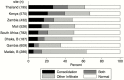
CXRs were interpretable in 3587 (85%) cases, of which 1935 (54%) were abnormal (site range, 35%–64%). Cases with abnormal CXRs were more likely than those with normal CXRs to have hypoxemia (45% vs 26%), crackles (69% vs 62%), tachypnea (85% vs 80%), or fever (20% vs 16%) and less likely to have wheeze (30% vs 38%; all P < .05). CXR consolidation was associated with a higher case fatality ratio at 30-day follow-up (13.5%) compared to other infiltrate (4.7%) or normal (4.9%) CXRs.
Conclusions.
Clinically diagnosed pneumonia cases with abnormal CXRs were more likely to have signs typically associated with pneumonia. However, CXR-normal cases were common, and clinical signs considered indicative of pneumonia were present in substantial proportions of these cases. CXR-consolidation cases represent a group with an increased likelihood of death at 30 days post-discharge.
-
Subjects:
-
Source:Clin Infect Dis. 2017; 64(Suppl 3):S262-S270.
-
Pubmed ID:28575361
-
Pubmed Central ID:PMC5447837
-
Document Type:
-
Name as Subject:
-
Place as Subject:
-
Volume:64
-
Collection(s):
-
Main Document Checksum:urn:sha256:56c52f15434ff9d420429dfc282cc9f3dd87451f2d19047ae4b3f386d1563098
-
Download URL:
-
File Type:
 [PDF
- 428.60 KB
]
[PDF
- 428.60 KB
]
Supporting Files


File Language:
English
ON THIS PAGE



CDC STACKS serves as an archival repository of CDC-published products including
scientific findings,
journal articles, guidelines, recommendations, or other public health information authored or
co-authored by CDC or funded partners.
As a repository, CDC STACKS retains documents in their original published format to ensure public access to scientific information.
As a repository, CDC STACKS retains documents in their original published format to ensure public access to scientific information.
You May Also Like
COLLECTION
CDC Public Access