


Association between mixed rotavirus vaccination types of infants and rotavirus acute gastroenteritis
Supporting Files

-
Aug 29 2015
-
Details
-
Alternative Title:Vaccine
-
Personal Author:
-
Description:Introduction
Rotavirus remains the leading cause of severe diarrhea in children under 5 years worldwide. In the US, Rotarix® (RV1) and RotaTeq® (RV5), have been associated with reductions in and severity of rotavirus disease. Studies have evaluated the impact of RV1 or RV5 but little is known about the impact of incomplete or mixed vaccination upon vaccine effectiveness.
Methods
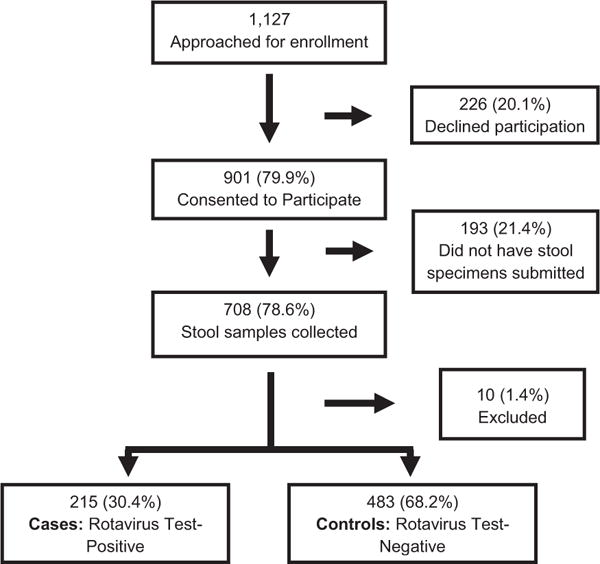
Case control study to examine association of combined RV1 and RV5 and rotavirus acute gastroenteritis, factoring severity of diarrheal disease. Children born after March 1, 2009 with acute gastroenteritis from three pediatric hospitals in Atlanta, Georgia were approached for enrollment. Survey was administered, stool specimen was collected, and vaccination records were obtained.
Results
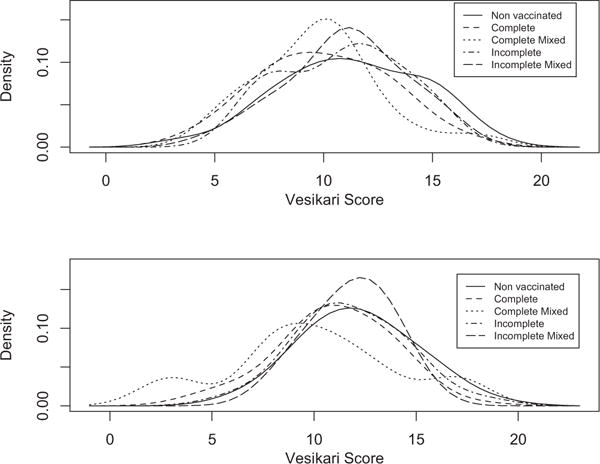
891 of 1127 children with acute gastroenteritis were enrolled. Stool specimens were collected from 708 for rotavirus testing; 215 stool samples tested positively for rotavirus. Children >12 months of age were more likely to have rotavirus. Children categorized with Vesikari score of >11 were almost twice as likely to be rotavirus positive. Prior rotavirus vaccination decreased the mean Vesikari score, p < 0.0001. Children with complete single type vaccination were protected against rotavirus (OR 0.21, 95% CI: 0.14–0.31, p < 0.0001).
Conclusion
Complete rotavirus vaccination with a single vaccine type resulted in protection against rotavirus diarrhea and decrease in severity of rotavirus gastroenteritis. Incomplete rotavirus vaccination either with a single vaccine or mixed vaccination types also provided some protection.
-
Subjects:
-
Source:Vaccine. 33(42):5670-5677.
-
Pubmed ID:26322843
-
Pubmed Central ID:PMC5444377
-
Document Type:
-
Funding:U54 MD007588/MD/NIMHD NIH HHS/United States ; R25 RR017694/RR/NCRR NIH HHS/United States ; G12 RR003034/RR/NCRR NIH HHS/United States ; U0I000312B/PHS HHS/United States ; U50 CK000196/CK/NCEZID CDC HHS/United States ; G12-RR03034/RR/NCRR NIH HHS/United States ; U01CI0000307-05/CI/NCPDCID CDC HHS/United States ; 2R25RR017694-06A1/RR/NCRR NIH HHS/United States ; UL1 RR025008/RR/NCRR NIH HHS/United States ; U01 CI000307/CI/NCPDCID CDC HHS/United States
-
Volume:33
-
Issue:42
-
Collection(s):
-
Main Document Checksum:urn:sha256:f4bc55506d5b24c207011cd01bba21ffa6b73c85a17bf41037349a6a464787a8
-
Download URL:
-
File Type:
 [PDF
- 512.14 KB
]
[PDF
- 512.14 KB
]
Supporting Files


ON THIS PAGE



CDC STACKS serves as an archival repository of CDC-published products including
scientific findings,
journal articles, guidelines, recommendations, or other public health information authored or
co-authored by CDC or funded partners.
As a repository, CDC STACKS retains documents in their original published format to ensure public access to scientific information.
As a repository, CDC STACKS retains documents in their original published format to ensure public access to scientific information.
You May Also Like
COLLECTION
CDC Public Access