



Hemodialyzer Reuse and Gram-Negative Bloodstream Infections
Supporting Files

-
2016/12/07
-
Available in CDC Stacks on 2018-06-01T00:00:00Z
File Language:
English
Details
-
Alternative Title:Am J Kidney Dis
-
Personal Author:Edens, Chris ; Wong, Jacklyn ; Lyman, Meghan ; Rizzo, Kyle ; Nguyen, Duc ; Blain, Michela ; Horwich-Scholefield, Sam ; Moulton-Meissner, Heather ; Epson, Erin ; Rosenberg, Jon ; Patel, Priti R.
-
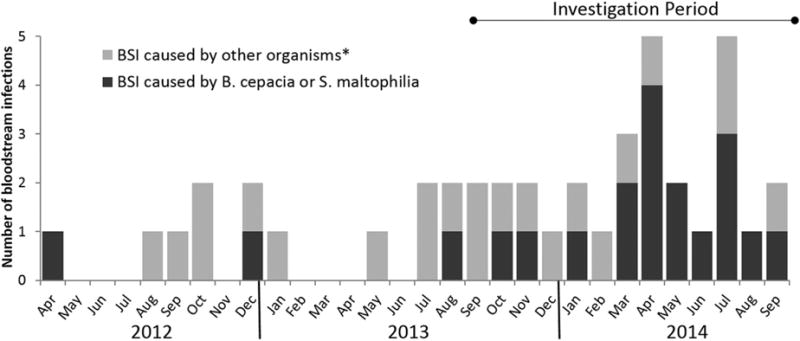
Description:Background ; Clusters of bloodstream infections caused by Burkholderia cepacia and Stenotrophomonas maltophilia are uncommon, but have been previously identified in hemodialysis centers that reprocessed dialyzers for reuse on patients. We investigated an outbreak of bloodstream infections caused by B cepacia and S maltophilia among hemodialysis patients in clinics of a dialysis organization. ; Study Design ; Outbreak investigation, including matched case-control study. ; Setting & Participants ; Hemodialysis patients treated in multiple outpatient clinics owned by a dialysis organization. ; Predictors ; Main predictors were dialyzer reuse, dialyzer model, and dialyzer reprocessing practice. ; Outcomes ; Case patients had a bloodstream infection caused by B cepacia or S maltophilia; controls were patients without infection dialyzed at the same clinic on the same day as a case; results of environmental cultures and organism typing. ; Results ; 17 cases (9 B cepacia and 8 S maltophilia bloodstream infections) occurred in 5 clinics owned by the same dialysis organization. Case patients were more likely to have received hemodialysis with a dialyzer that had been used more than 6 times (matched OR, 7.03; 95% CI, 1.38-69.76) and to have been dialyzed with a specific reusable dialyzer (Model R) with sealed ends (OR, 22.87; 95% CI, 4.49-∞). No major lapses during dialyzer reprocessing were identified that could explain the outbreak. B cepacia was isolated from samples collected from a dialyzer header-cleaning machine from a clinic with cases and was indistinguishable from a patient isolate collected from the same clinic, by pulsed-field gel electrophoresis. Gram-negative bacteria were isolated from 2 reused Model R dialyzers that had undergone the facility's reprocessing procedure. ; Limitations ; Limited statistical power and overmatching; few patient isolates and dialyzers available for testing. ; Conclusions ; This outbreak was likely caused by contamination during reprocessing of reused dialyzers. Results of this and previous investigations demonstrate that exposing patients to reused dialyzers increases the risk for bloodstream infections. To reduce infection risk, providers should consider implementing single dialyzer use whenever possible.
-
Subjects:
-
Source:Am J Kidney Dis. 69(6):726-733.
-
Pubmed ID:27940061
-
Pubmed Central ID:PMC5441929
-
Document Type:
-
Funding:
-
Genre:
-
Place as Subject:
-
Volume:69
-
Issue:6
-
Download URL:
-
File Type:
 [PDF - 376.79 KB]
 -
Collection(s):
-
Main Document Checksum:urn:sha-512:f39cb80fe7464096f30b8abcbf9d13f17bf35d4af79d8b962d05f17586ffcb7515c0dc22e3423cc0ad9a2dbc0f5316a31a8b254e0037ea3c0b4eea21b11e9c64
Supporting Files


File Language:
English
 Was this page helpful?
 Found an issue?

CDC STACKS serves as an archival repository of CDC-published products including
scientific findings, journal articles, guidelines, recommendations, or other public health information authored or
co-authored by CDC or funded partners.
As a repository, CDC STACKS retains documents in their original published format to ensure public access to scientific information.
As a repository, CDC STACKS retains documents in their original published format to ensure public access to scientific information.
You May Also Like
COLLECTION
CDC Public Access