


Adult Infiltrating Gliomas with WHO 2016 Integrated Diagnosis: Additional Prognostic Roles of ATRX and TERT
Supporting Files

-
Mar 02 2017
-
File Language:
English
Details
-
Alternative Title:Acta Neuropathol
-
Personal Author:Pekmezci, Melike ; Rice, Terri ; Molinaro, Annette M. ; Walsh, Kyle M. ; Decker, Paul A. ; Hansen, Helen ; Sicotte, Hugues ; Kollmeyer, Thomas M. ; McCoy, Lucie S. ; Sarkar, Gobinda ; Perry, Arie ; Giannini, Caterina ; Tihan, Tarik ; Berger, Mitchel S. ; Wiemels, Joseph L. ; Bracci, Paige M. ; Eckel-Passow, Jeanette E. ; Lachance, Daniel H. ; Clarke, Jennifer ; Taylor, Jennie W. ; Luks, Tracy ; Wiencke, John K. ; Jenkins RB, Robert B. ; Wrensch, Margaret R
-
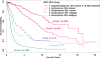
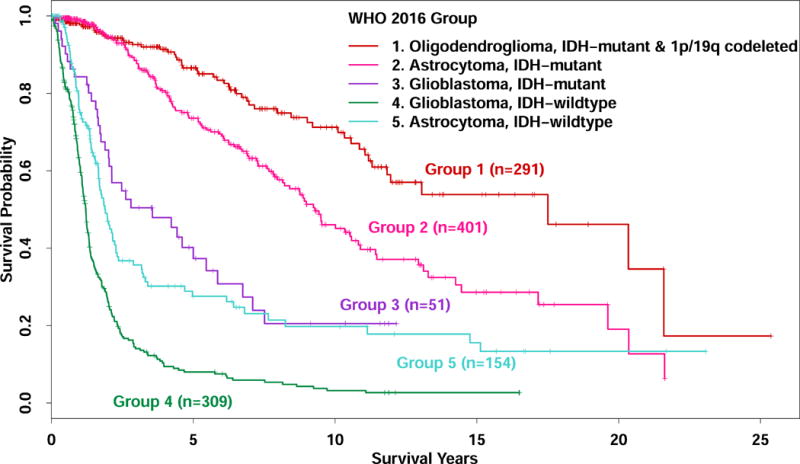
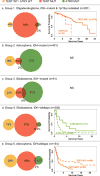
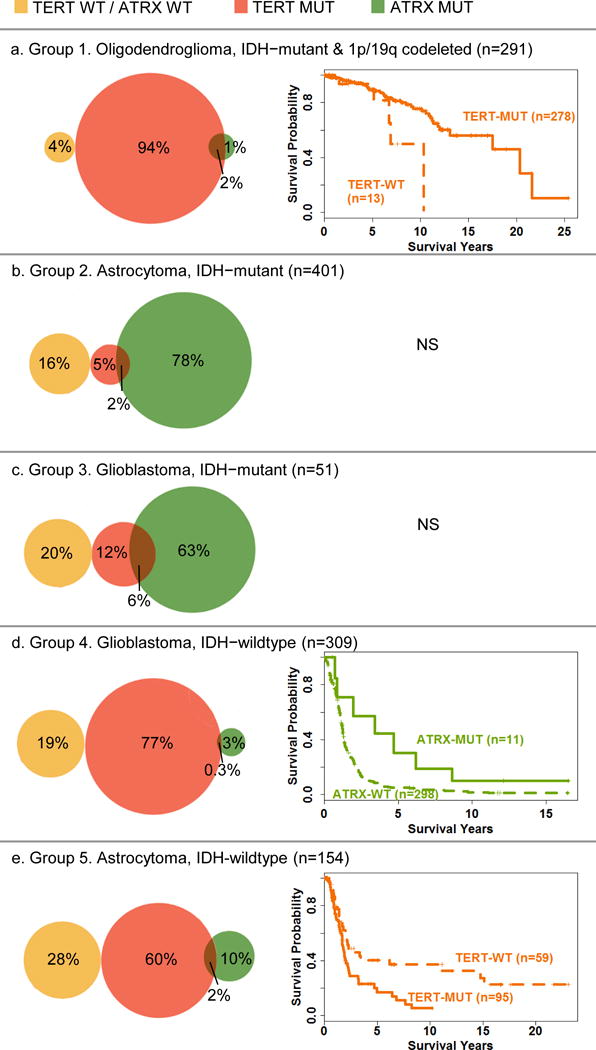
Description:The "integrated diagnosis" for infiltrating gliomas in the 2016 revised World Health Organization (WHO) classification of tumors of the central nervous system requires assessment of the tumor for IDH mutations and 1p/19q codeletion. Since TERT promoter mutations and ATRX alterations have been shown to be associated with prognosis, we analyzed whether these tumor markers provide additional prognostic information within each of the five WHO 2016 categories. We used data for 1206 patients from the UCSF Adult Glioma Study, the Mayo Clinic and The Cancer Genome Atlas (TCGA) with infiltrative glioma, grades II-IV for whom tumor status for IDH, 1p/19q codeletion, ATRX, and TERT had been determined. All cases were assigned to one of 5 groups following the WHO 2016 diagnostic criteria based on their morphologic features, and IDH and 1p/19q codeletion status. These groups are: (1) Oligodendroglioma, IDH-mutant and 1p/19q-codeleted; (2) Astrocytoma, IDH-mutant; (3) Glioblastoma, IDH-mutant; (4) Glioblastoma, IDH-wildtype; and (5) Astrocytoma, IDH-wildtype. Within each group, we used univariate and multivariate Cox proportional hazards models to assess associations of overall survival with patient age at diagnosis, grade, and ATRX alteration status and/or TERT promoter mutation status. Among Group 1 IDH-mutant 1p/19q-codeleted oligodendrogliomas, the TERT-WT group had significantly worse overall survival than the TERT-MUT group (HR: 2.72, 95% CI 1.05-7.04, p = 0.04). In both Group 2, IDH-mutant astrocytomas and Group 3, IDH-mutant glioblastomas, neither TERT mutations nor ATRX alterations were significantly associated with survival. Among Group 4, IDH-wildtype glioblastomas, ATRX alterations were associated with favorable outcomes (HR: 0.36, 95% CI 0.17-0.81, p = 0.01). Among Group 5, IDH-wildtype astrocytomas, the TERT-WT group had significantly better overall survival than the TERT-MUT group (HR: 0.48, 95% CI 0.27-0.87), p = 0.02). Thus, we present evidence that in certain WHO 2016 diagnostic groups, testing for TERT promoter mutations or ATRX alterations may provide additional useful prognostic information.
-
Subjects:
-
Source:Acta Neuropathol. 133(6):1001-1016.
-
Pubmed ID:28255664
-
Pubmed Central ID:PMC5432658
-
Document Type:
-
Funding:R01 CA139020/CA/NCI NIH HHS/United States ; HHSN261201000140C/CA/NCI NIH HHS/United States ; P50 CA108961/CA/NCI NIH HHS/United States ; HHSN261201000035C/CA/NCI NIH HHS/United States ; RC1 NS068222/NS/NINDS NIH HHS/United States ; UL1 TR001863/TR/NCATS NIH HHS/United States ; R25 CA112355/CA/NCI NIH HHS/United States ; R01 CA126831/CA/NCI NIH HHS/United States ; UL1 RR024131/RR/NCRR NIH HHS/United States ; P30 CA082103/CA/NCI NIH HHS/United States ; P50 CA097257/CA/NCI NIH HHS/United States ; P30 CA015083/CA/NCI NIH HHS/United States ; HHSN261201000035I/CA/NCI NIH HHS/United States ; HHSN261201000034C/CA/NCI NIH HHS/United States ; U58 DP003862/DP/NCCDPHP CDC HHS/United States ; KL2 TR001862/TR/NCATS NIH HHS/United States ; R01 CA052689/CA/NCI NIH HHS/United States
-
Name as Subject:
-
Volume:133
-
Issue:6
-
Collection(s):
-
Main Document Checksum:urn:sha256:e3cb0997c891a215495e1e370239562acb9283f73e44512ebb1df87c4baf48d2
-
Download URL:
-
File Type:
 [PDF
- 588.15 KB
]
[PDF
- 588.15 KB
]
Supporting Files


File Language:
English
ON THIS PAGE

CDC STACKS serves as an archival repository of CDC-published products including
scientific findings,
journal articles, guidelines, recommendations, or other public health information authored or
co-authored by CDC or funded partners.
As a repository, CDC STACKS retains documents in their original published format to ensure public access to scientific information.
As a repository, CDC STACKS retains documents in their original published format to ensure public access to scientific information.
You May Also Like
COLLECTION
CDC Public Access