


Vitamin D deficiency is associated with IL-6 levels and monocyte activation in HIV-infected persons
Supporting Files
Public Domain

-
May 02 2017
File Language:
English
Details
-
Alternative Title:PLoS One
-
Personal Author:
-
Corporate Authors:
-
Description:Background
Immune activation plays a key role in HIV pathogenesis. Markers of inflammation have been associated with vitamin D deficiency in the general population. Studies have also demonstrated associations of vitamin D deficiency with increased risk of HIV progression and death. The relationship between persistent inflammation and immune activation during chronic HIV infection and vitamin D deficiency remains unclear.
Methods
Cryopreserved specimens were analyzed from 663 participants at the time of enrollment from the Study to Understand the Natural History of HIV/AIDS in the Era of Effective Therapy (SUN Study) from 2004 to 2006. Biomarkers of inflammation, atherosclerosis, and coagulation were measured using enzyme-linked immunosorbent assays (ELISAs) and electrochemiluminescence. 25(OH)D, the stable precursor form of vitamin D, was measured using a radioimmunoassay with levels defined as: normal (≥30ng/mL), insufficient (20–29 ng/mL) and deficient (<20 ng/mL). Monocyte phenotypes were assessed by flow cytometry. Linear and logistic regression models were used to determine statistical associations between biomarkers and vitamin D deficiency.
Results
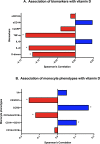
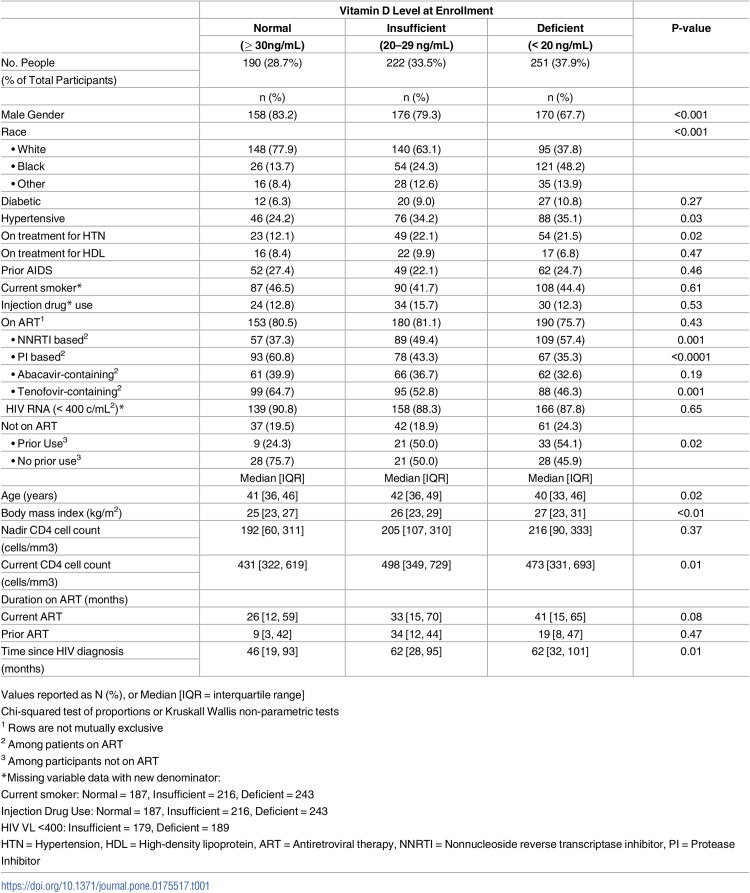
25(OH)D levels were deficient in 251 (38%) participants, insufficient in 222 (34%), and normal in 190 (29%). Patients with vitamin D deficiency, when compared to those with insufficient or normal vitamin D levels, had increased levels of IL-6 (23%; p<0.01), TNF-α (21%, p = 0.03), D-dimer (24%, p = 0.01), higher proportions of CD14dimCD16+ (22%, p<0.01) and CX3CR1+ monocytes (48%; p<0.001) and decreased frequency of CCR2+ monocytes (-3.4%, p<0.001). In fully adjusted models, vitamin D associations with abnormal biomarker levels persisted for IL-6 levels and CX3CR1+ and CCR2+ phenotypes.
Conclusions
Vitamin D deficiency is associated with greater inflammation and activated monocyte phenotypes. The role of vitamin D deficiency in persistent immune activation and associated complications during chronic HIV disease should be further evaluated as a possible target for intervention.
-
Subjects:
-
Source:PLoS One. 12(5).
-
Pubmed ID:28464004
-
Pubmed Central ID:PMC5413041
-
Document Type:
-
Volume:12
-
Issue:5
-
Collection(s):
-
Main Document Checksum:urn:sha256:8e4f5269154f4961140b829c80739ed868207e9460a36df1a5bf0cdba4c15c35
-
Download URL:
-
File Type:
 [PDF
- 1.28 MB
]
[PDF
- 1.28 MB
]
Supporting Files


File Language:
English
ON THIS PAGE






CDC STACKS serves as an archival repository of CDC-published products including
scientific findings,
journal articles, guidelines, recommendations, or other public health information authored or
co-authored by CDC or funded partners.
As a repository, CDC STACKS retains documents in their original published format to ensure public access to scientific information.
As a repository, CDC STACKS retains documents in their original published format to ensure public access to scientific information.
You May Also Like
COLLECTION
CDC Public Access