


Prevention of Chronic Hepatitis B after 3 Decades of Escalating Vaccination Policy, China
Supporting Files
Public Domain

-
May 2017
-
File Language:
English
Details
-
Alternative Title:Emerg Infect Dis
-
Personal Author:Cui, Fuqiang ; Shen, Lipin ; Li, Li ; Wang, Huaqing ; Wang, Fuzhen ; Bi, Shengli ; Liu, Jianhua ; Zhang, Guomin ; Wang, Feng ; Zheng, Hui ; Sun, Xiaojin ; Miao, Ning ; Yin, Zundong ; Feng, Zijian ; Liang, Xiaofeng ; Wang, Yu
-
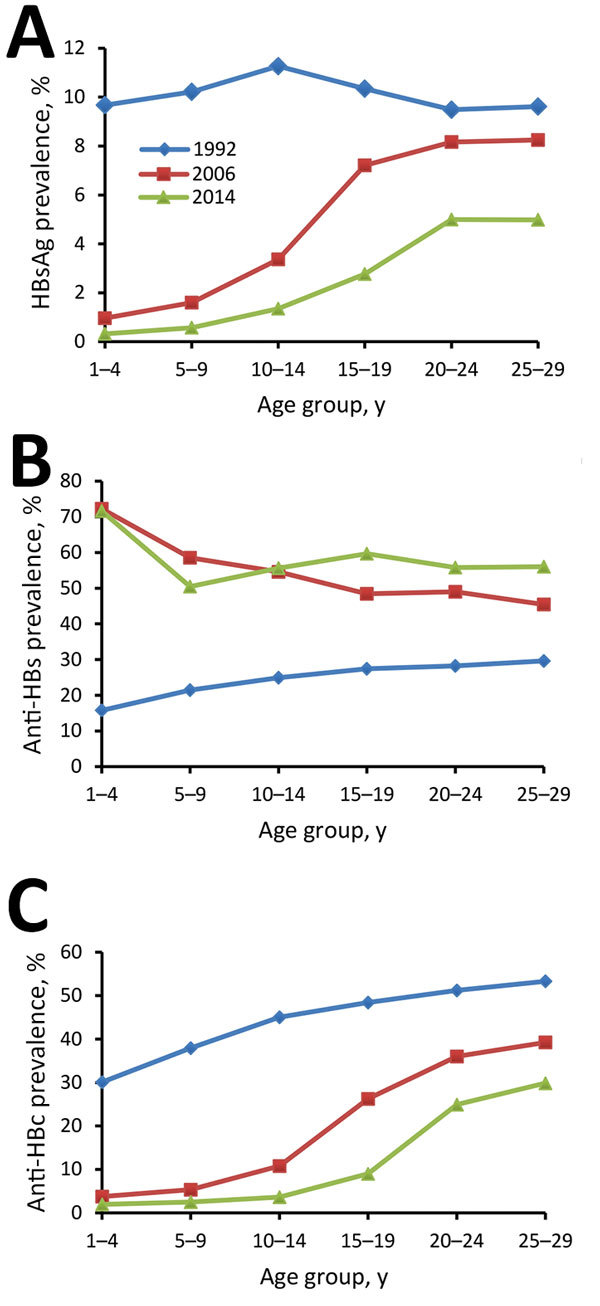
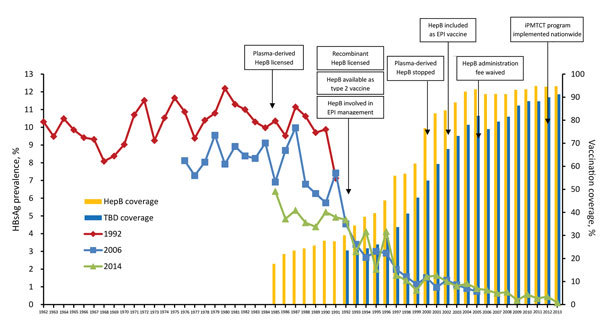
Description:China's hepatitis B virus (HBV) prevention policy has been evaluated through nationally representative serologic surveys conducted in 1992 and 2006. We report results of a 2014 serologic survey and reanalysis of the 1992 and 2006 surveys in the context of program policy. The 2014 survey used a 2-stage sample strategy in which townships were selected from 160 longstanding, nationally representative, county-level disease surveillance points, and persons 1-29 years of age were invited to participate. The 2014 sample size was 31,713; the response rate was 83.3%. Compared with the 1992 pre-recombinant vaccine survey, HBV surface antigen prevalence declined 46% by 2006 and by 52% by 2014. Among children <5 years of age, the decline was 97%. China's HBV prevention program, targeted toward interrupting perinatal transmission, has been highly successful and increasingly effective. However, this progress must be sustained for decades to come, and elimination of HBV transmission will require augmented strategies.
-
Subjects:
-
Source:Emerg Infect Dis. 23(5):765-772.
-
Pubmed ID:28418296
-
Pubmed Central ID:PMC5403029
-
Document Type:
-
Place as Subject:
-
Location:
-
Volume:23
-
Issue:5
-
Collection(s):
-
Main Document Checksum:urn:sha256:2a3068f42fada92abef6603f53118aaeecd48c49827b5f27c05e119201b59719
-
Download URL:
-
File Type:
 [PDF
- 1.62 MB
]
[PDF
- 1.62 MB
]
Supporting Files


File Language:
English
ON THIS PAGE





CDC STACKS serves as an archival repository of CDC-published products including
scientific findings,
journal articles, guidelines, recommendations, or other public health information authored or
co-authored by CDC or funded partners.
As a repository, CDC STACKS retains documents in their original published format to ensure public access to scientific information.
As a repository, CDC STACKS retains documents in their original published format to ensure public access to scientific information.
You May Also Like
COLLECTION
Emerging Infectious Diseases