


Grab a Cup, Fill It Up! An Intervention to Promote the Convenience of Drinking Water and Increase Student Water Consumption During School Lunch
Supporting Files

-
Jul 16 2015
-
Details
-
Alternative Title:Am J Public Health
-
Personal Author:
-
Description:Objectives
We evaluated a low-cost strategy for schools to improve the convenience and appeal of drinking water.
Methods
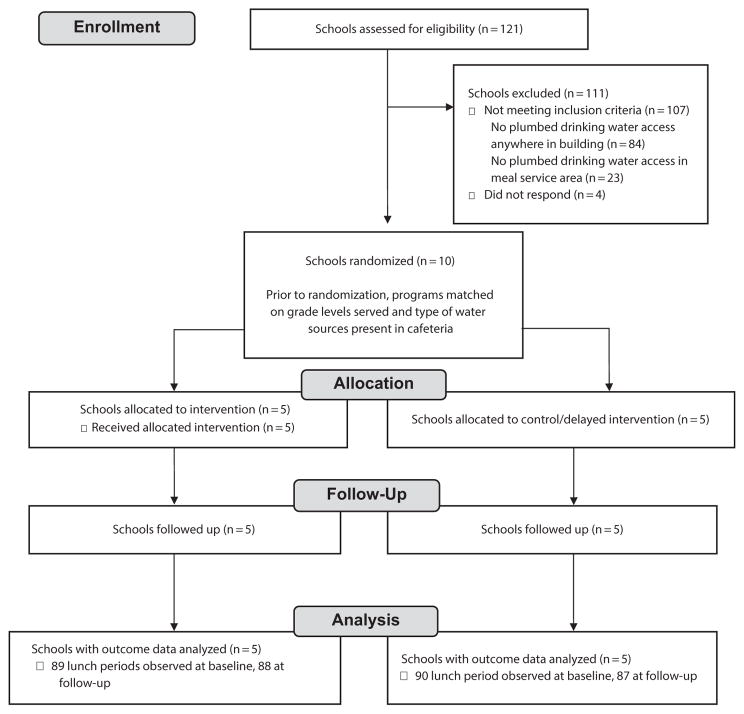
We conducted a group-randomized, controlled trial in 10 Boston, Massachusetts, schools in April through June 2013 to test a cafeteria-based intervention. Signage promoting water and disposable cups were installed near water sources. Mixed linear regression models adjusting for clustering evaluated the intervention impact on average student water consumption over 359 lunch periods.
Results
The percentage of students in intervention schools observed drinking water during lunch nearly doubled from baseline to follow-up compared with controls (+9.4%; P < .001). The intervention was associated with a 0.58-ounce increase in water intake across all students (P < .001). Without cups, children were observed drinking 2.4 (SE = 0.08) ounces of water from fountains; with cups, 5.2 (SE = 0.2) ounces. The percentage of intervention students observed with sugar-sweetened beverages declined (−3.3%; P < .005).
Conclusions
The current default of providing water through drinking fountains in cafeterias results in low water consumption. This study shows that an inexpensive intervention to improve drinking water’s convenience by providing cups can increase student water consumption.
-
Subjects:
-
Source:Am J Public Health. 105(9):1777-1783.
-
Pubmed ID:26180950
-
Pubmed Central ID:PMC4539814
-
Document Type:
-
Funding:
-
Volume:105
-
Issue:9
-
Collection(s):
-
Main Document Checksum:urn:sha256:ae0707c2c41307a60e186aac7994f36038922f9d2c8bcd5c13ae59046a543316
-
Download URL:
-
File Type:
 [PDF
- 280.66 KB
]
[PDF
- 280.66 KB
]
Supporting Files


ON THIS PAGE

CDC STACKS serves as an archival repository of CDC-published products including
scientific findings,
journal articles, guidelines, recommendations, or other public health information authored or
co-authored by CDC or funded partners.
As a repository, CDC STACKS retains documents in their original published format to ensure public access to scientific information.
As a repository, CDC STACKS retains documents in their original published format to ensure public access to scientific information.
You May Also Like
COLLECTION
CDC Public Access