


Alcohol Consumption and the Risk of Colorectal Cancer for Mismatch Repair Gene Mutation Carriers
Supporting Files

-
Nov 03 2016
-
File Language:
English
Details
-
Alternative Title:Cancer Epidemiol Biomarkers Prev
-
Personal Author:Dashti, S. Ghazaleh ; Buchanan, Daniel D. ; Jayasekara, Harindra ; Ouakrim, Driss Ait ; Clendenning, Mark ; Rosty, Christophe ; Winship, Ingrid M. ; Macrae, Finlay A. ; Giles, Graham G. ; Parry, Susan ; Casey, Graham ; Haile, Robert W. ; Gallinger, Steven ; Le Marchand, Loïc ; Thibodeau, Stephen N. ; Lindor, Noralane M. ; Newcomb, Polly A. ; Potter, John D. ; Baron, John A. ; Hopper, John L. ; Jenkins, Mark A. ; Win, Aung Ko
-
Description:Background
People with germline mutation in one of the DNA mismatch repair (MMR) genes have increased colorectal cancer risk. For these high-risk people, study findings of the relationship between alcohol consumption and colorectal cancer risk have been inconclusive.
Methods
1,925 MMR gene mutations carriers recruited into the Colon Cancer Family Registry who had completed a questionnaire on lifestyle factors were included. Weighted Cox proportional hazard regression models were used to estimate hazard ratios (HRs) and 95% confidence intervals (CIs) for the association between alcohol consumption and colorectal cancer.
Results
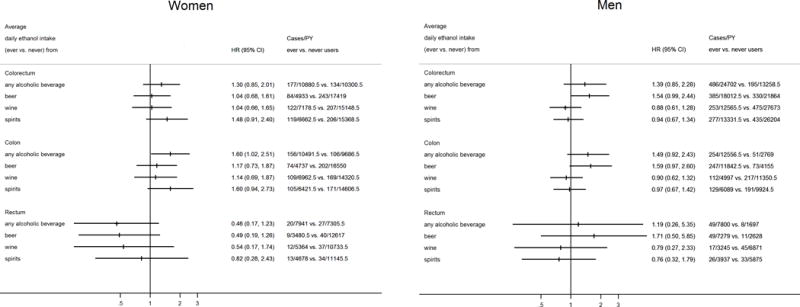
Colorectal cancer was diagnosed in 769 carriers (40%) at a mean (standard deviation) age of 42.6 (10.3) years. Compared with abstention, ethanol consumption from any alcoholic beverage up to 14 grams/day and >28 grams/day were associated with increased colorectal cancer risk (HR, 1.50; 95%CI, 1.09–2.07 and 1.69; 95%CI, 1.07–2.65 respectively; P-trend=0.05), and colon cancer risk (HR, 1.78; 95%CI, 1.27–2.49 and 1.94; 95%CI, 1.19–3.18 respectively; P-trend=0.02). However, there was no clear evidence for an association with rectal cancer risk. Also, there was no evidence for associations between consumption of individual alcoholic beverage types (beer, wine, spirits) and colorectal, colon, or rectal cancer risk.
Conclusion
Our data suggests that alcohol consumption, particularly more than 28 grams/day of ethanol (~2 standard drinks of alcohol in the US), is associated with increased colorectal cancer risk for MMR gene mutation carriers.
Impact
Although these data suggested that alcohol consumption in MMR carriers was associated with increased colorectal cancer risk, there was no evidence of a dose-response, and not all types of alcohol consumption were associated with increased risk.
-
Subjects:
-
Source:Cancer Epidemiol Biomarkers Prev. 26(3):366-375.
-
Pubmed ID:27811119
-
Pubmed Central ID:PMC5336397
-
Document Type:
-
Funding:HHSN261201000035C/PC,CA/None/None ; HHSN261201000140C/CA/NCI NIH HHS/United States ; U01 CA074799/CA/NCI NIH HHS/United States ; U24 CA074783/CA/NCI NIH HHS/United States ; N01 CN067009/CN/NCI NIH HHS/United States ; U24 CA074794/CA/NCI NIH HHS/United States ; N01PC35137/CA/NCI NIH HHS/United States ; U24 CA074806/CA/NCI NIH HHS/United States ; HHSN261201300009C/CA/NCI NIH HHS/United States ; U24 CA097735/CA/NCI NIH HHS/United States ; U01 CA074794/CA/NCI NIH HHS/United States ; HHSN261201300011C/RC/CCR NIH HHS/United States ; HHSN261201300012I/CA/NCI NIH HHS/United States ; N01PC35142/CA/NCI NIH HHS/United States ; HHSN261201300021C/CA/NCI NIH HHS/United States ; P30 CA015083/CA/NCI NIH HHS/United States ; HHSN261201000035I/CA/NCI NIH HHS/United States ; HHSN261201000034C/CA/NCI NIH HHS/United States ; U01 CA097735/CA/NCI NIH HHS/United States ; UM1 CA167551/CA/NCI NIH HHS/United States ; U58 DP003862/DP/NCCDPHP CDC HHS/United States ; U01 CA074783/CA/NCI NIH HHS/United States ; U24 CA074799/CA/NCI NIH HHS/United States ; U01 CA074806/CA/NCI NIH HHS/United States ; U24 CA074800/CA/NCI NIH HHS/United States ; P30 CA071789/CA/NCI NIH HHS/United States ; HHSN261201000121C/CP/NCI NIH HHS/United States ; U01 CA074800/CA/NCI NIH HHS/United States
-
Volume:26
-
Issue:3
-
Collection(s):
-
Main Document Checksum:urn:sha256:d3efb6df90f3c64e86093006e17fadc787fb017acc8dd143ad47bac68c2c0775
-
Download URL:
-
File Type:
 [PDF
- 201.49 KB
]
[PDF
- 201.49 KB
]
Supporting Files


File Language:
English
ON THIS PAGE

CDC STACKS serves as an archival repository of CDC-published products including
scientific findings,
journal articles, guidelines, recommendations, or other public health information authored or
co-authored by CDC or funded partners.
As a repository, CDC STACKS retains documents in their original published format to ensure public access to scientific information.
As a repository, CDC STACKS retains documents in their original published format to ensure public access to scientific information.
You May Also Like
COLLECTION
CDC Public Access