



The loss of 5-methyltetrahydrofolate in human serum under suboptimal preanalytical conditions can only partially be recovered by an oxidation product1,2,3
Supporting Files

-
Sep 17 2014
-
Available in CDC Stacks on 2017-03-01T00:00:00Z
Details
-
Alternative Title:J Nutr
-
Personal Author:
-
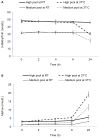
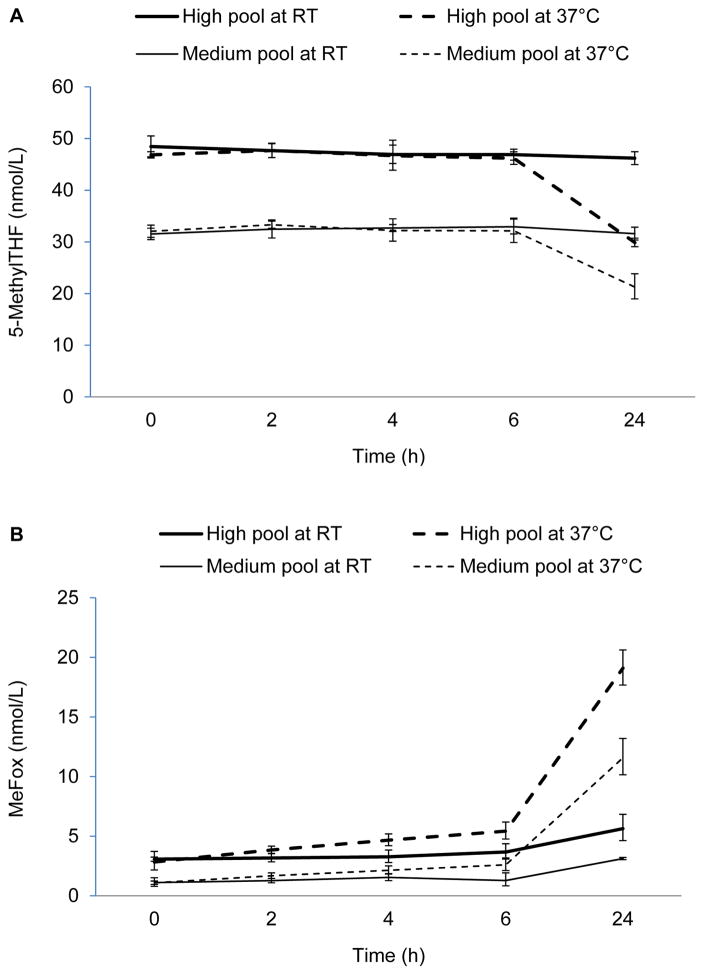
Description:Background ; Maintaining folate stability during sample handling is important, yet challenging. ; Objective ; We investigated the effects of suboptimal preanalytical conditions on serum folate stability. ; Design ; Using an HPLC-tandem MS method we measured folates 5-methyltetrahydrofolate (5-methylTHF), folic acid, and MeFox (5-methylTHF oxidation product), minor forms at or below limit of detection in human serum exposed to suboptimal conditions. ; Results ; Whole blood samples (n = 21) stored at 32°C for ≤3 d (experiment 1 – delayed processing) showed significant decreases in serum total folate (tFOL; sum of folate forms) 11–32%, 5.5–15.9 nmol/L and 5-methylTHF (36–62%, 14.5–25.1 nmol/L) and a significant increase in MeFox (346–415%, 7.17–8.63 nmol/L). Serum samples (n = 21) stored at 11°C for 7–14 d (experiment 2 – delayed freezing) also showed significant decreases in tFOL (4.6–10.4%, 2.3–5.1 nmol/L) and 5-methylTHF (8.4–29%, 3.4–11.6 nmol/L) and significant increases in MeFox (88–320%, 1.82–6.62 nmol/L). The molar loss in 5-methylTHF exceeded the gain in MeFox in these 2 experiments. When we exposed 3 serum pools (tFOL 16.7–58.3 nmol/L) for 24 h to 37°C elevated temperature (experiment 3), the significant decrease in 5-methylTHF (33% on average) was compensated by an equimolar gain in MeFox. Repeated freeze/thawing (≤3 cycles) of serum closed (experiment 4) and open (experiment 5) vials showed generally stable folates with small (<1 nmol/L) changes. Long-term (≤12 mo) exposure of 3 serum pools (tFOL 17.5–63.7 nmol/L) to suboptimal (−20°C) freezing temperature (experiment 6) showed significant decreases in tFOL (5% on average) already after 3 mo. The molar loss in 5-methylTHF exceeded the gain in MeFox. Folic acid generally showed good stability. ; Conclusions ; To avoid folate losses, unprocessed whole blood should be protected from elevated temperature and serum should not be refrigerated for >2 d or long-term stored at −20°C.
-
Subjects:
- Article
- Folate
- MeFox
- stability
- degradation
- preanalytical
- delayed processing
- frozen storage
- freeze/thawing
- and HPLC-MS/MS
- Blood Specimen Collection
- Chromatography, High Pressure Liquid
- Folic Acid
- Humans
- Limit of Detection
- Oxidation-Reduction
- Sensitivity and Specificity
- Tandem Mass Spectrometry
- Temperature
- Tetrahydrofolates
- Time Factors
-
Source:J Nutr. 144(11):1873-1879.
-
Pubmed ID:25332487
-
Pubmed Central ID:PMC5332148
-
Document Type:
-
Funding:
-
Volume:144
-
Issue:11
-
Download URL:
-
File Type:
 [PDF - 518.30 KB]
 -
Collection(s):
-
Main Document Checksum:urn:sha256:bf00cbc140fc11b3a30d514f0e0160cddcfaef738bb9056b63d6835b54d7d9d7
Supporting Files


 Was this page helpful?
 Found an issue?

CDC STACKS serves as an archival repository of CDC-published products including
scientific findings, journal articles, guidelines, recommendations, or other public health information authored or
co-authored by CDC or funded partners.
As a repository, CDC STACKS retains documents in their original published format to ensure public access to scientific information.
As a repository, CDC STACKS retains documents in their original published format to ensure public access to scientific information.
You May Also Like
COLLECTION
CDC Public Access