


Recurrence Risk Perception and Quality of Life Following Treatment of Breast Cancer
Supporting Files

-
Dec 21 2016
-
File Language:
English
Details
-
Alternative Title:Breast Cancer Res Treat
-
Personal Author:
-
Description:Purpose
Little is known about different ways of assessing risk of distant recurrence following cancer treatment (e.g., numeric or descriptive). We sought to evaluate the association between overestimation of risk of distant recurrence of breast cancer and key patient reported outcomes, including quality of life and worry.
Methods
We surveyed a weighted random sample of newly diagnosed patients with early-stage breast cancer identified through SEER registries of Los Angeles & Georgia (2013-14) ∼2 months after surgery (N=2578, RR=71%). Actual 10-year risk of distant recurrence after treatment was based on clinical factors for women with DCIS & low risk invasive cancer (Stg 1A, ER+HER2-, Gr 1-2). Women reported perceptions of their risk numerically (0 – 100%), with values ≥10% for DCIS & ≥20% for invasive considered overestimates. Perceptions of “moderate, high or very high” risk were considered descriptive overestimates. In our analytic sample (N=927), we assessed factors correlated with both types of overestimation and report multivariable associations between overestimation and QoL (PROMIS physical & mental health) and frequent worry.
Results
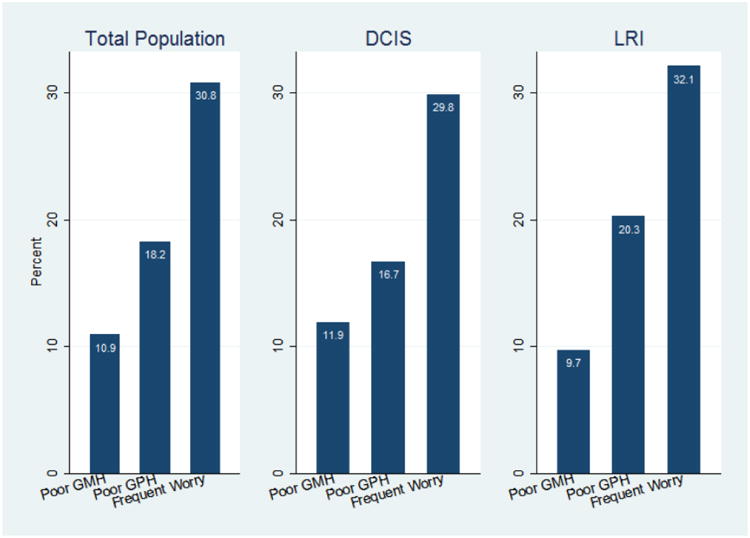
30.4% of women substantially overestimated their risk of distant recurrence numerically and 14.7% descriptively. Few factors other than family history were significantly associated with either type of overestimation. Both types of overestimation were significantly associated with frequent worry, and lower QoL.
Conclusions
Ensuring understanding of systemic recurrence risk, particularly among patients with favorable prognosis, is important. Better risk communication by clinicians may translate to better risk comprehension among patients and to improvements in QoL.
-
Subjects:
-
Source:Breast Cancer Res Treat. 161(3):557-565.
-
Pubmed ID:28004220
-
Pubmed Central ID:PMC5310669
-
Document Type:
-
Funding:HHSN261201000035C/PC,CA/None/None ; HHSN261201000140C/CA/NCI NIH HHS/United States ; P30 CA046592/CA/NCI NIH HHS/United States ; P01 CA163233/CA/NCI NIH HHS/United States ; U58 DP003875/DP/NCCDPHP CDC HHS/United States ; HHSN261201300015C/RC/CCR NIH HHS/United States ; HHSN261201000035I/CA/NCI NIH HHS/United States ; HHSN261201000034C/CA/NCI NIH HHS/United States ; U58 DP003862/DP/NCCDPHP CDC HHS/United States ; U01 CA197282/CA/NCI NIH HHS/United States
-
Volume:161
-
Issue:3
-
Collection(s):
-
Main Document Checksum:urn:sha256:72b0d2fb246e6b6c65f10784dea78bb142e1b1432b0e260708672325b16f7582
-
Download URL:
-
File Type:
 [PDF
- 466.32 KB
]
[PDF
- 466.32 KB
]
Supporting Files


File Language:
English
ON THIS PAGE



CDC STACKS serves as an archival repository of CDC-published products including
scientific findings,
journal articles, guidelines, recommendations, or other public health information authored or
co-authored by CDC or funded partners.
As a repository, CDC STACKS retains documents in their original published format to ensure public access to scientific information.
As a repository, CDC STACKS retains documents in their original published format to ensure public access to scientific information.
You May Also Like
COLLECTION
CDC Public Access