



Association of Testosterone and Sex Hormone–Binding Globulin With Metabolic Syndrome and Insulin Resistance in Men
Supporting Files
Public Domain

-
Apr 05 2010
File Language:
English
Details
-
Alternative Title:Diabetes Care
-
Personal Author:
-
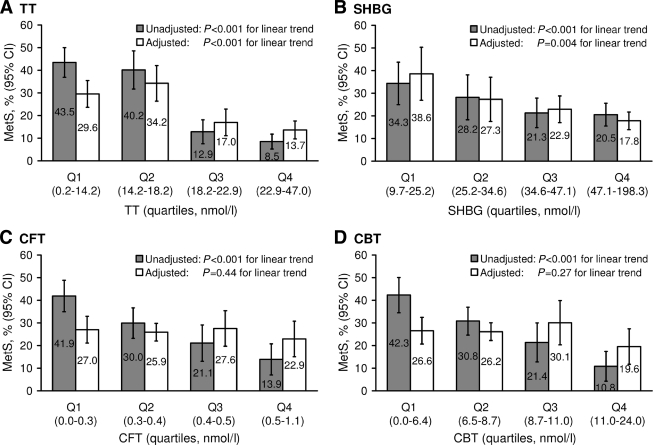
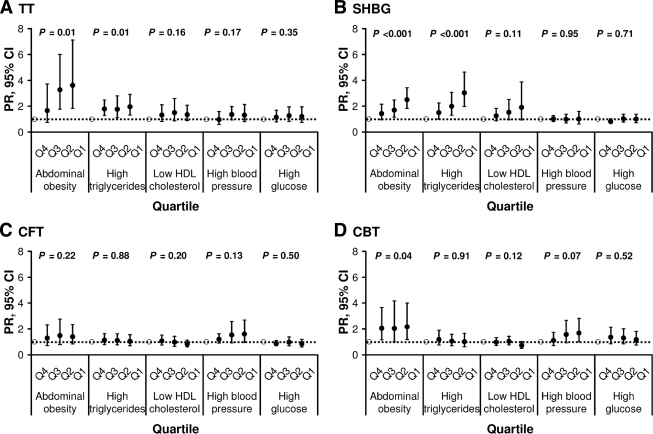
Description:OBJECTIVE ; We sought to assess the associations of testosterones and sex hormone–binding globulin (SHBG) with metabolic syndrome and insulin resistance in men. ; RESEARCH DESIGN AND METHODS ; We defined metabolic syndrome according to the National Cholesterol Education Program Expert Panel on Detection, Evaluation, and Treatment of High Blood Cholesterol in Adults. Among men aged ≥20 years who participated in the Third National Health and Nutrition Examination Survey (n = 1,226), the Cox proportional hazards model was used to estimate the prevalence ratio and 95% CI of metabolic syndrome according to circulating concentrations of testosterones and SHBG. ; RESULTS ; After adjustment for age, race/ethnicity, smoking status, alcohol intake, physical activity level, LDL cholesterol, C-reactive protein, and insulin resistance, men in the first quartile (lowest) (prevalence ratio 2.16 95% CI 1.53–3.06) and second quartile of total testosterone (2.51 1.86–3.37) were more likely to have metabolic syndrome than men in the fourth quartile (highest, referent group) (P < 0.001 for linear trend). Similarly, men in the first quartile of SHBG (2.17 1.32–3.56) were more likely to have metabolic syndrome than men in the fourth quartile (P = 0.02 for linear trend). No significant associations of calculated free testosterone (P = 0.31 for linear trend) and bioavailable testosterone (P = 0.11 for linear trend) with metabolic syndrome were detected after adjustment for all possible confounders. ; CONCLUSIONS ; Low concentrations of total testosterone and SHBG were strongly associated with increased likelihood of having metabolic syndrome, independent of traditional cardiovascular risk factors and insulin resistance.
-
Subjects:
-
Source:Diabetes Care. 33(7):1618-1624.
-
Document Type:
-
Place as Subject:
-
Volume:33
-
Issue:7
-
Download URL:
-
File Type:
 [PDF - 305.16 KB]
 -
Collection(s):
-
Main Document Checksum:urn:sha256:e3364b1e90ee3840a44f1eb854385e0ea0f20b4424256fac2bfd516cacb47663
Supporting Files


File Language:
English
 Was this page helpful?
 Found an issue?


CDC STACKS serves as an archival repository of CDC-published products including
scientific findings, journal articles, guidelines, recommendations, or other public health information authored or
co-authored by CDC or funded partners.
As a repository, CDC STACKS retains documents in their original published format to ensure public access to scientific information.
As a repository, CDC STACKS retains documents in their original published format to ensure public access to scientific information.
You May Also Like
COLLECTION
CDC Public Access