



Newly Discovered Ebola Virus Associated with Hemorrhagic Fever Outbreak in Uganda
Supporting Files
Public Domain

-
Nov 21 2008
File Language:
English
Details
-
Alternative Title:PLoS Pathog
-
Personal Author:Towner, Jonathan S. ; Sealy, Tara K. ; Khristova, Marina L. ; Albariño, César G. ; Conlan, Sean ; Reeder, Serena A. ; Quan, Phenix-Lan ; Lipkin, W. Ian ; Downing, Robert ; Tappero, Jordan W. ; Okware, Samuel ; Lutwama, Julius ; Bakamutumaho, Barnabas ; Kayiwa, John ; Comer, James A. ; Rollin, Pierre E. ; Ksiazek, Thomas G. ; Nichol, Stuart T.
-
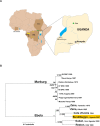
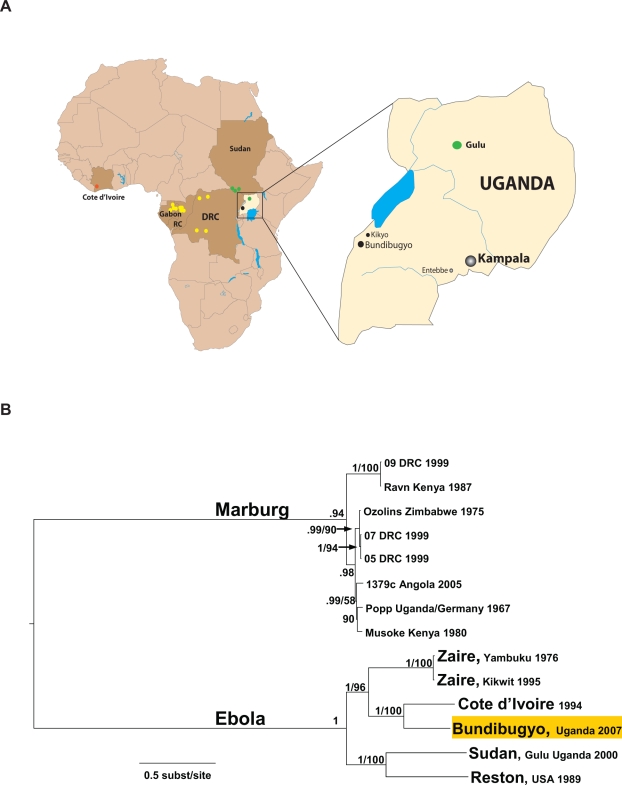
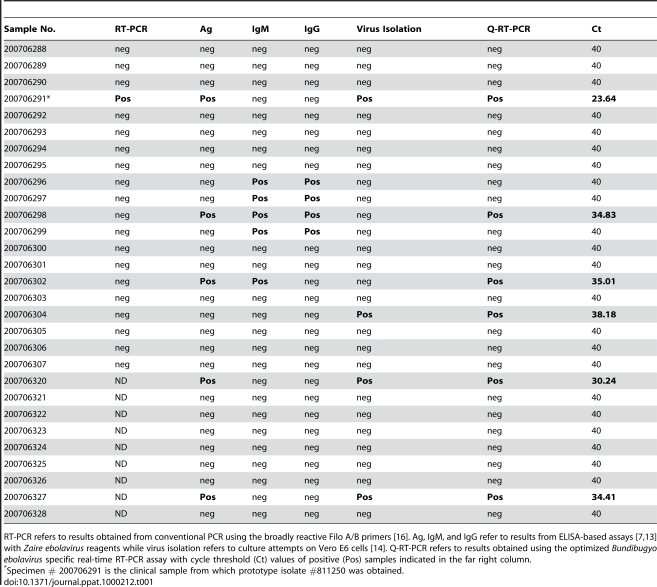
Description:Over the past 30 years, Zaire and Sudan ebolaviruses have been responsible for large hemorrhagic fever (HF) outbreaks with case fatalities ranging from 53% to 90%, while a third species, Côte d'Ivoire ebolavirus, caused a single non-fatal HF case. In November 2007, HF cases were reported in Bundibugyo District, Western Uganda. Laboratory investigation of the initial 29 suspect-case blood specimens by classic methods (antigen capture, IgM and IgG ELISA) and a recently developed random-primed pyrosequencing approach quickly identified this to be an Ebola HF outbreak associated with a newly discovered ebolavirus species (Bundibugyo ebolavirus) distantly related to the Côte d'Ivoire ebolavirus found in western Africa. Due to the sequence divergence of this new virus relative to all previously recognized ebolaviruses, these findings have important implications for design of future diagnostic assays to monitor Ebola HF disease in humans and animals, and ongoing efforts to develop effective antivirals and vaccines.
-
Subjects:
-
Source:PLoS Pathog. 2008; 4(11).
-
Document Type:
-
Place as Subject:
-
Volume:4
-
Issue:11
-
Download URL:
-
File Type:
 [PDF - 281.02 KB]
 -
Collection(s):
-
Main Document Checksum:urn:sha256:dfc0718bb86823686940ec36b2adc367576a4954efc572824d2a54eaf99e037f
Supporting Files


File Language:
English
 Was this page helpful?
 Found an issue?


CDC STACKS serves as an archival repository of CDC-published products including
scientific findings, journal articles, guidelines, recommendations, or other public health information authored or
co-authored by CDC or funded partners.
As a repository, CDC STACKS retains documents in their original published format to ensure public access to scientific information.
As a repository, CDC STACKS retains documents in their original published format to ensure public access to scientific information.
You May Also Like
COLLECTION
CDC Public Access