


Electrolyte and Metabolic Disturbances in Ebola Patients during a Clinical Trial, Guinea, 2015
Supporting Files
Public Domain

-
Dec 2016
-
File Language:
English
Details
-
Alternative Title:Emerg Infect Dis
-
Personal Author:van Griensven, Johan ; Bah, Elhadj Ibrahima ; Haba, Nyankoye ; Delamou, Alexandre ; Camara, Bienvenu Salim ; Olivier, Kadio Jean-Jacques ; De Clerck, Hilde ; Nordenstedt, Helena ; Semple, Malcolm G. ; Van Herp, Michel ; Buyze, Jozefien ; De Crop, Maaike ; Van Den Broucke, Steven ; Lynen, Lutgarde ; De Weggheleire, Anja
-
Corporate Authors:
-
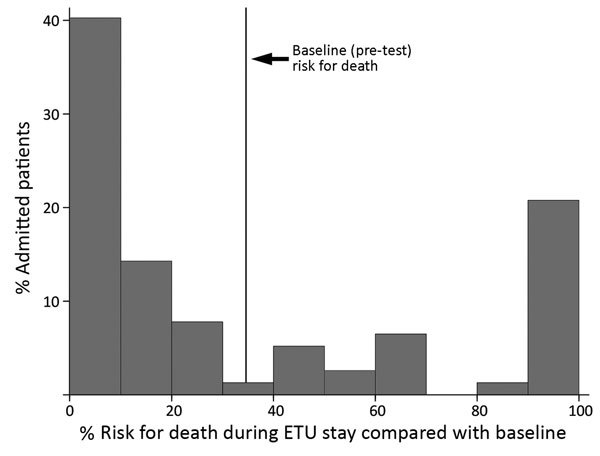
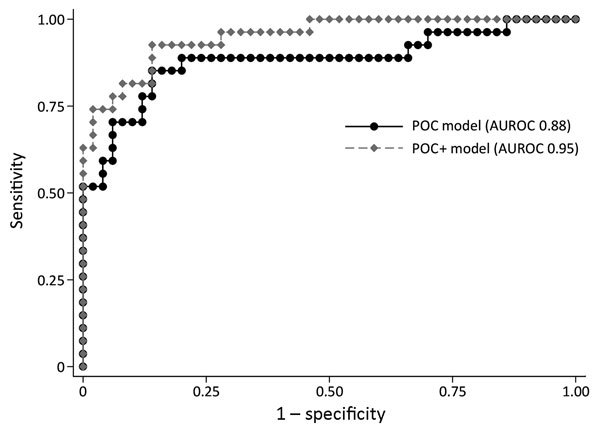
Description:By using data from a 2015 clinical trial on Ebola convalescent-phase plasma in Guinea, we assessed the prevalence of electrolyte and metabolic abnormalities at admission and their predictive value to stratify patients into risk groups. Patients underwent testing with a point-of-care device. We used logistic regression to construct a prognostic model and summarized the predictive value with the area under the receiver operating curve. Abnormalities were common among patients, particularly hypokalemia, hypocalcemia, hyponatremia, raised creatinine, high anion gap, and anemia. Besides age and PCR cycle threshold value, renal dysfunction, low calcium levels, and low hemoglobin levels were independently associated with increased risk for death. A prognostic model using all 5 factors was highly discriminatory (area under the receiver operating curve 0.95; 95% CI 0.90-0.99) and enabled the definition of risk criteria to guide targeted care. Most patients had a very low (<5%) or very high (>80%) risk for death.
-
Subjects:
-
Source:Emerg Infect Dis. 22(12):2120-2127.
-
Pubmed ID:27869610
-
Pubmed Central ID:PMC5189166
-
Document Type:
-
Place as Subject:
-
Volume:22
-
Issue:12
-
Collection(s):
-
Main Document Checksum:urn:sha256:7da23d04e07db45891d2271df330b6b0abdfb2c7d3dd130554cfd30ceae32dbf
-
Download URL:
-
File Type:
 [PDF
- 947.25 KB
]
[PDF
- 947.25 KB
]
Supporting Files


File Language:
English
ON THIS PAGE

CDC STACKS serves as an archival repository of CDC-published products including
scientific findings,
journal articles, guidelines, recommendations, or other public health information authored or
co-authored by CDC or funded partners.
As a repository, CDC STACKS retains documents in their original published format to ensure public access to scientific information.
As a repository, CDC STACKS retains documents in their original published format to ensure public access to scientific information.
You May Also Like
COLLECTION
Emerging Infectious Diseases