


Impact of Health Facility-Based Insecticide Treated Bednet Distribution in Malawi: Progress and Challenges towards Achieving Universal Coverage
Supporting Files

-
Jul 21 2011
-
File Language:
English
Details
-
Alternative Title:PLoS One
-
Personal Author:
-
Description:Background
High levels of insecticide treated bednet (ITN) use reduce malaria burden in countries with intense transmission such as Malawi. Since 2007 Malawi has implemented free health facility-based ITN distribution for pregnant women and children <5 years old (under-5s). We evaluated the progress of this targeted approach toward achieving universal ITN coverage.
Methods
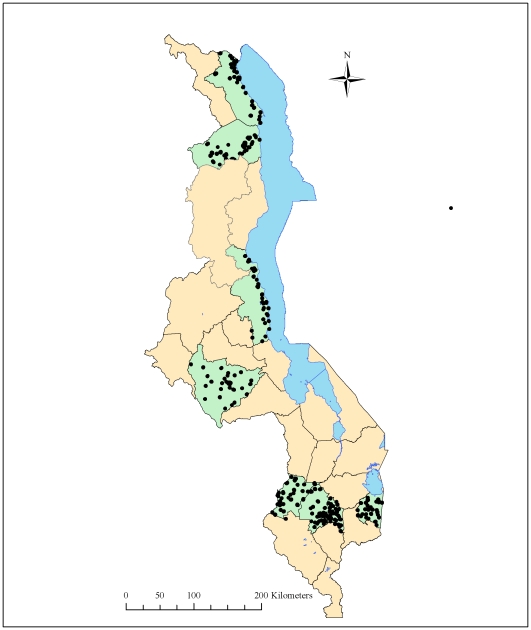
We conducted a cross-sectional household survey in eight districts in April 2009. We assessed household ITN possession, ITN use by all household members, and P. falciparum asexual parasitemia and anemia (hemoglobin <11 grams/deciliter) in under-5s.
Results
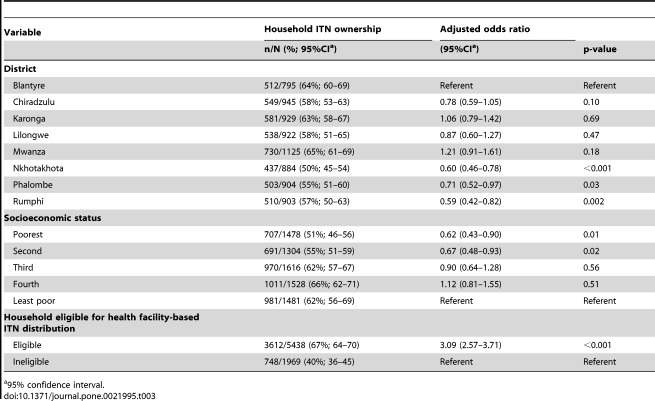
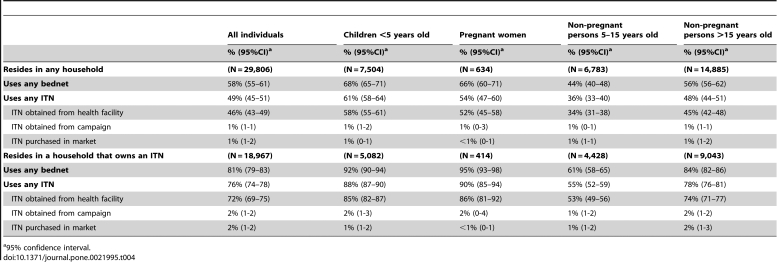
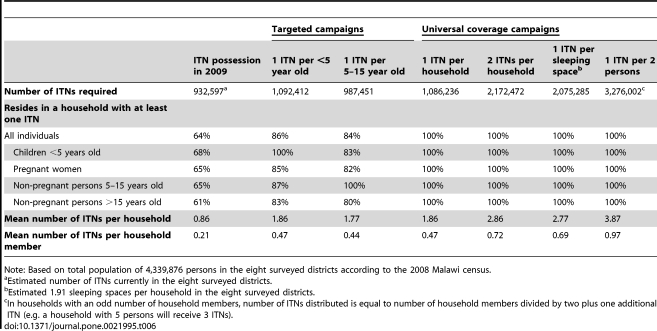
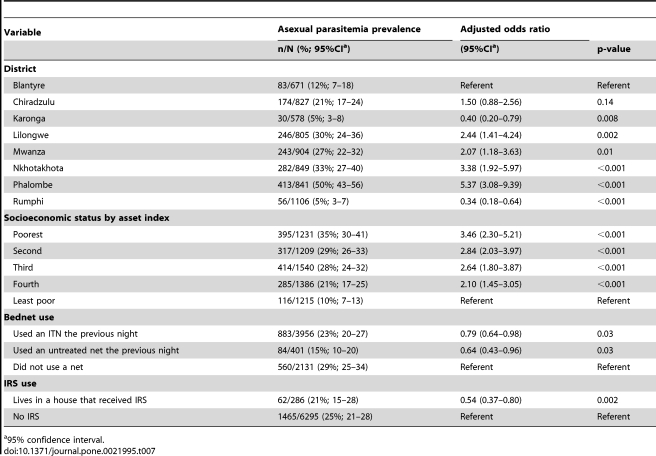
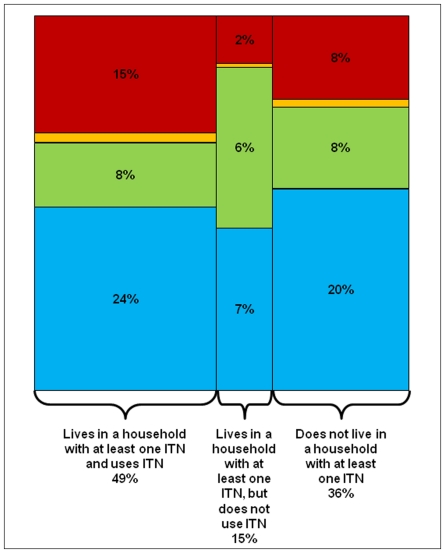
We surveyed 7,407 households containing 29,806 persons. Fifty-nine percent of all households (95% confidence interval [95% CI]: 56–62), 67% (95% CI: 64–70) of eligible households (i.e., households with pregnant women or under-5s), and 40% (95% CI: 36–45) of ineligible households owned an ITN. In households with at least one ITN, 76% (95% CI: 74–78) of all household members, 88% (95% CI: 87–90) of under-5s and 90% (95% CI: 85–94) of pregnant women used an ITN the previous night. Of 6,677 ITNs, 92% (95% CI: 90–94) were used the previous night with a mean of 2.4 persons sleeping under each ITN. In multivariable models adjusting for district, socioeconomic status and indoor residual spraying use, ITN use by under-5s was associated with a significant reduction in asexual parasitemia (adjusted odds ratio (aOR) 0.79; 95% CI: 0.64–0.98; p-value 0.03) and anemia (aOR 0.79; 95% CI 0.62–0.99; p-value 0.04). Of potential targeted and non-targeted mass distribution strategies, a campaign distributing 1 ITN per household might increase coverage to 2.1 household members per ITN, and thus achieve near universal coverage often defined as 2 household members per ITN.
Conclusions
Malawi has substantially increased ITN coverage using health facility-based distribution targeting pregnant women and under-5s, but needs to supplement these activities with non-targeted mass distribution campaigns to achieve universal coverage and maximum public health impact.
-
Subjects:
-
Source:PLoS One. 2011; 6(7).
-
Pubmed ID:21811553
-
Pubmed Central ID:PMC3141001
-
Document Type:
-
Funding:
-
Place as Subject:
-
Volume:6
-
Issue:7
-
Collection(s):
-
Main Document Checksum:urn:sha-512:be64820e2e9c7b8fac196b0a7d1833f28031870895859399736459d55e4eae74905c387bf90abf6669b910f29732c53d3630e25bb2690cc46ea2ab566cbcde76
-
Download URL:
-
File Type:
 [PDF
- 256.75 KB
]
[PDF
- 256.75 KB
]
Supporting Files


File Language:
English
ON THIS PAGE






CDC STACKS serves as an archival repository of CDC-published products including
scientific findings,
journal articles, guidelines, recommendations, or other public health information authored or
co-authored by CDC or funded partners.
As a repository, CDC STACKS retains documents in their original published format to ensure public access to scientific information.
As a repository, CDC STACKS retains documents in their original published format to ensure public access to scientific information.
You May Also Like
COLLECTION
CDC Public Access