


Comparison of anaemia and parasitaemia as indicators of malaria control in household and EPI-health facility surveys in Malawi
Supporting Files

-
Apr 21 2010
-
File Language:
English
Details
-
Alternative Title:Malar J
-
Personal Author:
-
Description:Background
The World Health Organization has recommended that anaemia be used as an additional indicator to monitor malaria burden at the community level as malaria interventions are nationally scaled up. To date, there are no published evaluations of this recommendation.
Methods
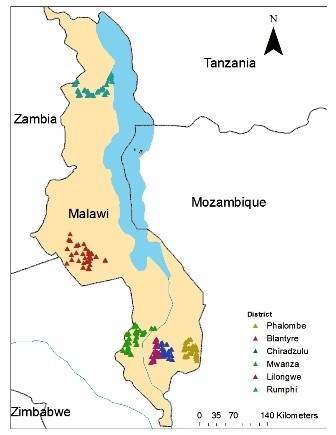
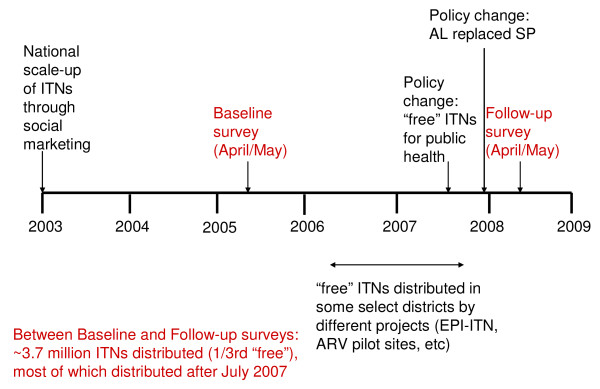
To evaluate this recommendation, a comparison of anaemia and parasitaemia among 6-30 month old children was made during two repeated cross-sectional household (HH) and health facility (HF) surveys in six districts across Malawi at baseline (2005) and in a follow-up survey (2008) after a scale up of malaria control interventions.
Results
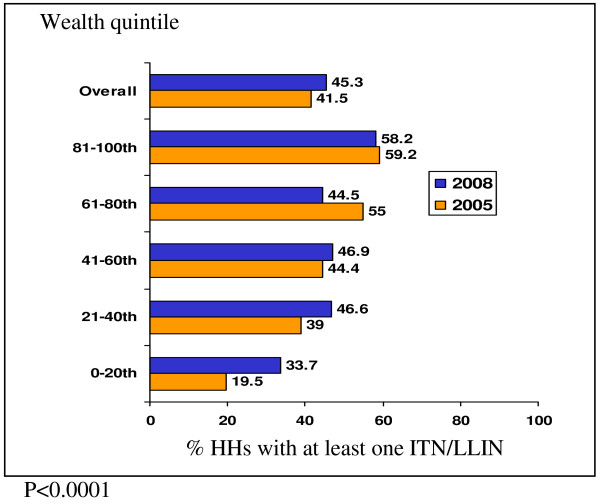
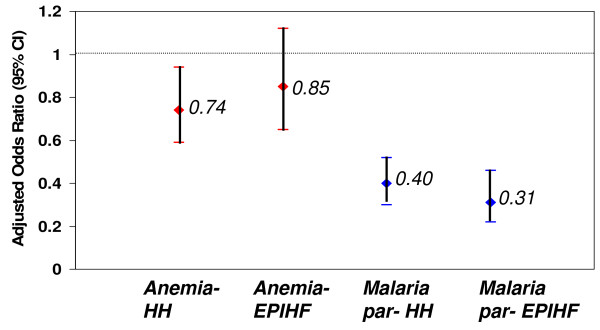
HH net ownership did not increase between the years (50.5% vs. 49.8%), but insecticide treated net (ITN) ownership increased modestly from 41.5% (95% CI: 37.2%-45.8%) in 2005 to 45.3% (95% CI: 42.6%-48.0%) in 2008. ITN use by children 6-30 months old, who were living in HH with at least one net, increased from 73.6% (95% CI:68.2%-79.1%) to 80.0% (95% CI:75.9%-84.1%) over the three-year period. This modest increase in ITN use was associated with a decrease in moderate to severe anaemia (Hb <8 g/dl) from 18.4% (95% CI:14.9%-21.8%) in 2005 to 15.4% (13.2%-17.7%) in 2008, while parasitaemia, measured as positive-slide microscopy, decreased from 18.9% (95% CI:14.7%-23.2%) to 16.9% (95% CI:13.8%-20.0%), a relative reduction of 16% and 11%, respectively. In HF surveys, anaemia prevalence decreased from 18.3% (95% CI: 14.9%-21.7%) to 15.4% (95% CI: 12.7%-18.2%), while parasitaemia decreased from 30.6% (95% CI: 25.7%-35.5%) to 13.2% (95% CI: 10.6%-15.8%), a relative reduction of 15% and 57%, respectively.
Conclusion
Increasing access to effective malaria prevention was associated with a reduced burden of malaria in young Malawian children. Anaemia measured at the HF level at time of routine vaccination may be a good surrogate indicator for its measurement at the HH level in evaluating national malaria control programmes.
-
Subjects:
-
Source:Malar J. 2010; 9:107.
-
Pubmed ID:20409342
-
Pubmed Central ID:PMC2864286
-
Document Type:
-
Funding:
-
Place as Subject:
-
Volume:9
-
Collection(s):
-
Main Document Checksum:urn:sha256:7791230c7ef7db940a0d36e423d64cd567d9c7dbd8fa258666988dd2ed95f989
-
Download URL:
-
File Type:
 [PDF
- 732.02 KB
]
[PDF
- 732.02 KB
]
Supporting Files


File Language:
English
ON THIS PAGE


CDC STACKS serves as an archival repository of CDC-published products including
scientific findings,
journal articles, guidelines, recommendations, or other public health information authored or
co-authored by CDC or funded partners.
As a repository, CDC STACKS retains documents in their original published format to ensure public access to scientific information.
As a repository, CDC STACKS retains documents in their original published format to ensure public access to scientific information.
You May Also Like
COLLECTION
CDC Public Access