


Developmental profiles of infants with an FMR1 premutation
Supporting Files

-
Nov 03 2016
-
Details
-
Alternative Title:J Neurodev Disord
-
Personal Author:
-
Description:Background
Emerging evidence suggests that a subset of FMR1 premutation carriers is at an increased risk for cognitive, emotional, and medical conditions. However, because the premutation is rarely diagnosed at birth, the early developmental trajectories of children with a premutation are not known.
Methods
This exploratory study examined the cognitive, communication, and social-behavioral profiles of 26 infants with a premutation who were identified through participation in a newborn screening for fragile X syndrome pilot study. In this study, families whose newborn screened positive for an FMR1 premutation were invited to participate in a longitudinal study of early development. Twenty-six infants with the premutation and 21 matched, screen-negative comparison babies were assessed using validated standardized measures at 6-month intervals starting as young as 3 months of age. The babies were assessed up to seven times over a 4-year period.
Results
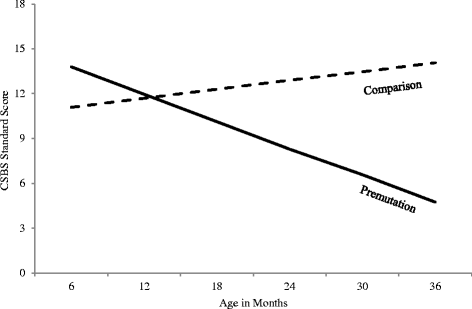
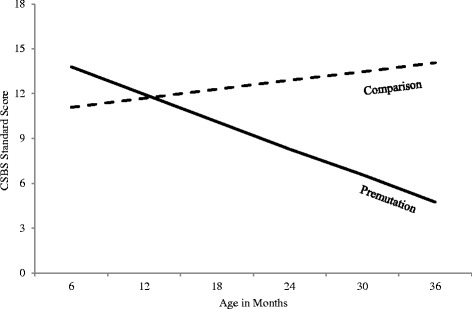
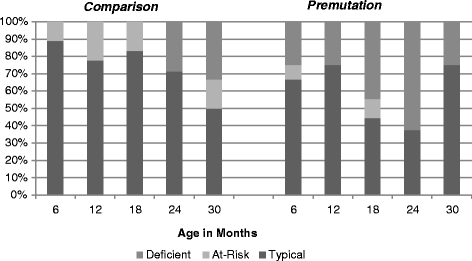
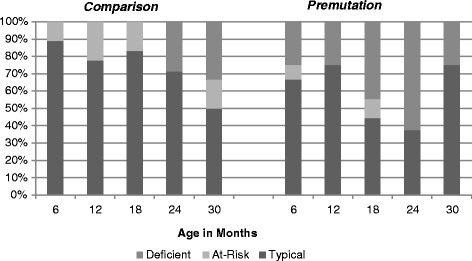
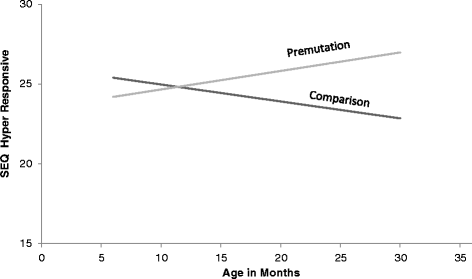
The premutation group was not statistically different from the comparison group on measures of cognitive development, adaptive behavior, temperament, or overall communication. However, the babies with the premutation had a significantly different developmental trajectory on measures of nonverbal communication and hyperresponsivity to sensory experiences. They also were significantly more hyporesponsive at all ages than the comparison group. Cytosine-guanine-guanine repeat length was linearly associated with overall cognitive development.
Conclusions
These results suggest that infants with a premutation may present with subtle developmental differences as young as 12 months of age that may be early markers of later anxiety, social deficits, or other challenges thought to be experienced by a subset of carriers.
-
Subjects:
-
Source:J Neurodev Disord. 8.
-
Pubmed ID:27822316
-
Pubmed Central ID:PMC5095966
-
Document Type:
-
Funding:
-
Volume:8
-
Collection(s):
-
Main Document Checksum:urn:sha256:366b61e7c3fb683009f0366fa3a181f4e5589bc951c62ef25a583b7ff218be65
-
Download URL:
-
File Type:
 [PDF
- 486.60 KB
]
[PDF
- 486.60 KB
]
Supporting Files


ON THIS PAGE


CDC STACKS serves as an archival repository of CDC-published products including
scientific findings,
journal articles, guidelines, recommendations, or other public health information authored or
co-authored by CDC or funded partners.
As a repository, CDC STACKS retains documents in their original published format to ensure public access to scientific information.
As a repository, CDC STACKS retains documents in their original published format to ensure public access to scientific information.
You May Also Like
COLLECTION
CDC Public Access