


Validation of genotype cluster investigations for Mycobacterium tuberculosis: application results for 44 clusters from four heterogeneous United States jurisdictions
Supporting Files
Public Domain

-
Oct 21 2016
-
File Language:
English
Details
-
Alternative Title:BMC Infect Dis
-
Personal Author:
-
Corporate Authors:
-
Description:Background
Tracking the dissemination of specific Mycobacterium tuberculosis (Mtb) strains using genotyped Mtb isolates from tuberculosis patients is a routine public health practice in the United States. The present study proposes a standardized cluster investigation method to identify epidemiologic-linked patients in Mtb genotype clusters. The study also attempts to determine the proportion of epidemiologic-linked patients the proposed method would identify beyond the outcome of the conventional contact investigation.
Methods
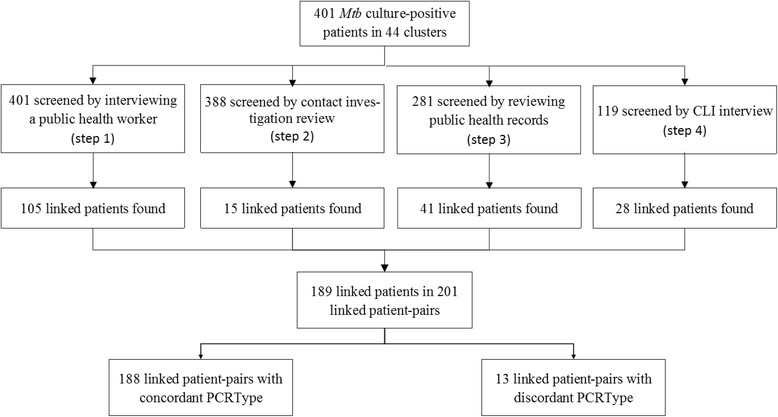
The study population included Mtb culture positive patients from Georgia, Maryland, Massachusetts and Houston, Texas. Mtb isolates were genotyped by CDC’s National TB Genotyping Service (NTGS) from January 2006 to October 2010. Mtb cluster investigations (CLIs) were conducted for patients whose isolates matched exactly by spoligotyping and 12-locus MIRU-VNTR. CLIs were carried out in four sequential steps: (1) Public Health Worker (PHW) Interview, (2) Contact Investigation (CI) Evaluation, (3) Public Health Records Review, and (4) CLI TB Patient Interviews. Comparison between patients whose links were identified through the study’s CLI interviews (Step 4) and patients whose links were identified earlier in CLI (Steps 1–3) was conducted using logistic regression.
Results
Forty-four clusters were randomly selected from the four study sites (401 patients in total). Epidemiologic links were identified for 189/401 (47 %) study patients in a total of 201 linked patient-pairs. The numbers of linked patients identified in each CLI steps were: Step 1 - 105/401 (26.2 %), Step 2 - 15/388 (3.9 %), Step 3 - 41/281 (14.6 %), and Step 4 - 28/119 (30 %). Among the 189 linked patients, 28 (14.8 %) were not identified in previous CI. No epidemiologic links were identified in 13/44 (30 %) clusters.
Conclusions
We validated a standardized and practical method to systematically identify epidemiologic links among patients in Mtb genotype clusters, which can be integrated into the TB control and prevention programs in public health settings. The CLI interview identified additional epidemiologic links that were not identified in previous CI. One-third of the clusters showed no epidemiologic links despite being extensively investigated, suggesting that some improvement in the interviewing methods is still needed.
Electronic supplementary material
The online version of this article (doi:10.1186/s12879-016-1937-9) contains supplementary material, which is available to authorized users.
-
Subjects:
-
Source:BMC Infect Dis. 16.
-
Pubmed ID:27769182
-
Pubmed Central ID:PMC5075185
-
Document Type:
-
Name as Subject:
-
Place as Subject:
-
Volume:16
-
Collection(s):
-
Main Document Checksum:urn:sha256:9daae81504552b3846b613e7ad38d301121cd8e599373f62339a3607a98fa67f
-
Download URL:
-
File Type:
 [PDF
- 750.16 KB
]
[PDF
- 750.16 KB
]
Supporting Files


File Language:
English
ON THIS PAGE


CDC STACKS serves as an archival repository of CDC-published products including
scientific findings,
journal articles, guidelines, recommendations, or other public health information authored or
co-authored by CDC or funded partners.
As a repository, CDC STACKS retains documents in their original published format to ensure public access to scientific information.
As a repository, CDC STACKS retains documents in their original published format to ensure public access to scientific information.
You May Also Like
COLLECTION
CDC Public Access