


Risk of extracolonic cancers for people with biallelic and monoallelic mutations in MUTYH
Supporting Files

-
10 1 2016
-
File Language:
English
Details
-
Alternative Title:Int J Cancer
-
Personal Author:Win, Aung Ko ; Reece, Jeanette C. ; Dowty, James G. ; Buchanan, Daniel D. ; Clendenning, Mark ; Rosty, Christophe ; Southey, Melissa C. ; Young, Joanne P. ; Cleary, Sean P. ; Kim, Hyeja ; Cotterchio, Michelle ; Macrae, Finlay A. ; Tucker, Katherine M. ; Baron, John A. ; Burnett, Terrilea ; Le Marchand, Loïc ; Casey, Graham ; Haile, Robert W. ; Newcomb, Polly A. ; Thibodeau, Stephen N. ; Hopper, John L. ; Gallinger, Steven ; Winship, Ingrid M. ; Lindor, Noralane M. ; Jenkins, Mark A.
-
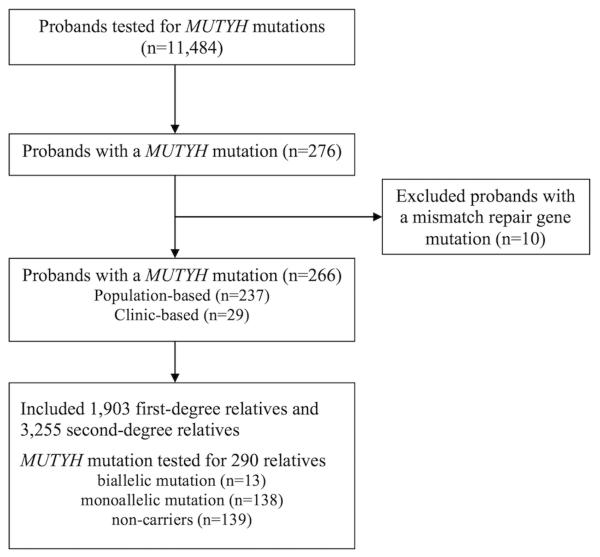
Description:Germline mutations in the DNA base excision repair gene MUTYH are known to increase a carrier's risk of colorectal cancer. However, the risks of other (extracolonic) cancers for MUTYH mutation carriers are not well defined. We identified 266 probands (91% Caucasians) with a MUTYH mutation (41 biallelic and 225 monoallelic) from the Colon Cancer Family Registry. Mutation status, sex, age and histories of cancer from their 1,903 first- and 3,255 second-degree relatives were analyzed using modified segregation analysis conditioned on the ascertainment criteria. Compared with incidences for the general population, hazard ratios (HRs) (95% confidence intervals [CIs]) for biallelic MUTYH mutation carriers were: urinary bladder cancer 19 (3.7-97) and ovarian cancer 17 (2.4-115). The HRs (95% CI) for monoallelic MUTYH mutation carriers were: gastric cancer 9.3 (6.7-13); hepatobiliary cancer 4.5 (2.7-7.5); endometrial cancer 2.1 (1.1-3.9) and breast cancer 1.4 (1.0-2.0). There was no evidence for an increased risk of cancers at the other sites examined (brain, pancreas, kidney or prostate). Based on the USA population incidences, the estimated cumulative risks (95% CI) to age 70 years for biallelic mutation carriers were: bladder cancer 25% (5-77%) for males and 8% (2-33%) for females and ovarian cancer 14% (2-65%). The cumulative risks (95% CI) for monoallelic mutation carriers were: gastric cancer 5% (4-7%) for males and 2.3% (1.7-3.3%) for females; hepatobiliary cancer 3% (2-5%) for males and 1.4% (0.8-2.3%) for females; endometrial cancer 3% (2%-6%) and breast cancer 11% (8-16%). These unbiased estimates of both relative and absolute risks of extracolonic cancers for people, mostly Caucasians, with MUTYH mutations will be important for their clinical management.
-
Subjects:
-
Keywords:
-
Source:Int J Cancer. 139(7):1557-1563
-
Pubmed ID:27194394
-
Pubmed Central ID:PMC5094810
-
Document Type:
-
Funding:U01 CA074799/CA/NCI NIH HHSUnited States/ ; U24 CA074794/CA/NCI NIH HHSUnited States/ ; N01PC35137/CA/NCI NIH HHSUnited States/ ; U24 CA074806/CA/NCI NIH HHSUnited States/ ; HHSN261201300012I/CA/NCI NIH HHSUnited States/ ; N01PC35142/CA/NCI NIH HHSUnited States/ ; P30 CA015083/CA/NCI NIH HHSUnited States/ ; U01 CA097735/CA/NCI NIH HHSUnited States/ ; UM1 CA167551/CA/NCI NIH HHSUnited States/ ; U58 DP003862/DP/NCCDPHP CDC HHSUnited States/ ; U01 CA074783/CA/NCI NIH HHSUnited States/ ; U24 CA074799/CA/NCI NIH HHSUnited States/ ; U01 CA074800/CA/NCI NIH HHSUnited States/ ; U24 CA074783/CA/NCI NIH HHSUnited States/ ; N01 CN067009/CN/NCI NIH HHSUnited States/ ; U24 CA097735/CA/NCI NIH HHSUnited States/ ; U01 CA074794/CA/NCI NIH HHSUnited States/ ; U01 CA074806/CA/NCI NIH HHSUnited States/ ; U24 CA074800/CA/NCI NIH HHSUnited States/
-
Volume:139
-
Issue:7
-
Collection(s):
-
Main Document Checksum:urn:sha256:83298f449d05992c905589b120f354855a6e612dbf4784596ac22af6d5ae3fb1
-
Download URL:
-
File Type:
 [PDF
- 235.11 KB
]
[PDF
- 235.11 KB
]
Supporting Files


File Language:
English
ON THIS PAGE

CDC STACKS serves as an archival repository of CDC-published products including
scientific findings,
journal articles, guidelines, recommendations, or other public health information authored or
co-authored by CDC or funded partners.
As a repository, CDC STACKS retains documents in their original published format to ensure public access to scientific information.
As a repository, CDC STACKS retains documents in their original published format to ensure public access to scientific information.
You May Also Like
COLLECTION
CDC Public Access